 November 4, 2026
SaaS Development Cost in 2026: A Realistic Budget Guide

4
Nov
2026
 Infigo Solutions Team
 Software Development
 0 Comments
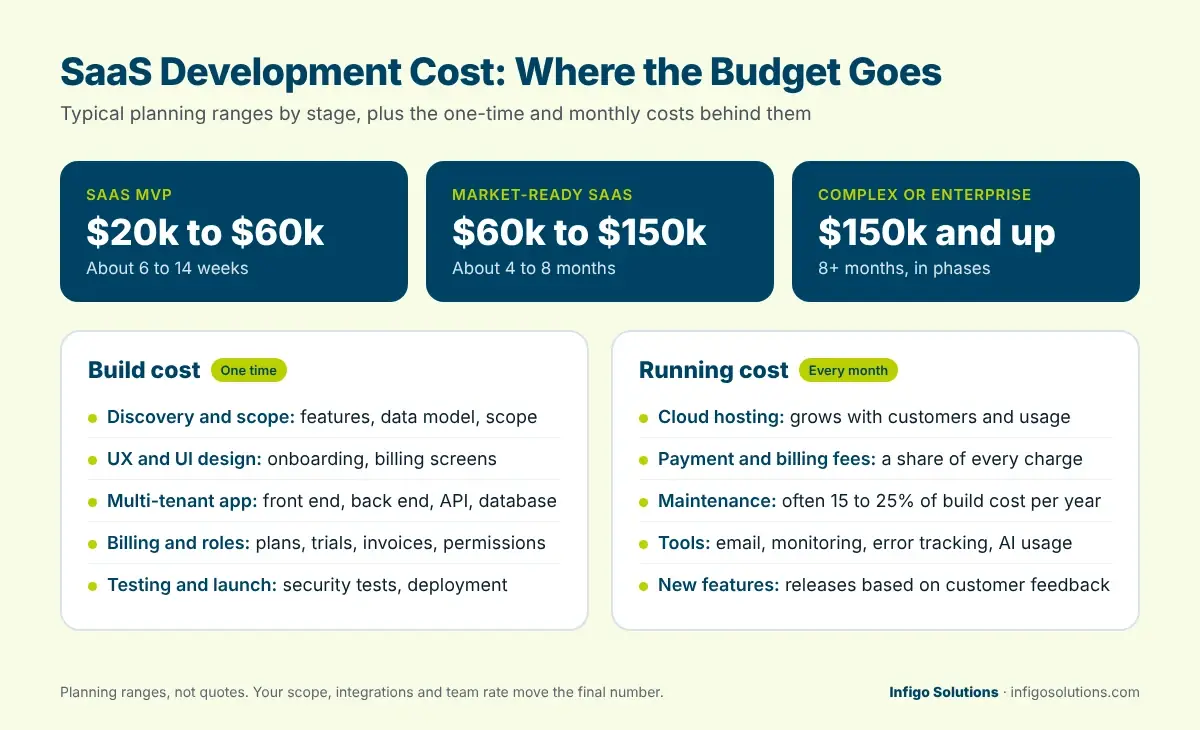
SaaS development cost usually falls between $20,000 and $60,000 for a focused SaaS MVP, $60,000 to $150,000 for a market-ready first version, and $150,000 or more for a complex, enterprise-grade platform. Scope, team rates, multi-tenancy, subscription billing and compliance drive most of the difference, and running costs continue every month after launch.
SaaS development costs vary this widely because "a SaaS product" can mean a small tool for one niche or a platform that serves thousands of companies. This guide explains what is included in SaaS development cost, why SaaS costs more than a regular web app, how to estimate your own budget, what you will pay to run the product after launch and how to lower the total without cutting the parts that matter.
What Is Included in SaaS Development Cost?
SaaS development cost is the total spend needed to plan, design, build, test and launch a software-as-a-service product, plus the recurring cost of hosting, maintaining and improving it. It has two parts: a one-time build cost and an ongoing running cost. Many first budgets cover only the first part.
The build cost usually includes:
- Discovery and scoping: user research, the feature list, the data model and a written scope.
- UX and UI design: sign-up, onboarding, the main workflow, settings and the billing screens.
- Front-end and back-end development: the application itself, the API and the database.
- SaaS foundations: tenant separation, user roles, subscriptions and an admin panel.
- Testing and launch: functional, security and performance testing, then deployment.
The running cost covers cloud hosting, payment fees, monitoring, third-party tools, maintenance, support and new features. We cover those in the section on costs after launch.
How Much Does SaaS Development Cost in 2026?
The table below shows typical SaaS development cost ranges by product stage. Treat them as planning ranges, not quotes. Your feature list, integrations and team location will move your own number up or down.
| Product stage | What it usually includes | Typical cost range | Typical timeline |
| SaaS MVP | One core workflow, sign-up and login, basic roles, simple subscription billing, a small admin panel | $20,000 to $60,000 | 6 to 14 weeks |
| Market-ready SaaS | Several workflows, team accounts, plan tiers and trials, key integrations, analytics, onboarding emails | $60,000 to $150,000 | 4 to 8 months |
| Complex or enterprise SaaS | Single sign-on (SSO), advanced permissions, audit logs, compliance work, many integrations, high traffic | $150,000 and up | 8 months and longer, delivered in phases |
Independent data points in the same direction. Clutch's pricing research (updated 2026) reports that most custom software projects reviewed on its platform cost $10,000 to $49,999, while the average project comes to about $132,000 because large builds pull the average up.
The MVP row matches our MVP development cost guide, which puts SaaS and B2B tool MVPs at $20,000 to $60,000. At the top end, SaaS platform development cost depends mostly on integrations, compliance work and expected traffic.
Why Does SaaS Cost More Than a Regular Web App?
A SaaS product is a web application with extra jobs. It must serve many customers from one system, charge them on a schedule and keep their data apart. Those jobs add work that a simple internal web app does not need, which is why SaaS development cost often sits above a comparable web application development cost.
These are the SaaS-specific parts that add the most to SaaS development cost:
- Multi-tenant architecture: each customer company is a "tenant" and must never see another tenant's data. The AWS SaaS Lens treats tenant isolation as a foundation that every SaaS architecture must put in place. Getting it wrong is expensive to fix later.
- Subscription billing: plans, trials, upgrades, downgrades, proration, invoices, failed payment retries and tax settings.
- Roles and access: owners, admins and members inside each customer account, and SSO for larger customers.
- Self-serve onboarding: sign-up, email verification, a first-run setup and in-app guidance, because nobody is there to train each new user.
- Admin and back office: tools for your own team to manage accounts, plans, refunds and support cases.
- Usage tracking and limits: counting seats, projects or API calls so plan limits work and usage-based pricing can be billed.
- Security, uptime and monitoring: backups, logging, alerts and a plan for outages, since customers pay for a service that is always on.
How you design these parts also shapes future cost. Our guide to web application architecture explains how early choices about the database and services affect what scaling will cost later.
How to Estimate Your SaaS Development Cost
A simple formula gives you a first SaaS development cost estimate: total hours for each feature and phase, multiplied by the team's blended hourly rate, plus a buffer for unknowns. A good estimate lists every assumption, so you can see what moves the number.
- List the features for the first release only, split into must-have and later.
- Estimate hours for design, front end, back end, testing and project management for each feature.
- Multiply by the blended rate of the team that will build it.
- Add a buffer of 10 to 20 percent for questions that only appear during the build.
Here is how the rate changes SaaS development cost for the same scope. For example, the cost to build a SaaS product that needs about 1,200 hours is about $60,000 at $50 per hour and about $120,000 at $100 per hour. The features are the same. Only the rate changed.
Team location changes SaaS development cost more than most founders expect. Clutch's 2026 pricing data shows most listed development companies charging $25 to $49 per hour, with typical bands of $50 to $99 for firms based in the United States and $100 to $149 for firms in Canada and Australia. Our software development outsourcing guide explains how to compare teams on total cost, not just the hourly rate.
For a quick starting figure for your own idea, try our free startup cost calculator.

Which Features Drive SaaS Development Cost the Most?
Scope is the biggest lever on SaaS development cost. These features add the most hours, so decide early whether each one belongs in the first release:
- Integrations: every connection to a CRM, accounting tool, calendar or data source needs mapping, testing and error handling.
- Complex permissions: custom roles, approval flows and per-record access add work across the whole app.
- Real-time features: live collaboration, chat and instant notifications need extra infrastructure.
- Reporting and analytics: custom dashboards and exports grow quickly once customers ask for "just one more chart".
- AI features: assistants, smart search and document processing add model, data and testing work. Our AI app development cost guide covers this in detail.
- Compliance: security reviews and audit preparation for frameworks such as SOC 2, or for privacy rules in your market, add design, documentation and testing time.
- Mobile apps: native iOS and Android apps on top of the web product add a second and third interface to build and maintain.
What Does It Cost to Run a SaaS Product After Launch?
Running costs are the part of SaaS development cost that never stops. Plan for them before launch, because they affect your pricing and your margins from the first paying customer.
| Ongoing cost | What it covers | Typical budget |
| Cloud hosting | Servers, databases, storage, backups and bandwidth | From tens to thousands of dollars per month, growing with customers and usage |
| Payment processing | Card fees on each subscription payment | Stripe charges 2.9% + 30 cents per successful domestic card transaction in the US |
| Billing software | Recurring invoices, plan changes and retries | Stripe Billing pay-as-you-go: 0.7% of billing volume |
| Maintenance and support | Bug fixes, security patches, dependency and framework updates | Often 15 to 25 percent of the build cost per year |
| Third-party tools | Email delivery, monitoring, error tracking, AI model usage | Usage based, varies by provider |
| New features | Improvements based on customer feedback | Planned as separate releases or a monthly retainer |
The payment and billing figures come from Stripe's published pricing. Other payment providers charge differently, so check current rates for your market. Payment fees look small at first, but at scale they become a real line in your SaaS development costs. For hosting, the AWS Pricing Calculator, and the matching tools from Azure and Google Cloud, let you model server and database costs before you commit to an architecture.

How Much Does a SaaS MVP Cost?
SaaS MVP development cost usually runs $20,000 to $60,000, and the build takes about 6 to 14 weeks, depending on scope. It covers one core workflow that customers will pay for, plus the basics every SaaS product needs: sign-up, login, simple roles, a payment flow and a small admin panel.
A SaaS MVP keeps SaaS development cost low while you test whether customers will pay, before you fund the full platform. The key is to build the foundations, especially tenant separation, correctly from day one, even while the feature list stays short. Our SaaS MVP development guide for founders explains what to include, what to cut and which mistakes make a fast MVP slow.
How to Reduce SaaS Development Cost Without Hurting the Product
You can lower SaaS development cost without cutting quality if you cut scope and rework, not testing or security. These steps keep SaaS product development cost under control from the first release onward.
- Launch one workflow first. Sell the core job well, then add features that paying customers ask for.
- Buy the commodity parts. Use proven services for payments, email, authentication and monitoring instead of building them yourself.
- Design tenant separation early. Retrofitting multi-tenancy after launch is one of the most expensive fixes in SaaS.
- Write a clear scope before coding. Most budget overruns start with features added mid-build without an estimate.
- Automate testing and deployment. Automated checks catch problems before customers do and make each release cheaper.
- Choose a team on total cost. A higher rate with fewer hours and less rework can cost less than the cheapest quote.

How to Get an Accurate SaaS Development Estimate
To get a SaaS development cost estimate you can trust, share the same brief with every team you talk to. Include your target customers, the core workflow, user roles, pricing model, required integrations, compliance needs and launch date. Then compare quotes line by line, including the hours, the rate, what is excluded and what happens if the scope changes.
At Infigo Solutions, we start every SaaS project with a short discovery and then give you a scoped estimate. For a SaaS MVP, we work to a fixed price for the scope agreed in writing, and any later change is estimated and approved before extra work starts. Infigo Solutions is rated 5.0 on Clutch from 41 client reviews, and most projects our clients have reviewed there fall in the same $10,000 to $49,999 band that Clutch reports as most common. See our SaaS development services or contact our team. We reply within 24 hours.
Frequently Asked Questions About SaaS Development Cost
How much does it cost to develop a SaaS platform?
SaaS development cost for most platforms falls between $20,000 and $150,000, and complex enterprise platforms can cost $150,000 or more. A focused SaaS MVP sits at the low end. The final figure depends on the number of workflows, user roles, integrations, billing rules, compliance needs and the hourly rate of the team you hire.
How long does it take to build a SaaS product?
A focused SaaS MVP usually takes about 6 to 14 weeks from a clear scope to launch. A market-ready product with several workflows, plan tiers and integrations often takes 4 to 8 months. Complex enterprise platforms take longer and are usually released in phases, so you can learn from paying customers between releases.
How much does it cost to maintain a SaaS application?
Many teams budget 15 to 25 percent of the original build cost per year for maintenance and support, covering bug fixes, security patches and framework updates. Hosting, payment fees, third-party tools and new features come on top. Hosting grows with your customer base, so review it every quarter as usage changes.
Can I build a SaaS product with no-code tools to save money?
No-code tools can be a cheap way to test demand with a small group of users. They become harder to use when you need strict tenant separation, custom billing rules, complex permissions or deep integrations. Many founders validate with no-code, then move to custom SaaS development once paying customers confirm the idea.
Can I get a fixed price for SaaS development?
Yes, for a clearly scoped SaaS MVP. At Infigo Solutions, once discovery is done and the SaaS MVP scope is agreed in writing, we work to a fixed price for that scope. If you add or change features later, we estimate the change first and you approve it before extra work starts, so there are no surprise costs.
Final Thoughts
SaaS development cost becomes manageable once you split it into the build cost and the running cost, and then break the build into features, hours and rates. Start with the stage that matches your product, design multi-tenancy and billing properly from the start, and budget for the months after launch. That approach protects your runway far better than chasing the lowest quote.


.webp "Share on LinkedIn")
Leave a Message

Infigo Solutions Team
Software Development Team
The Infigo Solutions team builds MVPs, AI products, SaaS platforms and custom software for startups and enterprises in the US, Canada and the UAE. Founded in 2020, Infigo Solutions is rated 5.0 on Clutch.
Recent Posts
November 4, 2026 November 2, 2026
Generative AI Implementation: A 6-Step Plan to Production
 October 27, 2026

Comments
No comments yet. Be the first to comment!