 September 14, 2026
MVP Development Cost in 2026: The Complete Pricing Guide for Startups
5
Sep
 Max
Max Startups
 0 Comments
MVP Development Cost in 2026: The Complete Pricing Guide for Startups
Every founder eventually asks the same question: what is the real MVP development cost, and why does it swing so wildly between quotes? One agency prices the same idea at $20,000. Another quotes $80,000 for what sounds like the same scope. The gap is not random. The cost to build an MVP depends on a specific, predictable set of variables, and once you understand them, you can budget with confidence instead of guessing.
This guide breaks down MVP pricing by complexity, platform, team model, and industry, then covers the hidden costs most founders miss and practical ways to bring the number down without cutting corners.
What Is MVP Development Cost and Why It Varies So Much
MVP development cost is the total amount a startup spends to design, build, test, and launch the leanest working version of a product that can validate a core assumption with real users. It is not the cost of a finished, feature-complete platform. It is the cost of proving that people want what you are building before you invest further.
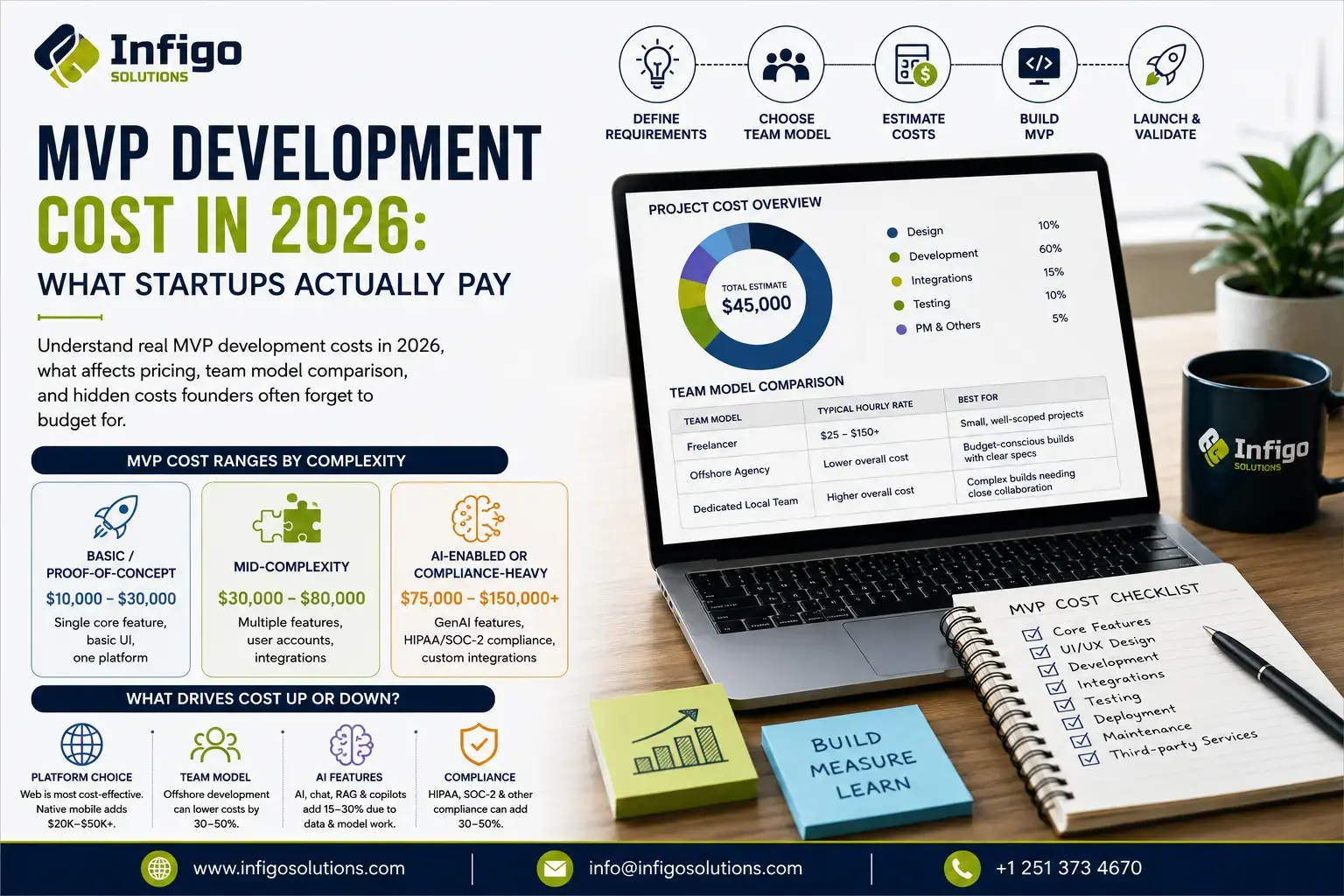
Because "minimum" means something different for every business, the minimum viable product cost in 2026 ranges from around $10,000 for a simple, single-feature web app to $150,000 or more for an AI-enabled or compliance-heavy build. A SaaS startup validating one workflow has completely different needs than a healthcare company launching a patient portal, and the price reflects that difference.
MVP Pricing by Complexity Level
The single biggest driver of what an MVP costs is how much the product actually needs to do. The table below breaks down typical 2026 pricing by complexity tier.
| Complexity Tier | Typical Price Range | What's Typically Included |
| Basic / Proof-of-Concept | $10,000 to $30,000 | One core feature, basic UI, single platform, minimal integrations |
| Mid-Complexity | $30,000 to $80,000 | Multiple features, user accounts, dashboards, third-party integrations |
| Advanced / AI-Enabled | $75,000 to $150,000+ | GenAI features, custom LLM integrations, HIPAA or SOC-2 compliance |
Most startups land in the $25,000 to $50,000 range for a functional, user-tested MVP. Anything priced significantly below that usually means corners are being cut in architecture, security, or testing, and those shortcuts tend to resurface as expensive rework later.
Cost to Build an MVP by Platform
Platform choice has a direct and measurable impact on the cost to build an MVP, because each platform requires different skills, tooling, and QA effort.
| Platform | Relative Cost | Notes |
| Web-only | Lowest baseline | Fastest to validate, easiest to iterate on |
| Native Mobile (iOS/Android) | Web baseline + $20,000 to $50,000 | Separate codebases unless combined with cross-platform tools |
| Cross-Platform (React Native, Flutter) | 30 to 40% less than building both platforms natively | Closes most of the performance gap with native apps in 2026 |
For most B2B and SaaS ideas, a web-only MVP remains the cheapest and fastest way to get real user feedback before committing to mobile development.
For mobile-first products, many startups pair their platform choice with Firebase for authentication, real-time data, and backend infrastructure without managing servers directly.
MVP Budget by Team Model and Location
Who builds the MVP affects the final number as much as what gets built. Choosing the right team model can reduce your total budget by up to 40% without lowering quality, provided the scope is clearly defined upfront.
| Team Model | Typical Hourly Rate | Best Fit |
| Freelancer | $25 to $150+ | Small, tightly scoped projects with a clear spec |
| Offshore Development Agency | 30 to 50% lower overall cost | Budget-conscious builds with well-documented requirements |
| Onshore / Local Agency | Highest overall cost | Complex builds needing close, real-time collaboration |
Offshore and nearshore teams in regions like South Asia and Eastern Europe are the most common way founders lower their MVP development cost, since developer salary is one of the largest components of any project quote.
Minimum Viable Product Cost by Industry
Industry context changes pricing because some sectors carry compliance, security, or integration requirements that others do not.
| Industry | Typical Price Range | Key Cost Drivers |
| SaaS / B2B Tools | $20,000 to $60,000 | Subscription billing, usage limits, multi-tenant architecture |
| Marketplace / Two-Sided Platform | $35,000 to $70,000 | Buyer and seller flows, trust and review systems, payment escrow |
| Healthcare / Healthtech | $50,000 to $120,000+ | HIPAA compliance, data security audits, patient data handling |
| AI-Powered Products | $40,000 to $100,000+ | RAG pipelines, model evaluation, guardrails engineering |
Sports, fitness, and recreation apps, like booking platforms, membership tools, or activity trackers, typically fall in the $20,000 to $50,000 range depending on integrations with wearables or payment systems.
Key Factors That Influence Your MVP Budget
Beyond complexity, platform, team, and industry, a handful of specific decisions move the final number more than founders expect:
- Feature scope. Every additional feature adds design, development, and QA time. The tighter the scope, the lower the cost and the faster the launch.
- Design depth. A polished, custom UI costs more than a functional template-based interface, and that gap widens with each additional screen.
- Third-party integrations. Payment processors, CRMs, analytics tools, and authentication providers each add setup and testing time.
- AI features. Chat interfaces, RAG pipelines, and AI copilots typically add 15 to 30% to a budget because of data preparation and model evaluation work.
- Compliance requirements. HIPAA, SOC-2, or GDPR-driven builds usually add 30 to 50% for audits, documentation, and additional security testing.
- Team communication overhead. Distributed or freelance teams can reduce hourly rates but sometimes add coordination costs that offset part of the savings.
Hidden Costs Founders Often Miss
Most MVP pricing estimates stop at launch, but a real budget needs to account for what comes after:
- Post-launch maintenance. Bug fixes, security patches, and minor updates typically run 15 to 25% of the original build cost every year.
- Hosting and infrastructure. Server costs scale with usage, and they are easy to underestimate before a product has real traffic.
- Third-party service fees. Payment processing, fraud detection, and monitoring tools often carry small recurring charges that add up over a year.
- Compliance audits. Health-tech and fintech products frequently need formal audits before onboarding their first paying users, and this cost rarely appears in an initial quote.
- Scaling costs. A successful MVP will need infrastructure upgrades, new integrations, and additional features based on user feedback, all of which sit outside the original MVP development cost.
How to Reduce MVP Development Cost Without Cutting Corners
Lowering the cost to build an MVP is possible without sacrificing quality, as long as the cuts are strategic rather than arbitrary:
- Cut scope, not quality. Reduce the number of features rather than the quality of the features you keep. A smaller, well-built MVP outperforms a larger, fragile one.
- Choose web-only first. Validating on web before building native mobile apps delays a significant cost until you know the product works.
- Reuse existing infrastructure. Third-party authentication, payment, and hosting services are almost always cheaper than building the equivalent in-house.
- Pick the right team model for your budget. A well-vetted offshore team with a clear specification often delivers the same savings as a freelancer, with less coordination risk.
- Plan for maintenance from day one. Budgeting the 15 to 25% annual maintenance cost upfront prevents a painful surprise six months after launch.
MVP Development Cost vs Full Product Development Cost
It helps to see MVP development cost next to the cost of a fully built product, since founders sometimes compare the two unfairly.
| MVP | Full Product | |
| Typical Cost | $10,000 to $150,000+ | $150,000 to $500,000+ |
| Timeline | 6 to 12 weeks | 6 to 12 months or longer |
| Goal | Validate demand for a core assumption | Serve a broad set of users at scale |
| Risk Level | Low, limited investment before validation | High, full investment before market feedback |
The purpose of keeping your MVP budget lean is not to save money for its own sake. It is to avoid spending full-product money before you know the product is worth building.
Frequently Asked Questions
What is the average MVP development cost in 2026?
Most startups spend between $25,000 and $50,000 for a functional, user-tested MVP in 2026, though the full range spans $10,000 to $150,000 or more depending on complexity, platform, and compliance needs.
Why does MVP development cost vary so much between agencies?
Two agencies can quote very different numbers for the same idea because "minimum" is interpreted differently, and because hourly rates, team location, and included services (design, QA, project management) vary widely.
Does a lower MVP development cost mean lower quality?
Not necessarily. A lower cost can come from a tighter, well-scoped feature set or an efficient team model. It becomes a quality risk only when the price is achieved by cutting testing, security, or architecture corners.
What is not included in a typical MVP development cost quote?
Most quotes cover design, development, and QA through launch. Hosting, third-party service fees, compliance audits, and post-launch maintenance are usually separate and are the most commonly forgotten costs.
Is it cheaper to build an MVP with a freelancer or an agency?
Freelancers are often cheaper per hour, which works well for small, tightly scoped projects. Agencies typically cost more but provide project management, QA, and accountability that reduce the risk of rework on larger builds.
Why do most startups fail even after building an MVP?
Building the MVP is only the first step. According to CB Insights' analysis of startup failure reasons, a lack of real market need remains one of the most common causes of startup failure, which is why validating demand quickly and cheaply matters more than building every feature founders originally planned.
Getting an Accurate Estimate for Your MVP
Every range in this guide is a starting point, not a quote. The real number depends on your specific feature list, platform choice, and industry requirements. Before locking in a budget, it is worth reviewing how to choose the right MVP development company and the core steps involved in MVP development, since both directly shape what realistic pricing looks like for your project. If you are building a SaaS product specifically, our SaaS MVP development guide for founders covers the additional considerations that come with subscription billing and multi-tenant architecture.
For a tailored number instead of a general range, our Startup Quote calculator walks through your stage, product type, and priorities to generate an estimate built around your actual scope, not an industry average.
We Are Awesome.
A business consulting agency is involved in the planning, implementation, and education of businesses. We work directly.


.webp "LinkedIn")
Leave a Message

Max
Senior Consultant
Helps startups and enterprises plan technical strategy, product roadmaps, and realistic development budgets.
Recent Posts
 September 11, 2026
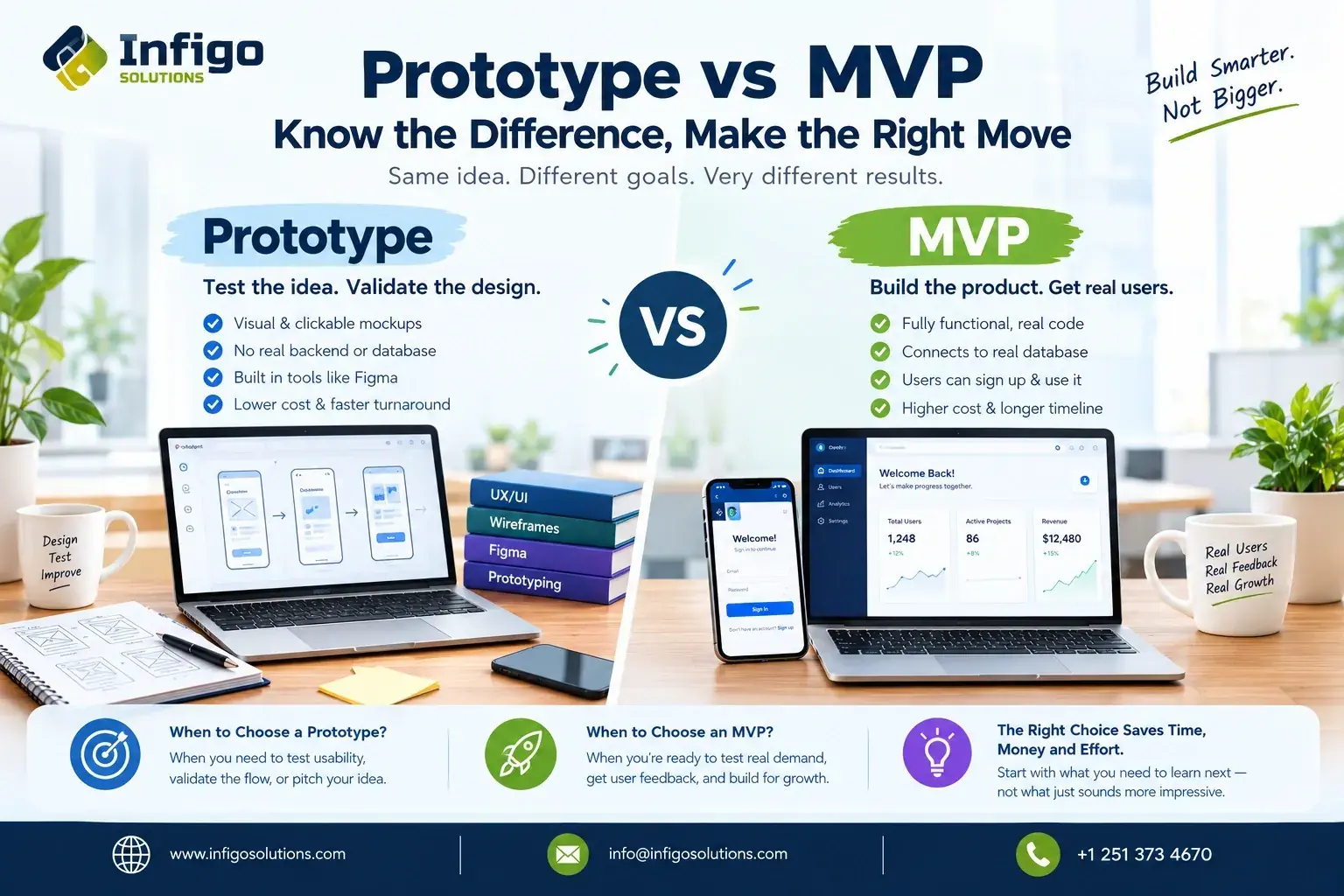
Prototype vs MVP: What's the Difference and Which Do You Need First?
 September 9, 2026
Comments
No comments yet. Be the first to comment!