 September 14, 2026
Custom Software Development for Startups: When to Build Instead of Buy
8
Sep
 Max
Max Startups
 0 Comments
Custom Software Development for Startups: When to Build Instead of Buy
Most startups begin on off-the-shelf tools, and that is usually the right call. Spreadsheets, no-code form builders, and generic SaaS platforms get an idea off the ground fast and cheap. But there is a point where those same tools start working against you instead of for you. Custom software development for startups becomes the right move exactly at that point, not before it and not long after.
This guide covers what going custom actually involves, how to tell if your startup has reached that point, what it costs, and how to avoid the mistakes that turn a custom build into an expensive mistake instead of a growth lever.
What Custom Software Development for Startups Actually Means
Custom software development for startups is the process of building an application, platform, or internal tool designed specifically around how your business operates, rather than adapting your operations to fit a generic product built for the widest possible audience.
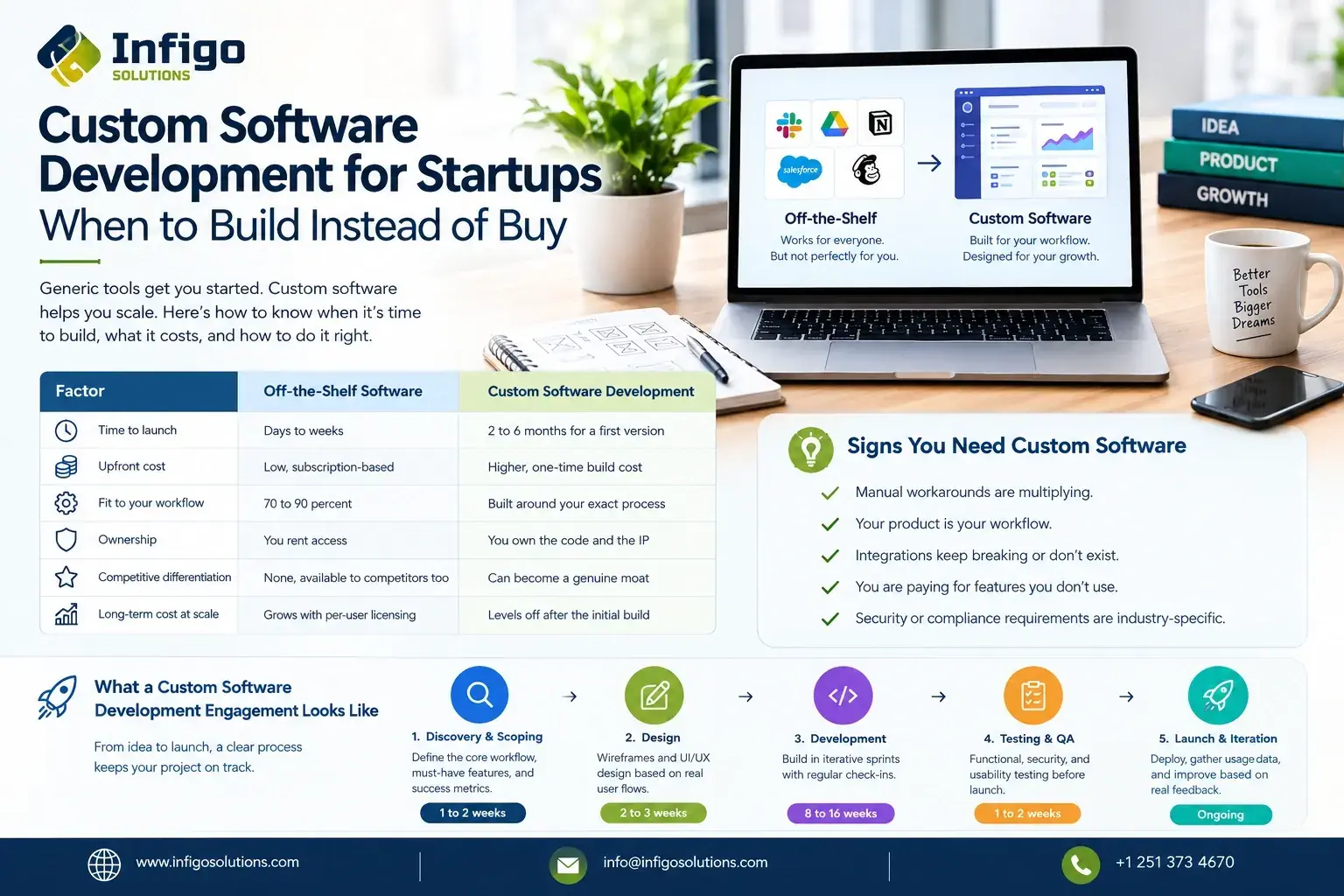
The distinction matters because off-the-shelf tools are built to serve thousands of different companies at once. They cover the 70 to 90 percent of a workflow that most businesses share. The remaining 10 to 30 percent, the part that is actually unique to how your startup creates value, is where generic tools fall short and where a custom build earns its cost.
Off-the-Shelf vs Custom Software for Startups
| Factor | Off-the-Shelf Software | Custom Software Development |
| Time to launch | Days to weeks | 2 to 6 months for a first version |
| Upfront cost | Low, subscription-based | Higher, one-time build cost |
| Fit to your workflow | 70 to 90 percent | Built around your exact process |
| Ownership | You rent access | You own the code and the IP |
| Competitive differentiation | None, available to competitors too | Can become a genuine moat |
| Long-term cost at scale | Grows with per-user licensing | Levels off after the initial build |
Neither option is universally better. Off-the-shelf makes sense for functions like accounting, email, or basic CRM, where your workflow does not need to be different from everyone else's. Custom software development for startups makes sense where your workflow is the product, or where it directly drives your competitive advantage.
Signs Your Startup Needs Custom Software
A few patterns show up consistently in startups that have outgrown generic tools:
- Manual workarounds are multiplying. Your team is exporting data, re-entering it into spreadsheets, or stitching together three different tools to do one job. This is sometimes called the "workaround tax," and it usually costs more in staff time than a custom build would have cost upfront.
- Your product is your workflow. If the thing you are selling depends on doing something in a way no competitor does, a generic tool cannot express that difference. It flattens you down to the same features everyone else has.
- Integrations keep breaking or don't exist. Off-the-shelf platforms integrate well with other popular tools, but poorly or not at all with anything specific to your industry or your own systems.
- You are paying for features you don't use. Per-seat SaaS pricing scales with headcount, not with value delivered, and that gap widens every year you grow.
- Security or compliance requirements are industry-specific. Healthcare, fintech, and other regulated spaces often need data handling that generic platforms were not built to support.
What a Custom Software Development Engagement Looks Like
A typical custom build for a startup moves through a consistent set of phases, whether the end result is an internal tool or a customer-facing product.
| Phase | What Happens | Typical Duration |
| Discovery and scoping | Define the core workflow, must-have features, and success metrics | 1 to 2 weeks |
| Design | Wireframes and UI/UX design based on real user flows | 2 to 3 weeks |
| Development | Building the application in iterative sprints with regular check-ins | 8 to 16 weeks |
| Testing and QA | Functional, security, and usability testing before launch | 1 to 2 weeks |
| Launch and iteration | Deploy, gather usage data, and refine based on real feedback | Ongoing |
Startups that treat this as a single monolithic build tend to overspend. Startups that scope it the way an MVP gets scoped, meaning build the smallest version that proves the workflow works, tend to get to a usable product faster and cheaper.
Cost and Timeline Expectations
Pricing for a custom build varies with scope, but a few general ranges hold up across most projects:
- A single internal tool or workflow automation typically runs $15,000 to $40,000 and takes 6 to 10 weeks.
- A customer-facing product or platform typically runs $30,000 to $100,000+ depending on complexity, integrations, and compliance needs.
- Ongoing maintenance after launch usually runs 15 to 25 percent of the build cost annually.
These numbers track closely with what founders see when they price out an MVP first, since an MVP is really the earliest, leanest form of custom software built specifically around a startup's own workflow.
Choosing the Right Custom Software Development Partner
A few questions separate a good custom software development partner from one that will slow you down:
- Do they ask about your workflow before your feature list? A partner that starts with "what do you want built" instead of "how does your business actually work" will build the wrong thing efficiently.
- Can they show relevant past work? Not necessarily in your exact industry, but in projects with a similar level of workflow complexity.
- Do they scope in phases? A partner willing to start with a smaller, testable version is thinking about your risk, not just their invoice.
- Who owns the code? Confirm in writing that you retain full ownership and IP rights to what gets built.
- What happens after launch? Maintenance, bug fixes, and future iteration should be discussed before the contract is signed, not after.
Common Mistakes Startups Make Going Custom
- Skipping the off-the-shelf comparison entirely. Sometimes the fastest path is buying a tool and customizing around its edges, not building from zero.
- Scoping the full vision instead of the current need. Building for the company you hope to be in three years adds cost and delay without adding validation today.
- Choosing a partner by price alone. The cheapest quote often means the least testing, the thinnest documentation, or the most rework later.
- Not planning for maintenance. A custom build that gets no attention after launch degrades fast, and that cost always shows up eventually.
Startup vs Enterprise Custom Software Development
| Startups | Enterprises | |
| Primary goal | Validate a workflow or product fast | Optimize an existing, proven process |
| Budget approach | Lean, phased, tied to runway | Larger, planned across fiscal cycles |
| Speed priority | High, time-to-market matters most | Moderate, stability matters more |
| Compliance load | Usually lighter, unless regulated industry | Often heavier, legacy system integration |
| Team model | Small dedicated team or agency partner | Larger teams, sometimes multiple vendors |
Frequently Asked Questions
Is custom software development worth it for an early-stage startup?
It depends on what you are building. If your core product or workflow is generic, off-the-shelf tools are usually the better early choice. If your workflow is the differentiator, custom software development for startups is often worth the earlier investment.
How much does custom software development for startups typically cost?
Internal tools and workflow automations usually run $15,000 to $40,000. Customer-facing products typically run $30,000 to $100,000 or more, depending on complexity and compliance needs.
What is the difference between custom software development and MVP development?
An MVP is a specific type of custom software, the leanest version built to validate demand before a larger investment. Custom software development is the broader category, which can include internal tools, full products, or enterprise systems at any stage of a company's growth.
Can a startup start with off-the-shelf tools and move to custom later?
Yes, and this is the most common path. Most startups run on off-the-shelf tools early, then replace the pieces that become bottlenecks with custom software as those workflows mature.
Who owns the code in a custom software development project?
In a properly structured engagement, the startup owns the code and intellectual property outright. This should be confirmed in the contract before development begins, not assumed.
Does custom software development slow a startup down compared to buying a tool?
It takes longer to launch than signing up for a SaaS tool, but it removes the ongoing workaround costs and licensing growth that generic tools create as a company scales. The tradeoff is speed now versus fit and ownership later.
Getting Started
The decision between building and buying is not really about budget alone. It comes down to whether the workflow in question is something you can safely rent from a vendor, or something that defines how your business wins. Global spending on digital transformation is forecast to reach $3.4 trillion by 2026 according to IDC, and a growing share of that spend is startups and mid-market companies building purpose-built systems instead of renting generic ones.
If you are trying to figure out whether your startup has reached that point, our startup product development services page walks through how we scope a first build, and our custom software development page covers the broader engagement model for teams past the earliest MVP stage. If you already know you want to start lean, our guide on MVP development cost breaks down realistic budgets for a first version.
For a tailored estimate instead of a general range, our Startup Quote calculator walks through your stage, product type, and priorities in a few minutes.
We Are Awesome.
A business consulting agency is involved in the planning, implementation, and education of businesses. We work directly.


.webp "LinkedIn")
Leave a Message

Max
Senior Consultant
Helps startups and enterprises decide when to build custom software versus buying off-the-shelf tools, and plans realistic budgets for both paths.
Recent Posts
 September 11, 2026
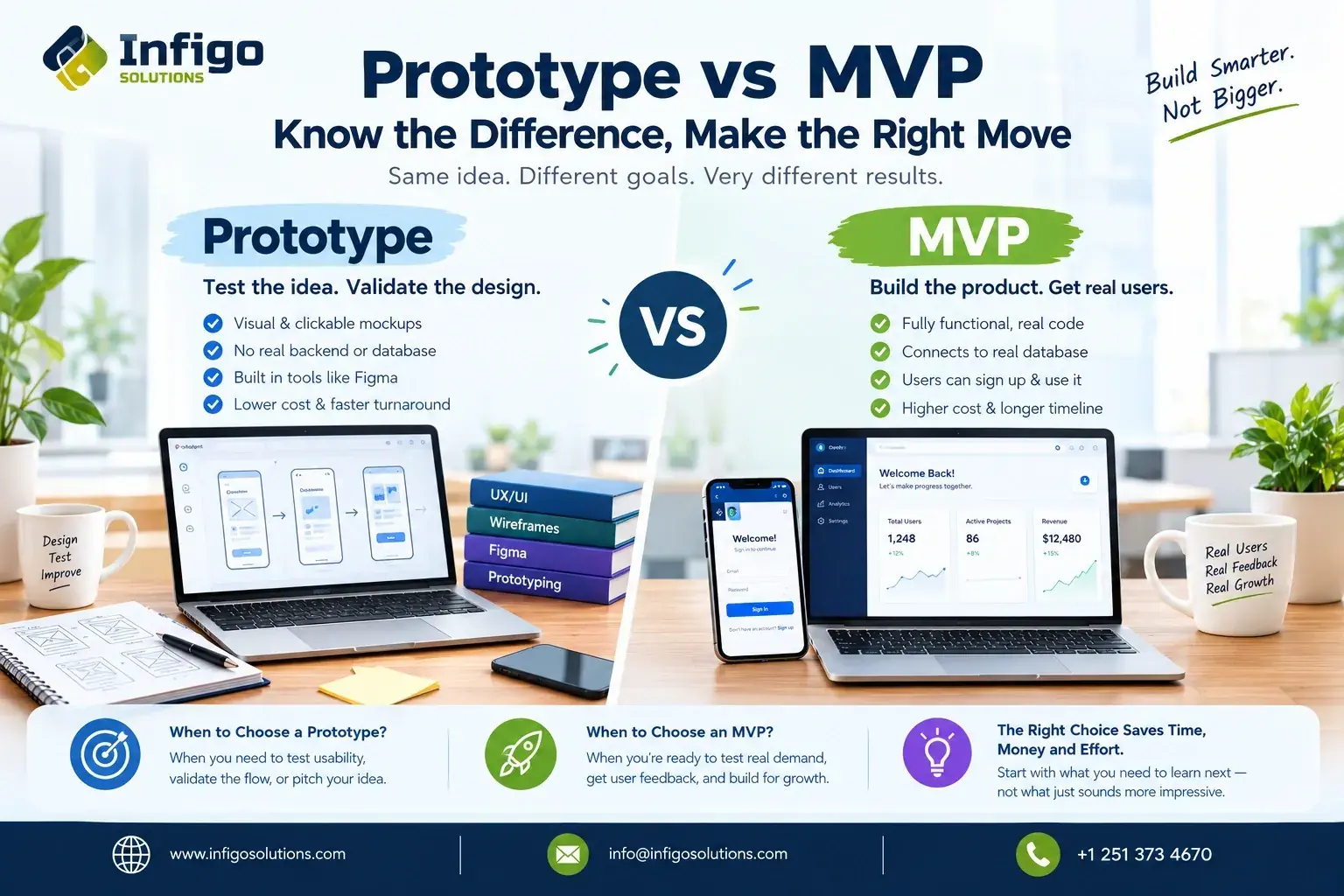
Prototype vs MVP: What's the Difference and Which Do You Need First?
 September 9, 2026
Comments
No comments yet. Be the first to comment!