 September 14, 2026
Prototype vs MVP: What's the Difference and Which Do You Need First?
11
Sep
 Max
Max Startups
 0 Comments
Prototype vs MVP: What's the Difference and Which Do You Need First?
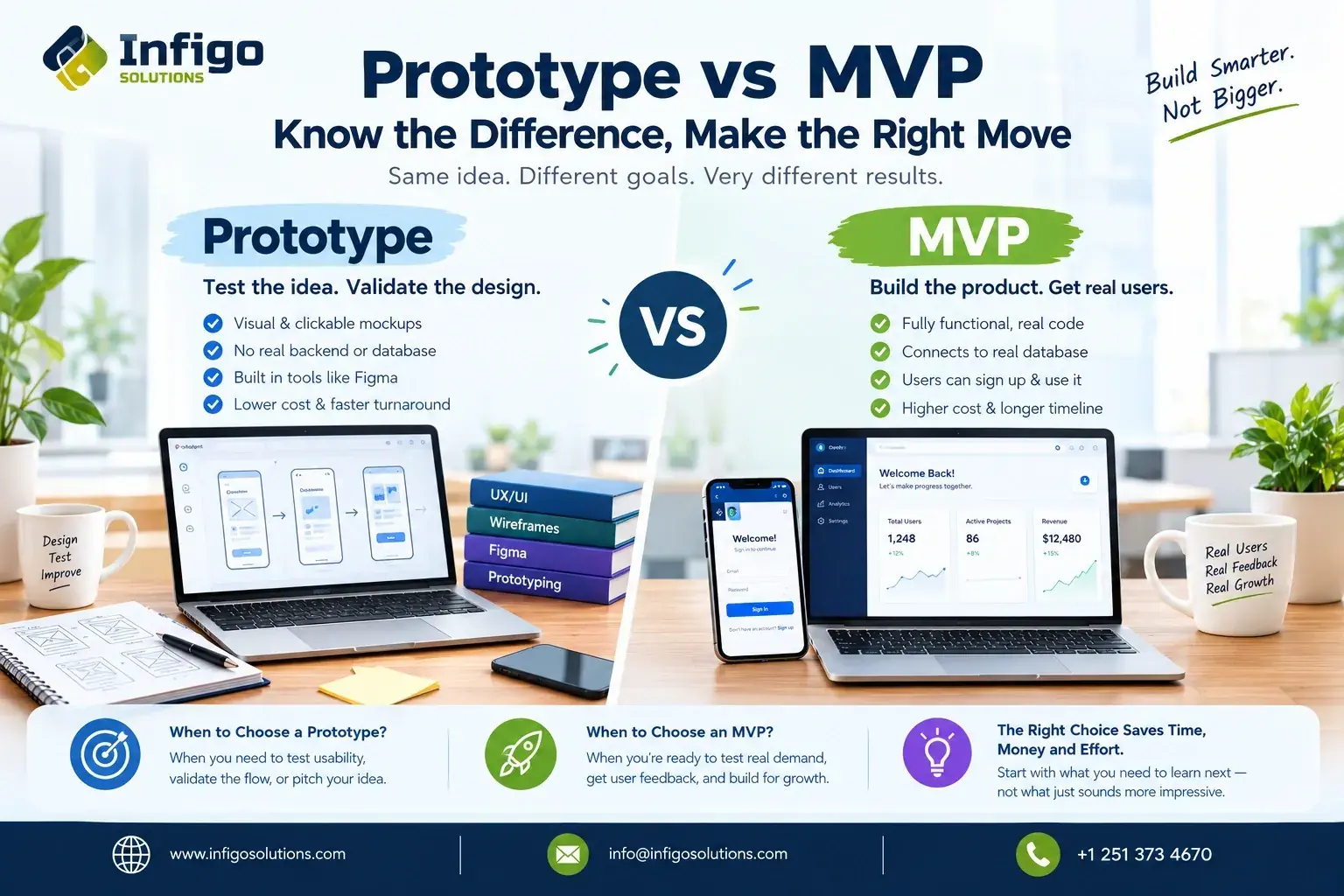
Founders often use "prototype" and "MVP" as if they mean the same thing, and that mix-up leads to real budget mistakes. One is a quick way to test whether an idea makes sense visually and functionally. The other is a working product real users can actually use, sign up for, and pay for. Confusing the two means either overbuilding something that was only meant to be a rough sketch, or underbuilding something meant to hold real users.
This guide breaks down the prototype vs MVP decision in practical terms: what each one actually is, when to use one over the other, and how the costs and timelines compare, so the choice is based on what you're trying to learn rather than which term sounds more serious.
A few extra terms are worth defining up front, since they get used almost interchangeably even though they mean different things: minimum viable product is the full name behind "MVP," and a clickable prototype is simply a prototype built in a tool like Figma that lets someone click through screens as if the app were real, without any of it actually working behind the scenes.
What a Prototype Actually Is
A prototype is a visual, often clickable representation of a product idea, built to test how something looks, feels, and flows before any real code is written. It answers one question: does this make sense to a real person?
Prototypes range from simple paper sketches to fully clickable Figma mockups that look like a finished app but have no working backend behind them. Nothing is functional. No data is saved, no accounts are created, nothing actually processes. The entire point is to catch confusing navigation, unclear value propositions, and broken user flows while they're still cheap to fix.
What an MVP Actually Is
An MVP, or minimum viable product, is a real, working version of a product with just enough functionality to let actual users sign up, use it, and give meaningful feedback. Unlike a prototype, an MVP is built with real code, connects to a real database, and can be used the way the finished product eventually will be, just with a narrower feature set.
The purpose is different too. A prototype asks whether a design makes sense. An MVP asks whether people actually want the product enough to use it, and ideally pay for it.
Prototype vs MVP: Side-by-Side Comparison
| Factor | Prototype | MVP |
| What it tests | Design, flow, comprehension | Real demand and product-market fit |
| Functionality | None, usually clickable mockups only | Fully functional, real code |
| Data | No real data saved | Real user data, accounts, transactions |
| Typical cost | $2,000 to $10,000 | $10,000 to $80,000+ |
| Typical timeline | 1 to 3 weeks | 6 to 12 weeks |
| Who sees it | Internal team, investors, early testers | Real end users in the market |
| What comes next | Refine design, then build the MVP | Refine the product based on usage data |
When to Build a Prototype First
A prototype is the right starting point when the main risk in your idea is whether people will understand and use it, not whether they'll pay for it. That's usually the case when:
- You're pitching investors or stakeholders and need something tangible to show, not just a slide deck or a static wireframe.
- The user flow is complex enough that you're not confident it will make sense to a first-time user.
- You want cheap, fast feedback before committing real development budget.
- Multiple team members or founders disagree on how a feature should work, and seeing it clickable settles the debate faster than a discussion does.
When to Skip Straight to an MVP
For founders asking the MVP vs prototype question from the other direction, meaning you already suspect you need a real product, not a mockup, some ideas don't need a prototype step at all, particularly when the interface itself is simple and well understood, and the real question is whether the underlying value proposition holds up. That's usually the case when:
- The product category is familiar (a marketplace, a booking tool, a dashboard) and the interaction patterns are already well established.
- The core risk is demand, not usability, meaning the real question is "will anyone actually use this," not "will people understand how to use this."
- You need real usage data, like retention or conversion, that a non-functional prototype simply cannot produce.
Cost and Timeline Comparison
Real numbers vary by scope, but these ranges hold up across most projects in 2026.
| Stage | Cost Range | Timeline | Primary Output |
| Paper Sketches | $0 to $500 | 1 to 3 days | Rough concept validation |
| Clickable Prototype (Figma) | $2,000 to $10,000 | 1 to 3 weeks | Design and flow validation |
| Basic MVP | $10,000 to $30,000 | 6 to 10 weeks | Core feature validation with real users |
| Full-Featured MVP | $30,000 to $80,000+ | 10 to 16 weeks | Market validation, ready to scale |
Common Mistakes When Choosing Between Them
- Skipping the prototype and building the wrong MVP. Teams sometimes go straight to code, only to discover three months in that the navigation confuses users or a key flow doesn't work the way they assumed. Fixing that in a prototype costs a fraction of fixing it in production code.
- Treating the prototype as the finished product. A prototype is disposable by design. Investing extra budget to polish it beyond what's needed to test the idea is money spent in the wrong place.
- Skipping usability testing on the prototype entirely. According to Nielsen Norman Group's research on MVP formats, a prototype is specifically useful for testing comprehension, usefulness, and whether users take the expected action, before any code gets written. Skipping that iteration step means carrying design problems straight into a costly build.
- Building an MVP that's really just a prototype with a database. If the goal is only to test whether people understand the interface, that's a prototype question. Paying MVP-level prices to answer a prototype-level question wastes budget.
A Simple Way to Decide
The prototype vs MVP question ultimately comes down to what you're actually trying to learn. If the honest answer is "will people understand and use this," start with a prototype. If the honest answer is "will people pay for this," you likely need a working MVP, because no amount of clickable mockup testing answers a real demand question.
Many founders weighing MVP development against a prototype-only approach end up doing both in sequence: a fast, cheap prototype to validate the design and flow, followed by an MVP once the interface has been tested and refined. That order avoids building a full working product around a flow that later turns out to confuse real users.
Frequently Asked Questions
Is a prototype the same as an MVP?
No. A prototype is a non-functional or partially clickable mockup used to test design and comprehension. An MVP is a real, working product used to test actual demand with real users.
Do I need a prototype before building an MVP?
Not always, but it helps when the user flow is complex or unproven. Testing a prototype first is significantly cheaper than discovering a confusing flow after the MVP has already been built.
How much does a prototype cost compared to an MVP?
A clickable prototype typically runs $2,000 to $10,000 and takes 1 to 3 weeks. An MVP typically runs $10,000 to $80,000 or more and takes 6 to 12 weeks, since it involves real development rather than design mockups.
Can I show a prototype to investors instead of an MVP?
Yes, and many founders do exactly that. A polished, clickable prototype is often enough to demonstrate the product vision during early fundraising conversations, before committing to a full MVP build.
What comes after the MVP stage?
Once an MVP validates real demand, the next step is usually iterating based on user feedback and usage data, then scaling the feature set and infrastructure to support a growing user base.
Which one should a non-technical founder start with?
A prototype is usually the more accessible starting point, since tools like Figma require no coding and let a non-technical founder test and refine the concept before involving a development team.
Getting Started
The prototype vs MVP decision comes down to what you actually need to learn next, not which one sounds more impressive. If you already know you're ready for a working product, our guide on MVP development steps walks through the full process, and how to choose an MVP development company covers what to look for in a build partner. For a realistic budget once you're ready to move forward, our MVP cost breakdown covers pricing by complexity and platform.
If you're still deciding which stage is right for your idea, our MVP development services page can help you think through the right starting point, and our Startup Quote calculator gives a tailored estimate for whichever path fits your project.
We Are Awesome.
A business consulting agency is involved in the planning, implementation, and education of businesses. We work directly.


.webp "LinkedIn")
Leave a Message

Max
Senior Consultant
Helps founders decide when to prototype, when to build an MVP, and how to budget realistically for each stage.
Recent Posts
 September 11, 2026
Prototype vs MVP: What's the Difference and Which Do You Need First?
 September 9, 2026
Comments
No comments yet. Be the first to comment!