
 September 14, 2026
MVP Development Steps: The 6-Stage Playbook for Building the Right Product
30
Jun
 Admin
Admin Technology
 0 Comments
MVP Development Steps: The 6-Stage Playbook for Building the Right Product
The MVP Development Playbook: 6 Steps, No Wasted Motion
Most teams know the broad strokes of MVP development. Identify a problem, build something, launch it. What separates teams that ship something users actually want from teams that ship something nobody touches is not the broad strokes. It is the specific decisions made at each of these six steps.
This is a tactical breakdown. Less philosophy, more "here is exactly what to do and what to avoid" at each stage.
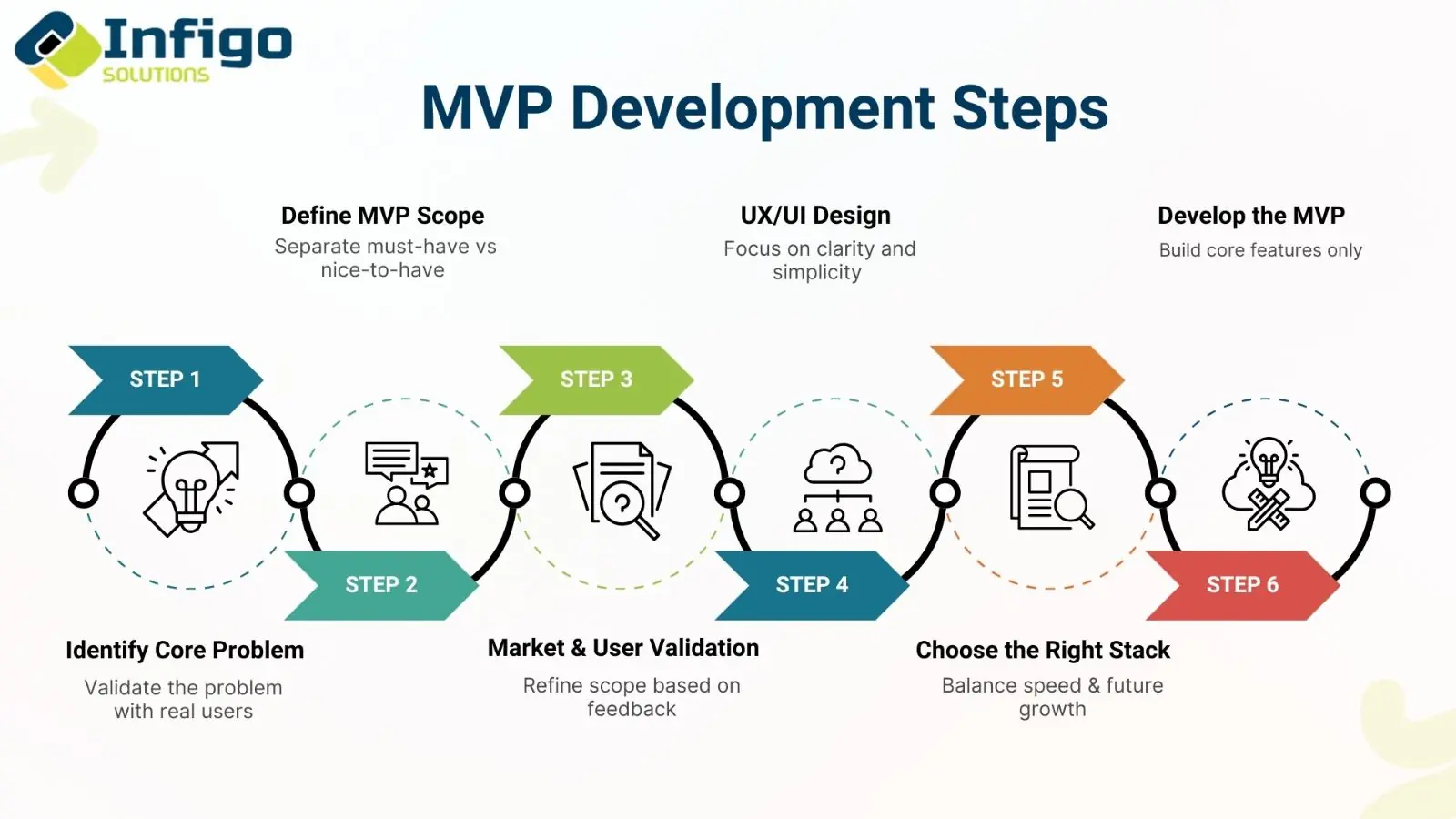
Step 1: Identify the Core Problem
The task: Validate the problem with real users before writing a single line of code.
This step gets skipped more than any other, usually because founders are confident the problem is real. They experienced it themselves, or they have heard about it from a handful of people, and that feels like enough evidence to move forward.
It is not enough evidence. Here is what actually counts as validation at this stage.
Talk to at least ten to fifteen people who match your target user profile. Ask about their current behavior, not their opinion of your idea. "Walk me through the last time you dealt with this" produces far better information than "would you find this useful." Look specifically for evidence that people are already trying to solve this problem on their own, through workarounds, spreadsheets, or competing tools used imperfectly.
What to avoid: Leading questions that fish for validation. Asking friends and family, who are statistically unlikely to give you honest pushback. Treating polite enthusiasm as a green light. "That sounds interesting" is not the same as "I would pay for that today."
Output of this step: A documented, specific problem statement backed by evidence from real conversations, not assumptions.
Step 2: Market and User Validation
The task: Refine your scope based on what the validation conversations actually revealed.
This step is distinct from step one, though they get conflated often. Step one asks whether the problem is real. Step two asks who specifically has this problem badly enough to be your first users, and what the boundaries of your solution should actually be.
Segment what you learned. Some of the people you talked to had the problem mildly. Some had it acutely. The acute group is your initial target, not the broader population who might theoretically benefit eventually.
Map the competitive landscape specifically against the segment you are targeting. What are they currently using, even if imperfectly? What do they complain about in reviews of existing tools? That complaint list is effectively a feature prioritization document handed to you for free.
What to avoid: Trying to serve everyone who showed any interest. Ignoring negative feedback because it is uncomfortable. Skipping competitive analysis because you believe your idea is sufficiently novel; very few ideas have zero competition, and assuming otherwise usually means you have not looked hard enough.
Output of this step: A specific target user segment and a scoped understanding of what would make your solution meaningfully better than current alternatives.
Step 3: Define MVP Scope
The task: Separate must-have features from nice-to-have features, ruthlessly.
This is where most MVPs go wrong, and it happens at the planning stage, not the building stage. The feature list gets generated, and almost everything on it feels important, because almost everything would genuinely add value eventually.
The filter that works: a feature is must-have only if its absence makes the core function impossible to test. Everything else, no matter how valuable it seems, is nice-to-have and gets deferred.
Run every proposed feature through this question: if we removed this, could a user still accomplish the core task and could we still learn whether the core hypothesis is correct? If yes, it is not must-have, regardless of how good it would feel to include it.
What to avoid: Scope creep disguised as thoroughness. The instinct to add "just one more thing" because it seems quick. Building for hypothetical future users instead of the specific segment identified in step two.
Output of this step: A locked feature list with a hard line between what ships in version one and what gets deferred to later iterations.
Step 4: UX/UI Design
The task: Design for clarity and simplicity above everything else.
At the MVP stage, design is not about visual polish for its own sake. It is about removing every possible source of confusion between a user opening your product and accomplishing the core task it exists to deliver.
Every screen should answer one clear question: what is the user supposed to do here, and is that obvious without explanation. If a screen requires a tooltip or an onboarding tutorial to be understood, the design has not yet done its job.
Wireframe before you build. Test the wireframe with a handful of real users before any development resources are committed. This catches confusion at the cheapest possible point in the process, before a single line of production code has been written.
What to avoid: Designing for visual impressiveness over functional clarity at this stage. Adding design flourishes that do not serve the core task. Skipping wireframe testing because the team feels confident the flow makes sense; internal teams are consistently bad at predicting where real users will get confused, because they already understand the product too well.
Output of this step: A tested, validated user flow that real users navigated successfully without explanation.
Step 5: Choose the Right Stack
The task: Balance build speed against future growth needs.
This decision gets made too conservatively or too aggressively, almost never in the right balance. Too conservative means choosing a stack purely for speed, with no consideration for what happens if the product succeeds and needs to scale. Too aggressive means over-engineering for a scale you have not yet earned, slowing down the MVP build for infrastructure decisions that may never be needed.
The right approach: choose technologies your team can build fast in, that have a credible path to scaling if the product validates, even if that scaling requires some rework down the line. Do not choose technology purely because it is trendy or because a senior engineer wants to learn it on the company's time. Choose what gets a working, testable product into users' hands fastest, with a reasonable growth path.
What to avoid: Premature optimization for scale you do not have yet. Choosing unfamiliar technology that slows the team down during the highest-pressure phase of the build. Ignoring scalability entirely, which creates expensive rebuilds the moment the product gains real traction.
Output of this step: A technology stack decision documented with the reasoning behind it, so future team members understand the tradeoffs that were made and why.
Step 6: Develop the MVP
The task: Build core features only. Nothing else.
By the time a team reaches this step, the previous five should have done most of the hard thinking. Step six is execution discipline: building exactly what was scoped in step three, designed in step four, on the stack chosen in step five, without scope expanding mid-build.
This is the stage where "just one more feature" requests are most dangerous, because the team is in motion and adding something feels low-cost in the moment. It rarely is. Every addition during the build phase delays the point at which you get real user data, which is the entire point of building an MVP in the first place.
Set a hard internal deadline and protect it. If a feature was not in the locked scope from step three, it does not get added during step six, no matter how compelling the argument sounds in a Tuesday afternoon meeting. It goes on the list for version two, informed by real usage data instead of speculation.
What to avoid: Scope creep during the build, even well-intentioned scope creep. Polishing features beyond what is needed to test the core hypothesis. Treating internal deadlines as flexible suggestions rather than commitments.
Output of this step: A working product, scoped exactly as planned, in the hands of real users as fast as the team can responsibly get it there.
Why This Sequence Matters More Than Any Individual Step
Each of these six steps feeds directly into the next. Skip the validation in steps one and two, and step three has nothing solid to base scope decisions on. Rush step three, and step four is designing clarity around a feature set that was never properly prioritized. Skip wireframe testing in step four, and step six builds confusion at full development cost instead of catching it at the cheapest possible stage.
Teams that struggle with MVP development rarely fail because of a single catastrophic mistake. They fail because they treat these six steps as loosely related activities instead of a sequence where each step's quality depends on the step before it.
Treat it as a sequence. Do not move to the next step until the current one has a real, evidence-backed output, not a confident guess.
Frequently Asked Questions
How long should the entire six-step process take for a typical MVP?
For a focused MVP with a clear scope, validation through development typically takes eight to fourteen weeks. Steps one and two, the validation work, should take two to three weeks. Step three and four, scope and design, another two to three weeks. Steps five and six, stack decisions and actual development, usually take the remaining time, depending on complexity.
Can steps be run in parallel to save time?
Some can. UX/UI design work in step four can often begin once scope is roughly locked in step three, even before every detail is finalized. Stack decisions in step five can be made in parallel with design work. What should not be parallelized is skipping steps one and two before moving forward; everything downstream depends on those being solid first.
What's the biggest mistake teams make in step three, defining scope?
Confusing "would be valuable" with "must-have." Almost every feature on a brainstormed list would add value eventually. The discipline required is asking whether the core hypothesis can still be tested without it, not whether it would be useful in general.
How do you choose the right tech stack without over-engineering?
Choose technology your team already knows well enough to move fast in, that has a credible, well-documented path to scaling. Avoid choosing tools purely because they are trendy, and avoid building infrastructure for a scale of users you do not have yet. The right stack lets you build fast now without painting yourself into a corner later.
Should the MVP development team be different from the team that built the original prototype?
Not necessarily, but the team composition matters less than discipline around scope. Whether it is the same team or a new one, the critical factor is whether they protect the locked scope from step three during the actual build in step six, rather than letting it expand under pressure.
The Bottom Line on This Process
MVP development is not complicated in concept. It becomes complicated when teams skip steps, blur the boundaries between them, or let later stages compensate for shortcuts taken earlier. Each of these six steps exists because it answers a specific question that the next step depends on.
Run the sequence properly, and the MVP that comes out the other end is not a guess dressed up as a product. It is a tested hypothesis, validated at each stage, ready to generate real data the moment it reaches users.
If your team is navigating this process and wants a partner who has run this playbook across dozens of products, Infigo Solutions works with founders and teams from problem validation through full MVP development. Reach out at info@infigosolutions.com to talk through where your product currently stands.
We Are Awesome.
A business consulting agency is involved in the planning, implementation, and education of businesses. We work directly.


.webp "LinkedIn")
Leave a Message
Recent Posts
 September 11, 2026
Prototype vs MVP: What's the Difference and Which Do You Need First?
 September 9, 2026
Comments
No comments yet. Be the first to comment!