 October 2, 2026
Software Development Outsourcing: What to Outsource vs Keep In-House
2
Oct
 Morgan
 Software Development
 0 Comments
The hardest software development outsourcing decision is not whether an external team can write the code.
It is deciding which parts of software delivery should leave your organization and which responsibilities should never leave it.
Two companies can use the same outsourcing partner and get completely different results. One gains engineering capacity, specialist expertise, and faster delivery. The other loses product knowledge, creates dependency, and spends months coordinating work that should have remained internal.
The difference usually comes down to ownership.
Software development outsourcing works best when the external team owns clearly defined execution while the business retains control of the decisions that create competitive advantage.
This guide provides a practical framework for deciding what to outsource, what to keep in-house, and how to structure the relationship so an external engineering team adds capability without taking control away from your organization.
What Is Software Development Outsourcing?
Software development outsourcing means assigning part or all of the software delivery process to an external engineering company or development team.
That work can include product design, frontend and backend development, QA, DevOps, integrations, cloud engineering, AI development, modernization, support, or complete application delivery.
It does not require handing over the entire technology function.
A company can outsource one specialist capability, add several engineers to an existing team, create a dedicated external squad, or give a partner responsibility for a complete product stream.
The right structure depends on what the organization needs help executing and what it needs to continue owning internally.
If the goal is a complete bespoke product rather than additional engineering capacity, the decision should also be evaluated against Infigo's custom software development services.
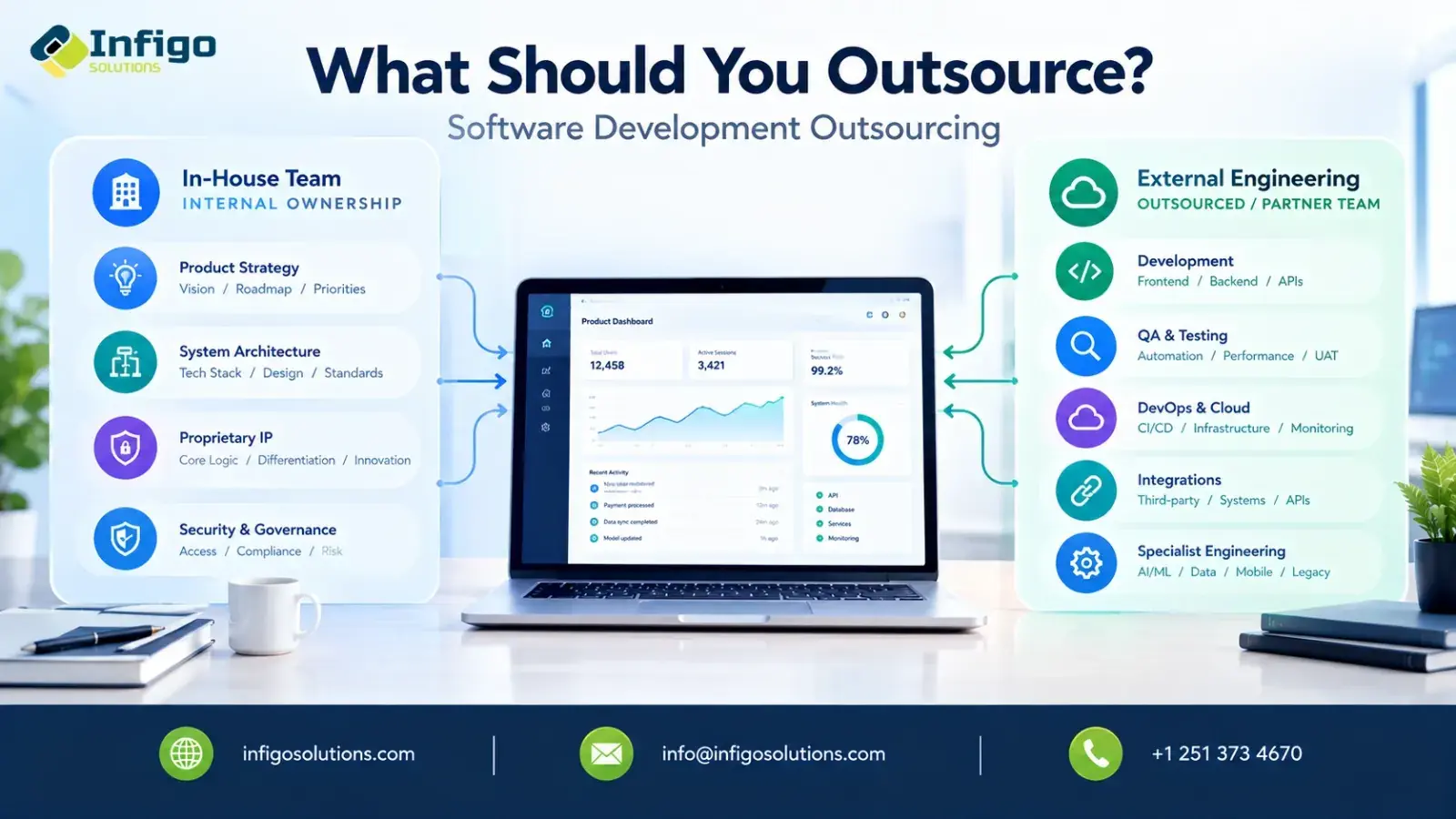
What Software Development Work Can You Outsource?
The safest outsourcing candidates are usually activities where execution requires engineering expertise but strategic control can remain with the client.
Product Design and UI/UX Execution
An external team can translate validated business requirements into user flows, wireframes, interface designs, prototypes, and design systems.
The client should still own the underlying product goals, target users, business rules, and prioritization decisions.
Frontend and Backend Development
Implementation is one of the most natural candidates for software development outsourcing.
External engineers can build:
- web applications
- APIs
- backend services
- customer portals
- mobile applications
- dashboards
- integrations
- internal business applications
The important distinction is that the partner can own implementation without automatically owning product direction.
QA and Test Automation
QA capacity is particularly suitable for outsourcing because it can be defined through measurable release criteria.
An external QA function may cover:
- functional testing
- regression testing
- API testing
- cross-browser testing
- mobile testing
- test automation
- release verification
- defect reporting
Independent QA can also reduce the risk of development teams validating only their own assumptions.
DevOps and Cloud Engineering
Organizations often need DevOps capability before they need enough DevOps workload to justify a large permanent team.
External specialists can support:
- CI/CD pipelines
- cloud infrastructure
- environment configuration
- deployment automation
- observability
- containerization
- infrastructure as code
Production access and infrastructure ownership, however, should remain governed by the client's security model.
Specialist Engineering
Temporary specialist needs are another strong outsourcing use case.
Examples include:
- AI and machine learning
- mobile engineering
- data engineering
- cloud migration
- performance engineering
- ERP integrations
- legacy modernization
The U.S. Bureau of Labor Statistics reports a median annual wage of $135,980 for software developers in May 2025 and projects overall employment for software developers, QA analysts, and testers to grow 10% between 2025 and 2035. That does not by itself make outsourcing preferable, but it illustrates the value and continuing demand for specialist software talent. Bureau of Labor Statistics
Legacy Modernization
Modernization projects often need a temporary concentration of engineering capacity.
An external team can assess, refactor, migrate, integrate, or rebuild parts of a legacy platform while internal teams continue supporting business-critical operations.
Infigo's legacy system modernization service is an example of this type of specialized delivery capability.
What Should Usually Stay In-House?
Outsourcing execution does not mean outsourcing accountability.
Several responsibilities should normally remain controlled internally.
Product Strategy
An external team can challenge assumptions and contribute ideas, but it should not independently determine:
- which market to pursue
- which customers matter most
- which problems deserve investment
- which business outcomes define success
Those decisions belong to the organization building the product.
Prioritization
Someone inside the business needs final authority over the roadmap.
Without internal prioritization, an external team may deliver features efficiently while the business still fails to build the right product.
Critical Business Knowledge
Rules that differentiate the business should not exist only inside a vendor's heads.
Domain knowledge must remain documented and accessible internally.
This includes:
- proprietary workflows
- pricing logic
- operational rules
- regulatory requirements
- customer-specific processes
- critical integration knowledge
Core Intellectual Property Decisions
The development partner may implement proprietary technology, but the client should retain control over the architecture and knowledge that constitute strategic intellectual property.
Code ownership, repositories, documentation, credentials, and infrastructure responsibilities should be established contractually before development starts.
Security Governance
An external team may implement security controls, but accountability for access policies and risk acceptance should remain internal.
NIST's software supply-chain guidance explicitly addresses risks associated with acquiring and using software and services from third-party suppliers and recommends supplier-risk controls, software verification, vulnerability management, and enhanced vendor assessments. NIST
How to Decide What Is Core vs Non-Core
A simple question helps separate work that can be outsourced from work that should remain internal:
If another company became excellent at this capability, would our competitive advantage disappear?
If the answer is no, the work may be a good outsourcing candidate.
If the answer is yes, internal ownership deserves closer consideration.
For example:
A retailer may outsource development of a mobile application while retaining ownership of proprietary pricing and fulfillment logic.
A healthcare company may outsource application engineering while keeping clinical governance and compliance decisions internal.
A SaaS startup may use external engineers to accelerate delivery while the founders continue owning product discovery and roadmap prioritization.
The objective is not maximum outsourcing.
It is deliberate ownership.
Which Outsourcing Model Fits Which Type of Work?
Different workloads require different engagement models.
| Situation | Recommended Model | Why |
| Clearly defined application | Project-based | Scope and outcome can be agreed upfront |
| Existing team needs additional specialists | Staff augmentation | Internal team retains day-to-day control |
| Product roadmap will evolve continuously | Dedicated team | Stable team builds long-term product knowledge |
| Multiple internal and external workstreams | Hybrid | Ownership can be divided by capability or product area |
Project-Based Outsourcing
Use this when the required outcome is sufficiently defined.
The external team owns delivery against an agreed scope while the client owns business acceptance.
It becomes less effective when requirements are changing every week.
Staff Augmentation
Use staff augmentation when you already have technical leadership and simply need more capacity or specialist skills.
The engineers join your operating model rather than replacing it.
Dedicated Development Team
A dedicated team is better when software development is ongoing and priorities will continue changing.
Instead of repeatedly onboarding new vendors or freelancers, the same team builds knowledge of the product, architecture, and business.
Infigo's dedicated development teams are structured around cross-functional squads, staff augmentation, delivery management, and flexible scaling. Infigo Solutions
Hybrid Delivery
A hybrid model splits responsibility intentionally.
For example:
Internal team owns:
product strategy, architecture standards, security governance, roadmap, critical IP.
External team owns:
feature development, QA, integrations, DevOps execution, or a defined product stream.
For many established companies, this is more practical than treating outsourcing as an all-or-nothing decision.
When Should You Outsource Software Development?
Several signals suggest that external engineering capacity may be useful.
Your Hiring Pipeline Is Slowing the Roadmap
If approved product work repeatedly waits for recruitment, outsourcing can decouple delivery capacity from permanent hiring speed.
Your Team Lacks a Specialist Capability
Hiring a permanent expert may not make sense for a six-month migration, AI implementation, security initiative, or modernization program.
The Existing Team Is Overloaded
When a core team spends most of its time handling maintenance and urgent requests, an external squad can take ownership of a separate development stream.
A New Product Needs a Cross-Functional Team Quickly
Launching a product may require engineering, QA, design, DevOps, and technical leadership simultaneously.
Building each role individually may take longer than the product opportunity allows.
You Need Flexible Capacity
Engineering demand changes.
External capacity can be increased during major delivery phases and reduced when those phases are complete.
When Should You Not Outsource?
Outsourcing is a poor solution when the underlying problem is not engineering capacity.
The Product Direction Is Still Completely Undefined
Adding developers does not resolve an unclear business problem.
Discovery needs to happen before scaling execution.
Nobody Internally Owns the Product
A vendor should not become the default product owner because no one inside the company has time to make decisions.
The Company Cannot Define Decision Rights
If every technical or product decision requires multiple unresolved internal approvals, adding an external team may increase coordination overhead rather than reduce it.
You Intend to Hand Over Critical Knowledge Permanently
An outsourcing relationship should not create a situation in which the client cannot operate, maintain, or transition the software without the original vendor.
In-House vs Outsourced Software Development
Neither model is universally superior.
| Factor | In-House | Outsourced |
| Product knowledge | Strong | Must be transferred |
| Initial team formation | Often slower | Can be faster |
| Specialist availability | Requires hiring | Can be added selectively |
| Capacity flexibility | Lower | Higher |
| Direct organizational control | Highest | Depends on model |
| Permanent fixed cost | Higher | More variable |
| External dependency | Low | Must be actively managed |
| Scaling for temporary demand | More difficult | Easier |
In-house teams are strongest where continuous organizational knowledge and strategic ownership matter most.
External teams are strongest where speed, specialist expertise, or flexible capacity matter most.
Many companies need both.
How Should Ownership Be Split?
A successful outsourced team needs explicit decision boundaries.
Before development begins, define ownership across five areas.
Product
Who controls the roadmap?
Who approves requirements?
Who decides when priorities change?
Architecture
Who approves major architecture decisions?
Which standards must the external team follow?
Who owns technical debt decisions?
Code and Infrastructure
The client should know:
- where repositories live
- who owns cloud accounts
- who controls production access
- where documentation is maintained
- how credentials are managed
- how deployments work
Quality
Define:
- acceptance criteria
- test responsibilities
- release gates
- defect severity
- sign-off authority
Security
External suppliers may introduce software supply-chain risks, which is why supplier assessment, secure development practices, vulnerability handling, and access governance should be part of the engagement rather than added after launch. NIST specifically recommends enhanced vendor risk assessments and supplier security controls in software acquisition contexts. NIST
How to Evaluate a Software Development Outsourcing Company
Do not evaluate a provider only by asking whether it uses your technology stack.
Ask how it builds software.
Useful questions include:
- Who will actually work on our project?
- Who owns architecture decisions?
- How are pull requests reviewed?
- How is QA separated from development?
- How are releases approved?
- Where will our code repositories live?
- Who controls cloud and production credentials?
- How is documentation maintained?
- What happens when an engineer leaves the team?
- How does knowledge transfer work?
- How are security incidents escalated?
- What happens when priorities change?
The answers reveal whether the provider is selling developer availability or a mature delivery capability.
A Practical Software Development Outsourcing Checklist
Before outsourcing any software work, confirm:
Strategy
- We know the business outcome.
- An internal stakeholder owns the product.
Scope
- We know what the external team owns.
- We know what remains internal.
Delivery
- We selected the right engagement model.
- Decision rights are documented.
Engineering
- Repositories and infrastructure ownership are clear.
- Architecture and coding standards are defined.
- QA and release responsibilities are explicit.
Security
- Access follows least-privilege principles.
- Credentials remain under appropriate organizational control.
- Supplier security practices have been reviewed.
Continuity
- Documentation is maintained continuously.
- Knowledge is not concentrated in one external person.
- Transition and offboarding procedures exist.
If several of these answers are unclear, the engagement is not ready to scale.
How to Decide What to Outsource vs Keep In-House
The better question is:
What should we own, and what should we use an external team to execute?
Companies rarely need to choose between a completely internal organization and a completely outsourced one.
They need an operating model.
Keep strategy, critical domain knowledge, governance, and competitive differentiation under internal control.
Use external engineering capacity where it gives the company faster execution, specialist capability, or more flexible delivery.
Infigo Solutions provides both custom software development and dedicated development teams, so the delivery model can be structured around the work instead of forcing every project into the same engagement type. Infigo Solutions
If you are deciding which parts of your roadmap should remain internal and which could move to an external engineering team, talk to Infigo Solutions about your software project.
Frequently Asked Questions
What is software development outsourcing?
Software development outsourcing means using an external engineering provider to execute part or all of software delivery while the client defines the responsibilities and decisions that remain internal.
What software development work can be outsourced?
Common candidates include UI/UX execution, application development, QA, DevOps, integrations, mobile engineering, specialist development, maintenance, and modernization.
What software development work should stay in-house?
Product strategy, critical business knowledge, roadmap authority, security governance, and strategically important intellectual-property decisions generally require strong internal ownership even when external teams contribute to implementation.
Is a dedicated team the same as project outsourcing?
No. Project outsourcing focuses on an agreed deliverable, while a dedicated team provides ongoing engineering capacity for a changing roadmap.
How do you prevent dependency on an outsourcing vendor?
Retain organizational control of repositories, infrastructure, documentation, credentials, architecture knowledge, and product decisions, and define knowledge-transfer and transition requirements from the beginning.


.webp "LinkedIn")
Leave a Message

Morgan
Senior Consultant
Helps startups and businesses evaluate software strategies, choose the right delivery model, plan scalable products, and turn technical decisions into practical business outcomes.
Recent Posts
 September 30, 2026
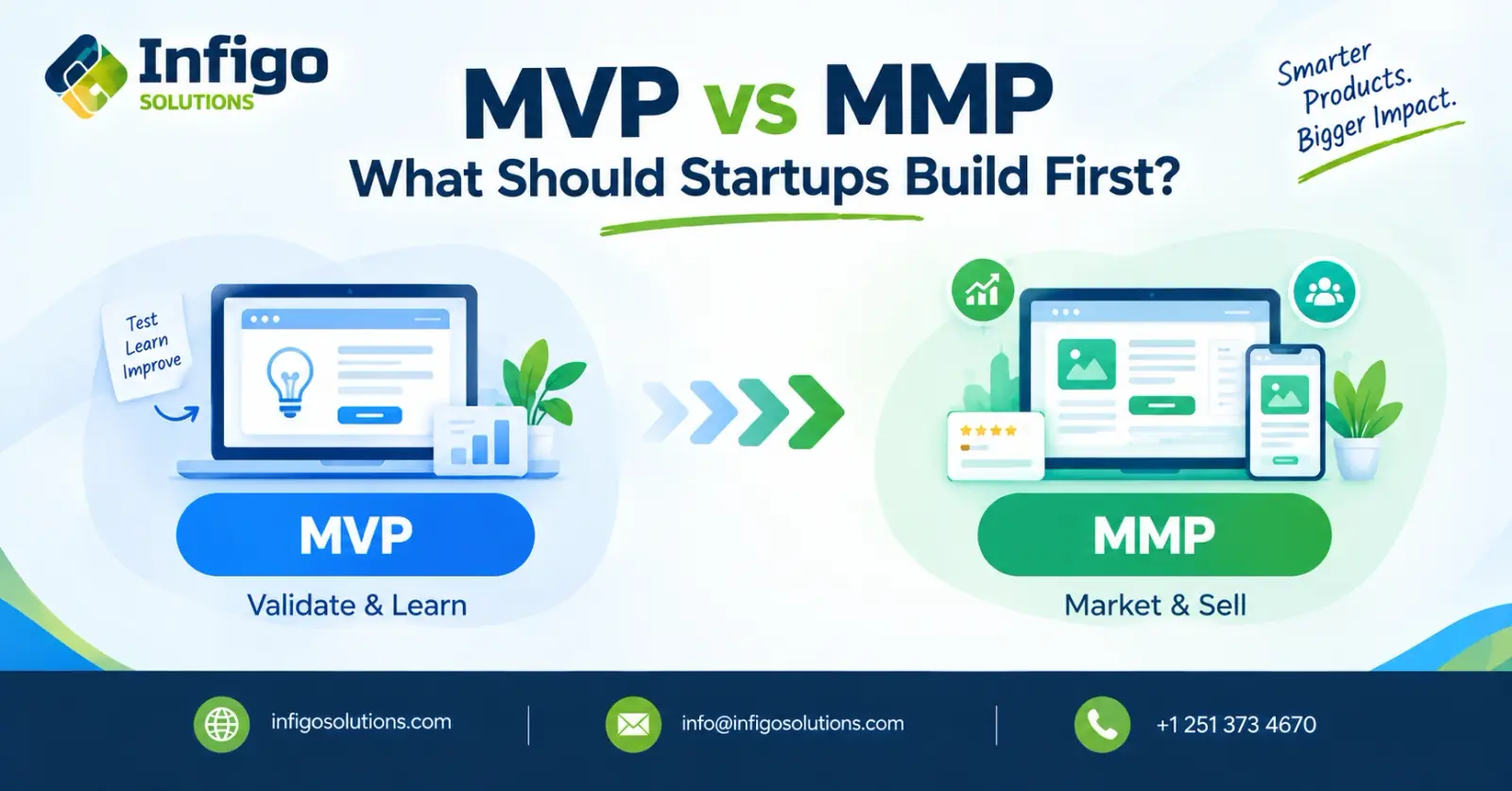
MVP vs MMP: What Should Startups Build First?
 September 28, 2026
Comments
No comments yet. Be the first to comment!