 September 30, 2026
MVP vs MMP: What Should Startups Build First?
30
Sep
 Morgan
 Software Development
 0 Comments
Building the smallest possible product is not the same as building the smallest product people will confidently buy.
That distinction is where many startups confuse an MVP, or Minimum Viable Product, with an MMP, or Minimum Marketable Product.
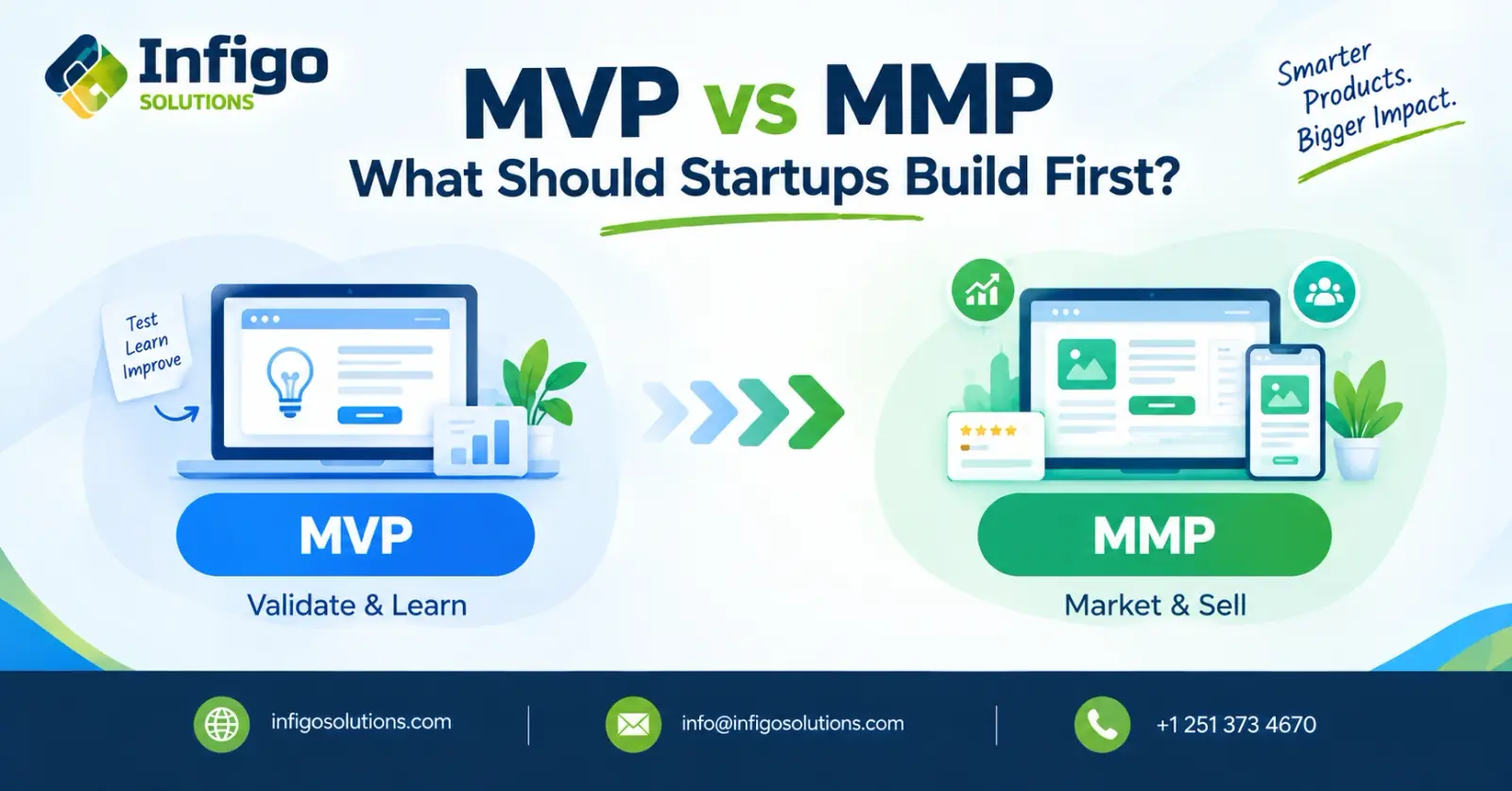
An MVP is primarily built to reduce uncertainty. It helps a startup test whether a problem is real, whether the proposed solution creates value, and whether users behave the way founders expected.
An MMP comes later in most product journeys. It is the smallest version of the product that is complete, reliable, and commercially credible enough to take to a broader market.
In simple terms:
An MVP proves that the idea is worth pursuing. An MMP proves that the product is ready to be sold more confidently.
For most startups, the practical sequence is MVP first, then MMP. The right decision still depends on customer expectations, product risk, market maturity, and how damaging a poor first impression could be.
MVP vs MMP at a Glance
| Factor | MVP | MMP |
| Primary goal | Validate assumptions | Deliver marketable value |
| Main question | Should we keep building this? | Are we ready to sell this? |
| Audience | Early adopters and test users | Broader paying market |
| Feature scope | Core functionality only | Complete core customer journey |
| Quality bar | Functional and usable | Reliable and commercially credible |
| Monetization | Optional | Usually important |
| Main metrics | Learning, activation, usage | Conversion, retention, revenue |
| Primary risk | Building the wrong product | Damaging adoption or market trust |
| Typical next step | Iterate or pivot | Acquire, retain, and grow customers |
The difference is not simply the number of features.
A product can contain many features and still fail to qualify as a strong MMP if onboarding, reliability, support, positioning, or the overall customer experience is weak.
What Is an MVP?
A Minimum Viable Product is the smallest useful version of a product that allows a team to test important assumptions with real users.
The purpose of an MVP is not to create a cheap or unfinished product. Its purpose is to create enough functionality to generate meaningful evidence.
The Lean Startup methodology popularized MVP thinking around validated learning. The product should help a team learn what customers actually need before unnecessary development effort is committed.
For a startup, an MVP may be designed to answer questions such as:
- Do users experience the problem we are trying to solve?
- Will they use this solution repeatedly?
- Which part of the workflow creates the most value?
- Are users willing to sign up, engage, or pay?
- Which assumptions about the product are wrong?
That makes an MVP an experiment with a usable product attached to it, not simply the first version of a complete product.
If you are planning this stage in more detail, our MVP Development Steps guide explains how to move from idea validation through development without overbuilding.
What Is an MMP?
An MMP, or Minimum Marketable Product, is the smallest version of a product that delivers enough complete value to be marketed and adopted by its intended customers.
The Project Management Institute defines a Minimum Marketable Product as the smallest product version with enough features to be offered to the market and deliver value customers will pay for or adopt.
With an MVP, the team is still trying to discover whether the product deserves additional investment.
With an MMP, the team is making a stronger promise to the customer.
That promise may involve:
- a reliable core workflow
- clear onboarding
- consistent performance
- appropriate security
- billing or payment flows
- support processes
- error handling
- understandable product messaging
- a level of usability customers will accept without constant assistance
An MMP is still intentionally focused. It does not contain every feature on the long-term roadmap.
It contains the minimum product experience required to compete credibly in the chosen market.
The Real Difference Between MVP and MMP
The easiest way to understand MVP vs MMP is to compare the decisions each one is designed to support.
Learning vs Selling
An MVP is optimized for learning.
The company wants evidence before committing more development time, budget, and operational resources.
An MMP is optimized for marketability.
The company already has enough evidence to justify moving from experimentation toward repeatable customer acquisition and delivery.
Early Adopters vs Paying Customers
Early MVP users are often more tolerant.
They may accept manual processes, basic interfaces, limited integrations, or occasional friction because they care strongly about solving the underlying problem.
A broader market behaves differently.
Customers evaluating an MMP are more likely to compare alternatives, judge the overall experience, expect clear onboarding, and hold the company accountable for reliability.
Core Functionality vs Complete Core Journey
An MVP may validate only the most important part of the workflow.
For example, a scheduling SaaS MVP might prove that service businesses want automated appointment scheduling.
Its MMP may need considerably more than the scheduling engine itself:
- account onboarding
- calendar configuration
- reminders
- cancellation flows
- billing
- user permissions
- customer support
- error recovery
The product is still focused, but the core customer journey is more complete.
Validation Metrics vs Business Metrics
MVP metrics should tell founders whether their assumptions are becoming stronger or weaker.
Useful MVP signals can include:
- activation
- task completion
- qualitative user feedback
- repeat usage
- feature adoption
- willingness to continue using the product
MMP metrics move closer to commercial performance:
- trial-to-paid conversion
- customer retention
- churn
- recurring revenue
- acquisition efficiency
- expansion
- support burden
This shift in metrics reflects a deeper change in product maturity.
Product Risk vs Market Risk
The MVP stage is dominated by questions such as:
Are we solving the right problem?
Does the product create enough value?
Will customers actually use it?
By the MMP stage, another category of risk becomes more important:
Can we reliably deliver the experience we are marketing?
A technically functional product may still be commercially unready if customers cannot onboard successfully, recover from errors, understand pricing, obtain support, or trust the system with important workflows.
Should a Startup Build an MVP or MMP First?
For most early-stage startups, MVP first is the more practical sequence.
When major product assumptions remain untested, building directly toward a polished marketable release can increase the amount of money committed before the company has enough evidence.
An MVP is usually appropriate when:
- customer demand is uncertain
- the core value proposition still needs testing
- feature priorities are unclear
- founders need behavioral evidence
- the startup wants to reduce development risk before scaling
However, some products require a higher initial quality threshold.
A startup may need to approach MMP-level readiness earlier when:
- customers will entrust sensitive data to the product
- enterprise buyers require security or compliance basics
- failures could create meaningful financial consequences
- poor reliability could permanently damage customer trust
- onboarding cannot reasonably depend on founder assistance
- market demand is already understood and execution risk is now more important
The right decision therefore depends less on a fixed startup stage and more on what uncertainty the company still needs to resolve.
For startups still determining product scope, MVP development services can help turn early assumptions into a focused product that can be tested before unnecessary features and costs accumulate.
When Is an MVP Ready to Become an MMP?
Adding more features does not automatically turn an MVP into an MMP.
The transition should happen when evidence from the MVP suggests that the startup is no longer primarily asking whether the core value exists.
Several signals matter.
1. Users Consistently Complete the Core Workflow
Users should be able to reach the product's main outcome repeatedly.
If most users still fail before receiving the core value, the startup may have more validation or usability work to complete.
2. Users Return Without Heavy Founder Involvement
Early founders often manually onboard customers, explain workflows, fix mistakes, and compensate for missing product functionality.
That can be useful during MVP validation.
It becomes a problem when the startup wants to acquire customers at a larger scale.
If users increasingly succeed without continuous manual assistance, the product may be approaching MMP readiness.
3. The Value Proposition Is Becoming Predictable
Different users do not need to love every feature.
But successful users should demonstrate a consistent reason for using the product.
If each customer values something entirely different, the product positioning may still be too uncertain for a focused marketable release.
4. Reliability Problems Are Becoming a Growth Constraint
At the MVP stage, teams often prioritize learning speed.
As adoption grows, reliability becomes part of the product's value.
If customers want to use the product more frequently but bugs, performance, onboarding friction, or operational gaps prevent them, the next investment may need to focus on product readiness rather than additional validation.
5. Customers Show Real Commercial Intent
Commercial evidence can include:
- willingness to pay
- successful paid pilots
- recurring usage
- renewal interest
- referrals
- requests to expand access
- demand from similar customers
These signals do not guarantee product-market fit, but they provide stronger evidence that the company can begin turning validated product value into a marketable offering.
MVP vs MMP Feature Priorities
Feature prioritization should change as the product matures.
Typical MVP Priorities
An MVP may focus on:
- one core customer problem
- one primary workflow
- minimum viable onboarding
- basic analytics
- feedback collection
- acceptable reliability
- enough functionality to validate key assumptions
Anything that does not contribute to learning or delivery of the core value should be questioned.
Typical MMP Priorities
An MMP may require:
- a complete core customer journey
- stronger onboarding
- reliable authentication
- payment or billing where relevant
- clear error handling
- support processes
- security appropriate to the product
- improved performance
- product analytics
- retention-oriented functionality
- clearer packaging and positioning
The goal is still not to build everything.
The goal is to remove the gaps that prevent a validated product from being adopted confidently by the intended market.
Startups trying to estimate how product scope affects budget can also review our MVP development cost guide before expanding the feature set.
MVP vs MMP Metrics Founders Should Track
Founders often make the mistake of evaluating an MVP with mature SaaS metrics too early, or continuing to rely on qualitative MVP feedback after the business has entered a more commercial stage.
The metrics should evolve with the product.
MVP Metrics
During MVP validation, focus on evidence such as:
- activation rate
- completion of the core task
- repeat usage
- frequency of use
- user interviews
- observed friction
- willingness to continue
- willingness to pay
The question is:
Are users demonstrating that our assumptions are directionally correct?
MMP Metrics
Once the product becomes commercially available, the questions expand.
Track:
- conversion rate
- retention
- churn
- recurring revenue
- paid activation
- acquisition efficiency
- support volume
- customer satisfaction
- expansion or upgrades
The question becomes:
Can this product consistently acquire, serve, and retain customers?
A Simple MVP vs MMP Decision Framework
Founders can simplify the decision using four questions.
1. Are We Still Proving Demand?
If yes, prioritize the MVP.
Do not solve future scale problems while the fundamental customer problem remains uncertain.
2. Do Users Already Depend on the Core Product?
If users repeatedly receive value and begin relying on the workflow, product quality and reliability become more important.
That is a signal to move toward MMP-level readiness.
3. Could a Poor Experience Damage Trust or Revenue?
If the answer is yes, some market-readiness requirements may need to appear earlier.
Security, data integrity, reliability, and recovery flows cannot always be postponed simply because the product is still young.
4. Can We Clearly Market, Price, Deliver, and Support This Version?
If the startup cannot confidently answer yes, it may not yet have an MMP.
A marketable product requires more than functioning software.
It needs a coherent customer promise that the business can repeatedly fulfill.
Example: Moving a SaaS Product From MVP to MMP
Consider a startup building scheduling software for service businesses.
The initial MVP might include:
- account creation
- one appointment calendar
- customer booking
- basic confirmation messages
- manual subscription handling
That may be enough to determine whether target businesses want the core scheduling solution.
Suppose the team finds that users repeatedly book appointments, return every week, and ask whether they can move more of their workflow onto the platform.
The next problem is no longer simply demand validation.
The product may now need:
- self-service onboarding
- automated billing
- configurable reminders
- cancellation and rescheduling
- multiple staff accounts
- stronger error recovery
- support
- reporting
- better reliability
Those additions are not random feature expansion.
They remove the barriers preventing the validated core product from becoming a product the company can market and support more broadly.
For a broader view of this transition, see our MVP to Product Launch Roadmap, which covers the journey from validation toward a complete launch.
SaaS founders can also use our SaaS MVP Development: A Founder’s Guide for a more specific look at scope, timelines, product decisions, and early-stage SaaS development.
MVP vs Prototype vs MMP
These terms are often mixed together, but they solve different problems.
Prototype: tests an idea, interface, workflow, or technical concept.
MVP: tests whether real users receive enough value from the product concept.
MMP: packages validated value into the smallest offering the business can credibly market and support.
A prototype can therefore exist before an MVP, while an MMP commonly follows successful MVP validation.
Startups planning the broader product journey can also review our Startup Product Development approach, which covers validation, design, MVP development, engineering, launch, and scaling.
Common MVP vs MMP Mistakes
Treating an MVP as a Low-Quality Product
Minimum does not mean careless.
An MVP can have limited scope while still being usable, appropriately secure for its purpose, and intentionally designed.
Adding Features Instead of Resolving Uncertainty
More features do not automatically create stronger validation.
Every feature should have a clear reason for existing.
Moving to MMP Before Demand Is Validated
Polish cannot compensate for weak product value.
A startup can spend months improving onboarding, infrastructure, and design around a product users still do not need.
Assuming an MMP Is the Final Product
An MMP is not the end of product development.
It is the smallest commercially credible version from which the business can continue learning, competing, and expanding.
Ignoring Operational Readiness
Software alone does not create a market-ready product.
Billing, support, onboarding, security, monitoring, and internal processes may all determine whether customers have a reliable experience.
MVP vs MMP: Final Takeaway
The difference between MVP and MMP comes down to the question the startup needs to answer.
An MVP asks whether the product creates enough value to justify further investment.
An MMP asks whether that validated value has been packaged into a product the company can confidently market, sell, and support.
Most startups should resist the temptation to skip validation and build a polished commercial product too early.
At the same time, they should not remain in MVP mode indefinitely once customers demonstrate repeatable value.
Build enough to learn first.
Then build enough to make a credible market promise.
If you are planning a new digital product, Infigo Solutions provides MVP development services to help startups define lean product scope, validate critical assumptions, build production-ready software, and prepare validated products for launch and growth.
Frequently Asked Questions
What is the main difference between MVP and MMP?
An MVP is designed primarily to validate assumptions and learn from real users. An MMP is designed to turn validated product value into the smallest commercially credible version that can be marketed, adopted, and supported by a broader customer base.
Does MMP come after MVP?
In many startup journeys, yes. The MVP helps validate core product assumptions first. Once users demonstrate repeatable value and commercial interest, the startup can improve reliability, onboarding, support, and other market-readiness requirements to create an MMP.
Can a startup skip the MVP stage?
Yes, but only when the core market assumptions are already sufficiently understood or when the product requires a higher initial quality threshold. Skipping validation can increase risk when customer demand, product value, or feature priorities remain uncertain.
When should an MVP become an MMP?
An MVP may be ready to evolve into an MMP when users consistently complete the core workflow, return without heavy manual assistance, understand the value proposition, demonstrate commercial intent, and begin encountering reliability or usability limitations that restrict broader adoption.
Is an MMP a finished product?
No. An MMP is the minimum version that can be marketed credibly. The product should continue evolving based on retention, revenue, customer feedback, competitive pressure, and new product opportunities.
Is a prototype the same as an MVP?
No. A prototype generally tests a concept, design, workflow, or technical assumption. An MVP is a usable product intended to generate real customer learning. An MMP moves further toward a commercially marketable and supportable product.


.webp "LinkedIn")
Leave a Message

Morgan
Senior Consultant
Helps startups and businesses validate product ideas, plan MVPs, evaluate technology opportunities, and build scalable software strategies around real business goals.
Recent Posts
September 30, 2026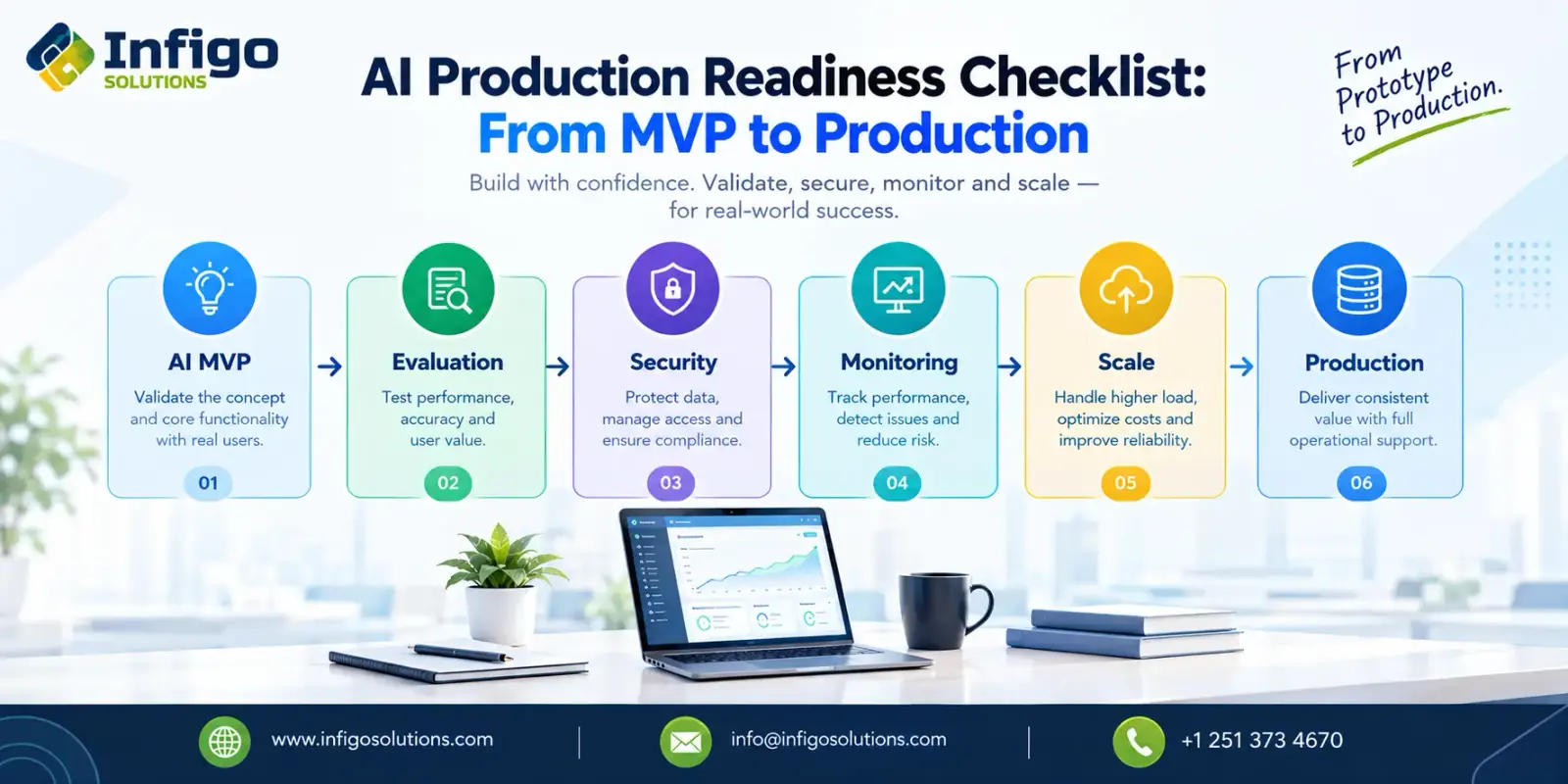 September 28, 2026
AI Production Readiness Checklist: From MVP to Production
 September 24, 2026
Comments
No comments yet. Be the first to comment!