 September 28, 2026
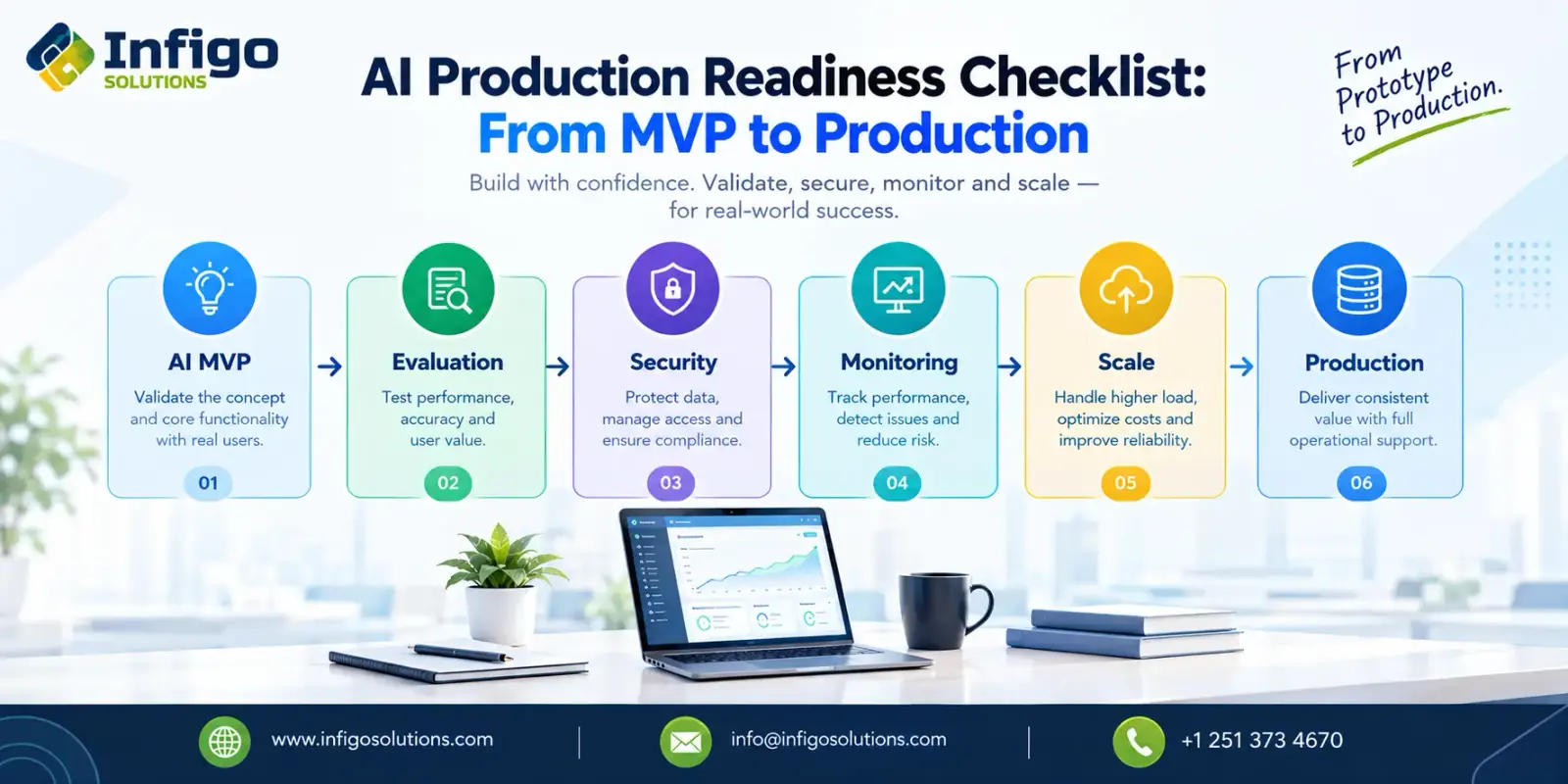
AI Production Readiness Checklist: From MVP to Production
28
Sep
 Morgan
 AI
AI 0 Comments
Getting an AI MVP to work is an important milestone. It is not the same as being ready for production.
A controlled demo may perform well with selected data, predictable requests, and a small group of testers. Production introduces something different: real users, unpredictable inputs, higher traffic, sensitive data, infrastructure failures, changing model behavior, and costs that can grow quickly.
That gap is where AI production readiness matters.
Before moving an AI product from MVP to production, teams need to determine whether the system can deliver useful results reliably, securely, and at a sustainable cost under real operating conditions.
This AI production readiness checklist provides a practical framework for making that decision.
What Is AI Production Readiness?
AI production readiness is the process of determining whether an AI system is prepared to operate reliably under real-world conditions.
It goes beyond asking whether the model works.
A production-ready AI system should have measurable quality standards, appropriate security controls, reliable infrastructure, monitoring and observability, failure-handling mechanisms, manageable operating costs, and clear ownership when something goes wrong.
This distinction becomes especially important with generative AI and machine learning systems because their behavior can change as inputs, users, data, models, and underlying dependencies change.
AWS describes production as an ongoing operational stage rather than a final deployment event, emphasizing continuous monitoring, drift detection, feedback loops, security, and governance. AWS Documentation
In practical terms:
An MVP proves that an AI product is worth pursuing. Production readiness determines whether it is safe and sustainable to operate at scale.
AI MVP vs Production-Ready AI
An AI MVP is designed primarily to validate assumptions.
Those assumptions might include whether users find the feature useful, whether a model can perform a particular task, or whether an AI workflow creates enough business value to justify further investment.
A production-ready AI system has a broader responsibility.
It must continue performing when:
- usage increases
- inputs become unpredictable
- dependencies fail
- models or prompts change
- sensitive information enters the workflow
- latency increases
- costs fluctuate
- AI responses fall outside expected quality thresholds
This is why moving directly from a successful demo to a full production launch can create problems that were invisible during MVP development.
If your team is still deciding whether the underlying AI capability should be tested through a proof of concept or an MVP, read our AI PoC vs MVP guide.
If the product itself is still at the validation stage, our AI MVP development guide explains what should be validated before scaling.
The 7-Gate AI Production Readiness Checklist
Instead of treating production readiness as a single technical review, it is more useful to evaluate the system across seven gates.
1. Business and User Outcome Readiness
Start with the outcome, not the model.
Before production deployment, the team should be able to explain what successful AI performance means from a business and user perspective.
Ask:
- What business outcome should the AI system improve?
- Which user workflow does it support?
- What does an acceptable response look like?
- Which failures are tolerable?
- Which failures require intervention?
- What metrics indicate that the AI feature is actually creating value?
A technically impressive model can still fail as a product if its outputs do not improve the workflow it was introduced to support.
This is also why production monitoring should include business metrics rather than infrastructure metrics alone. AWS production guidance separates monitoring across application health, business outcomes, and model quality. AWS Documentation
Production gate: Do not proceed until success and failure can be measured against defined user and business outcomes.
2. AI Quality and Evaluation Readiness
Testing a handful of prompts manually is not enough for production.
Teams need a repeatable evaluation process that measures how the AI performs across representative scenarios, difficult cases, and known failure conditions.
Depending on the application, evaluation may include:
- accuracy
- relevance
- task completion
- hallucination rate
- consistency
- groundedness
- response safety
- latency
- domain-specific quality measures
The evaluation dataset should represent the types of inputs the production system is actually expected to receive.
Acceptance thresholds should also be defined before deployment.
That creates a baseline against which future prompt changes, model upgrades, retrieval changes, or infrastructure modifications can be evaluated.
Microsoft's AI evaluation guidance similarly recommends establishing performance baselines and acceptance thresholds before releasing AI systems to users. Microsoft Learn
Production gate: The AI should pass a repeatable evaluation suite against predefined quality thresholds before release.
3. Data, Privacy, and Security Readiness
Production AI systems often interact with significantly more data than an MVP.
That can include customer information, internal documents, transaction data, proprietary knowledge, retrieved content, prompts, model responses, and logs.
Before production, teams should know:
- what information enters the system
- where that information is stored
- which systems can access it
- whether sensitive data can reach third-party models
- how permissions are enforced
- what gets logged
- how long data is retained
- whether outputs can expose restricted information
For retrieval-augmented generation and enterprise AI systems, authorization is particularly important. A model should not retrieve information simply because the information exists in the knowledge base.
AWS recommends controls including least-privilege access, encryption, input filtering, output safeguards, runtime monitoring, and audit trails for production AI workloads. AWS Documentation
Teams preparing sensitive or high-impact AI applications can also use the NIST AI Risk Management Framework as a non-vendor framework for considering AI risk and governance.
If the underlying data itself has not yet been assessed, complete an AI data readiness assessment before treating the system as production ready.
Production gate: Data access, privacy, security, retention, and AI-specific risks must have defined controls.
4. Reliability and Failure-Handling Readiness
Production systems need a plan for failure.
An AI request might fail because:
- a model provider becomes unavailable
- an API times out
- retrieval returns poor context
- the model generates an unsafe response
- the system exceeds a token or context limit
- a downstream service fails
- the response confidence is insufficient
The important question is not whether failures will occur. It is what the application does when they occur.
Depending on the use case, that may require retries, fallback models, cached responses, graceful error messages, deterministic business rules, human review, or temporary feature shutdown.
For higher-risk workflows, human intervention may need to be part of the architecture rather than an emergency workaround.
AWS also recommends resilience measures such as fallback mechanisms and architecture capable of maintaining availability under changing load. AWS Documentation
Production gate: Critical failure scenarios should have defined detection, fallback, escalation, and recovery behavior.
5. Monitoring and Observability Readiness
Traditional software monitoring asks whether the application is running.
AI monitoring must also ask whether the application is still producing acceptable results.
A production monitoring strategy should therefore cover several layers.
System metrics may include latency, throughput, uptime, error rates, resource utilization, and API availability.
AI quality metrics may include relevance, accuracy, hallucination rates, drift, safety violations, and evaluation scores.
Business metrics should track whether the AI feature continues delivering its intended outcome.
AWS recommends monitoring latency, throughput, uptime, cost efficiency, AI quality, hallucinations, drift, and traceability in production AI applications. AWS Documentation
Logs should also make it possible to trace significant outputs back to relevant application, prompt, model, retrieval, and configuration versions where appropriate.
Without that visibility, diagnosing a production AI problem can become extremely difficult.
Production gate: The team should be able to detect both technical degradation and AI-quality degradation after deployment.
6. Cost and Scalability Readiness
An AI MVP can appear affordable simply because very few people are using it.
Production changes the economics.
Costs may grow through:
- model API calls
- input and output tokens
- embeddings
- vector search
- GPU or compute resources
- storage
- logging
- monitoring
- data processing
- third-party services
Model selection should therefore consider cost, latency, quality, and workload requirements together.
The most capable model is not automatically the right production model for every request.
Teams may reduce production costs through techniques such as model routing, caching, smaller models for simpler tasks, prompt optimization, asynchronous processing, rate limits, and infrastructure optimization.
Load testing is equally important. A system that works for 20 internal testers may behave very differently when hundreds or thousands of users interact with it concurrently.
Production gate: Expected usage should have a tested capacity model and an acceptable cost per transaction, user, or business outcome.
7. Deployment, Rollback, and Ownership Readiness
The final gate concerns operational control.
AI systems evolve continuously. Models change, prompts change, knowledge bases change, application logic changes, and external providers release new versions.
Production deployment therefore needs version control and a safe release process.
Teams should determine:
- how AI changes are tested before release
- how prompts and configurations are versioned
- whether automated evaluation is part of deployment
- how releases are staged
- how a failed release is rolled back
- who receives production alerts
- who owns AI quality
- who can approve significant changes
AWS recommends automated quality and security gates, controlled deployment strategies, and rollback mechanisms for production generative AI systems. AWS Documentation
This turns deployment from a one-time launch into a controlled operating process.
Production gate: Every important AI change should be testable, observable, reversible, and owned by a responsible team.
A Simple AI Production Readiness Scorecard
Before launch, teams can summarize the seven gates with a simple internal review:
| Production Gate | Key Question |
| Business Outcome | Do we know what successful AI performance means? |
| AI Evaluation | Does the system consistently meet defined quality thresholds? |
| Data & Security | Are sensitive data and AI-specific risks controlled? |
| Reliability | Do we know what happens when the AI or its dependencies fail? |
| Monitoring | Can we detect technical and AI-quality degradation? |
| Cost & Scale | Can the architecture handle expected usage economically? |
| Deployment & Ownership | Can changes be released, monitored, and rolled back safely? |
A weak result in one area does not always mean the product cannot launch.
It does mean the risk should be understood and deliberately accepted rather than discovered after users encounter it.
Common Signs Your AI MVP Is Not Ready for Production
Some warning signs appear repeatedly during the transition from AI MVP to production:
- quality is judged mainly through manual testing
- there is no representative evaluation dataset
- success thresholds have not been defined
- prompts are changed directly in production
- sensitive data access is broader than necessary
- model outputs cannot be traced effectively
- there is no monitoring for AI quality
- costs have only been estimated at MVP traffic levels
- failure scenarios depend entirely on the model recovering
- nobody clearly owns production AI quality
- there is no rollback process
These gaps do not necessarily mean the AI product has failed.
They usually mean the product needs another engineering and operational hardening stage before broader deployment.
When Should You Move an AI MVP to Production?
An AI MVP should move toward production when the important product assumptions have been validated and the system can meet defined standards for quality, security, reliability, observability, cost, and operational control.
That does not mean eliminating every possible risk.
It means understanding the important risks, measuring what matters, putting appropriate controls around the system, and having a response when real-world behavior differs from expectations.
For companies moving from validated AI concepts toward scalable products, AI Product Development can include the engineering work required to move from validation into a production-oriented architecture.
Organizations deploying AI across larger workflows may require broader governance, integration, security, and scalability considerations through Enterprise AI Solutions.
From Working AI to Production-Ready AI
The hardest part of AI development is not always making a model produce a good result.
It is building a system that continues producing useful results when real users, real data, operational failures, security requirements, changing models, and business constraints enter the picture.
That is the purpose of AI production readiness.
Treat the move from MVP to production as an engineering and operational gate rather than simply the next deployment environment.
Evaluate the business outcome, AI quality, data security, reliability, monitoring, scalability, cost, and deployment controls before expanding usage.
A successful AI MVP proves that an idea can create value.
A production-ready AI system is designed to keep delivering that value under real-world conditions.
Planning to move an AI MVP into production? Infigo Solutions can help assess the architecture, AI quality, deployment risks, and scalability requirements before you expand to real users.


.webp "LinkedIn")
Leave a Message

Morgan
Senior Consultant
Helps startups and businesses validate product ideas, plan MVPs, evaluate AI opportunities, and build scalable software strategies around real business goals.
Recent Posts
September 28, 2026 September 24, 2026
AI Data Readiness: Is Your Data Ready for AI?
 September 23, 2026
Comments
No comments yet. Be the first to comment!