 September 16, 2026
AI MVP Development Services: How to Validate an AI Product Before You Scale It
16
Sep
 Morgan
 AI
AI 0 Comments
AI MVP Development Services: How to Validate an AI Product Before You Scale It
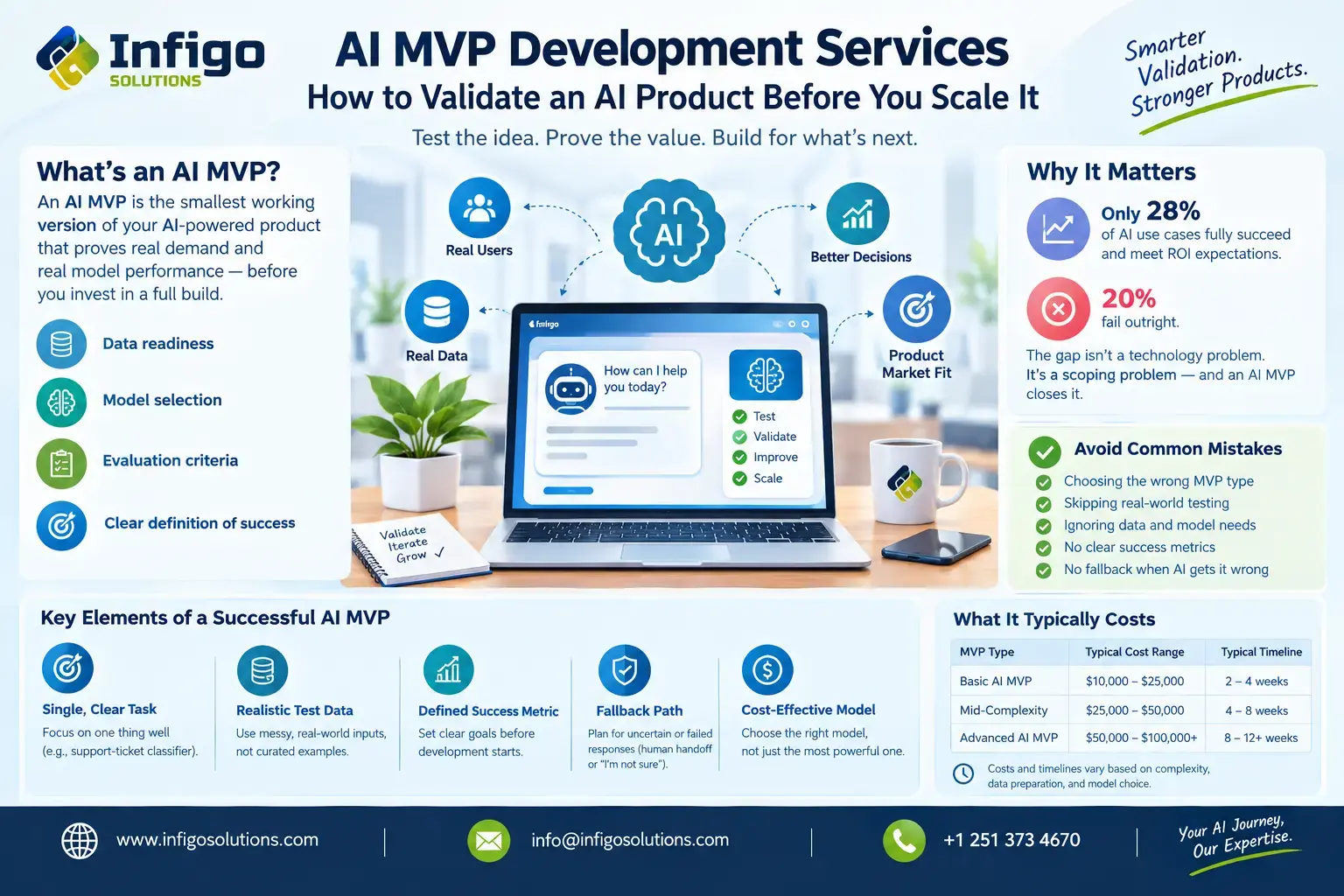
Most AI products fail before they ever reach real users, and the reason is rarely the model. It is usually a missing validation step, the same step that AI MVP development services exist to solve. According to Gartner's 2025 survey of infrastructure and operations leaders, only 28 percent of AI use cases fully succeed and meet ROI expectations, while 20 percent fail outright. The gap between those numbers is not a technology problem. It is a scoping problem, and it is exactly what a properly built AI MVP is designed to close.
This guide covers what AI MVP development services actually involve, how building an AI MVP differs from a standard software MVP, what it costs, and how to avoid the mistakes that put your project in that 20 percent.
What AI MVP Development Services Actually Involve
AI MVP development services help founders and product teams build the smallest working version of an AI-powered product that can prove real demand and real model performance before a larger investment. That means more than wiring up an API call to a language model. A proper engagement covers data readiness, model selection, evaluation criteria, and a clear definition of what "working" actually means before a single line of code gets written.
This distinction matters because AI introduces a second layer of risk that a traditional MVP does not have. A regular MVP has to prove people want the product. An AI MVP has to prove both that people want it and that the AI component performs reliably enough to be useful, which is a fundamentally different validation problem.
How an AI MVP Differs From a Standard MVP
| Factor | Standard MVP | AI MVP |
| Core question | Do people want this product? | Do people want it, and does the AI actually work reliably? |
| Main risk | Market demand | Model performance plus market demand |
| Data requirements | Minimal | Often needs curated or labeled data upfront |
| Success metric | Usage and retention | Usage, retention, and accuracy or task-completion rate |
| Typical failure mode | Nobody uses it | It works in the demo but breaks on real inputs |
| Iteration cycle | Feature-driven | Feature-driven plus model and prompt tuning |
Why So Many AI Projects Fail Before They Scale
The failure pattern behind Gartner's numbers is consistent across most AI MVP development services engagements that go wrong: a demo built on carefully chosen examples looks impressive, gets approved, and then falls apart against real, messy user input. The AI works in the pitch deck and fails in production, because nobody stress-tested it against the inputs real users would actually provide.
This is precisely the gap AI MVP development services are meant to close. Instead of building toward a polished demo, the goal is building toward a version that gets tested against realistic, imperfect conditions early, while changes are still cheap.
What Goes Into a Properly Scoped AI MVP
A few components separate an AI MVP that validates something real from one that just looks impressive in a meeting:
- A single, clearly defined task. The strongest AI MVPs prove one thing well rather than attempting broad capability. A support-ticket classifier that works reliably beats a general assistant that sometimes helps.
- Realistic test data, not curated examples. Testing against messy, real-world inputs, incomplete requests, unclear phrasing, edge cases, is what reveals whether the AI component actually works.
- A defined success metric before development starts. Without an agreed definition of success, teams cannot tell whether the MVP validated anything at all, which is one of the most common root causes behind failed AI projects.
- A fallback path for when the AI gets it wrong. Every AI MVP needs a plan for uncertain or failed responses, whether that's a human handoff or a graceful "I'm not sure" response, rather than a confident wrong answer.
- A cost-effective model choice. The most powerful available model is not always the right one; the right model is the one that reliably completes the task within a sustainable cost per interaction.
What AI MVP Development Typically Costs
Pricing depends on the complexity of the AI component and how much data preparation is required, but a few ranges hold up across most projects in 2026.
| MVP Type | Typical Cost Range | Typical Timeline |
| Single AI feature added to an existing product | $10,000 to $25,000 | 4 to 6 weeks |
| Standalone AI MVP (chat, classification, or recommendation) | $25,000 to $60,000 | 8 to 12 weeks |
| AI agent MVP with tool use and multi-step workflows | $40,000 to $90,000+ | 10 to 16 weeks |
| Ongoing model monitoring and iteration | 15 to 25 percent of build cost annually | Ongoing |
AI features typically add 15 to 30 percent to a standard MVP budget, largely due to data preparation, evaluation work, and the extra testing needed to validate model behavior against real inputs rather than curated demos.
Choosing the Right AI MVP Development Partner
A few questions separate a partner who understands AI validation from one who will just wire up an API and call it done:
- Do they ask about your success metric before your feature list? A partner that starts with "how will we know this worked" is thinking about validation, not just delivery.
- How do they handle data readiness? Weak or missing data is one of the most common reasons AI projects get abandoned, and a good partner will flag this early rather than after the build starts.
- Do they test against realistic inputs, not just demo scripts? Ask specifically how they plan to stress-test the AI component before launch.
- What is their plan for AI failures or low-confidence responses? A partner with no answer here has not thought through the reliability bar an AI product actually needs.
- Do they scope one task well instead of promising broad capability? Teams that promise an AI that "does everything" from day one are underestimating both cost and risk.
Common Mistakes in AI MVP Development
- Skipping the definition of success. Projects with a clear, quantified success metric defined upfront succeed at meaningfully higher rates than those without one, according to recent industry research on AI project outcomes.
- Testing only with curated examples. A demo that only ever sees ideal inputs tells you nothing about how the AI will behave with real, messy user data.
- Building broad instead of narrow. An AI MVP that tries to handle every possible use case on day one is both harder to build and harder to evaluate than one that proves a single task works reliably.
- Choosing the most expensive model by default. Cost per interaction compounds quickly at scale, and the most capable model is not always necessary for the task being validated.
- No fallback for uncertainty. An AI MVP that always gives a confident answer, even when it should not be confident, erodes user trust faster than an honest "I don't know."
Frequently Asked Questions
What makes AI MVP development different from regular MVP development?
An AI MVP has to validate two things at once: whether people want the product and whether the AI component performs reliably enough to be useful. A standard MVP only has to prove the first.
How much does AI MVP development typically cost?
A single AI feature added to an existing product typically runs $10,000 to $25,000. A standalone AI MVP typically runs $25,000 to $60,000, and an AI agent MVP with multi-step workflows typically runs $40,000 to $90,000 or more.
Why do so many AI projects fail after launch?
Most AI project failures trace back to a missing or unclear definition of success, testing against curated examples instead of real inputs, or scope that was too broad to properly validate. These are scoping and validation problems, not technology problems.
Do I need a lot of data before starting an AI MVP?
It depends on the use case, but having at least some realistic, representative data upfront significantly improves an AI MVP's chances of working reliably. Weak or missing data readiness is one of the most common reasons AI projects stall.
Should an AI MVP use the most advanced model available?
Not necessarily. The right model is the one that reliably completes the defined task at a sustainable cost per interaction, which is not always the most powerful or most expensive option on the market.
Can an AI MVP be added to an existing product instead of built standalone?
Yes, and this is often the lower-risk starting point. Adding a single, well-scoped AI feature to a product that already has users is usually faster and cheaper to validate than launching a standalone AI product.
Getting Started
The organizations landing in Gartner's successful 28 percent are not the ones with the most advanced models. They are the ones that scoped a real success metric, tested against real conditions, and validated one thing well before expanding scope.
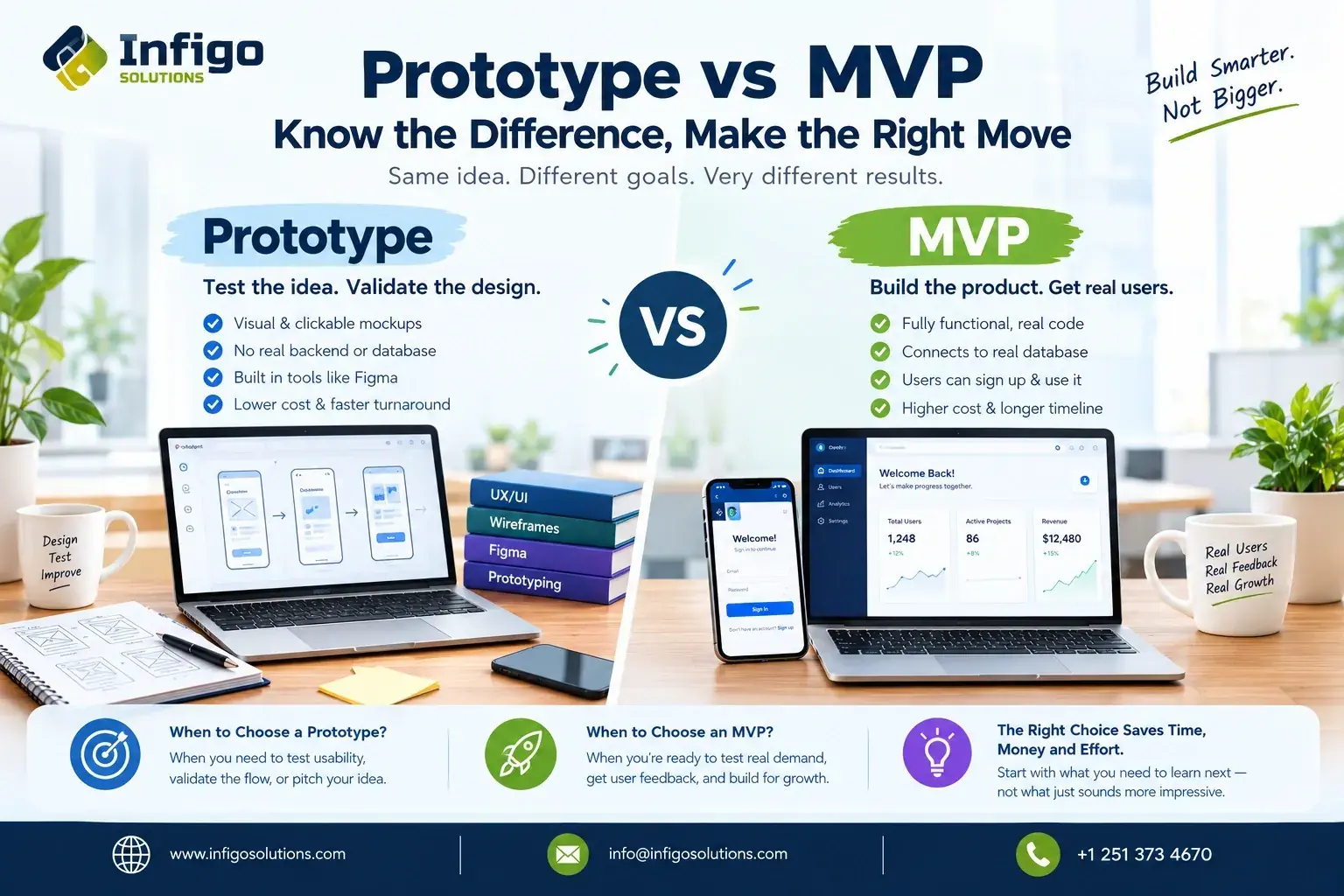
Our AI product development page covers how we approach this kind of validation-first build, and our AI agent development page goes deeper into multi-step, tool-using AI products specifically. If you are still deciding whether your idea needs a prototype, an AI MVP, or a standard MVP first, our guide on prototype vs MVP walks through that decision, and our MVP development cost breakdown covers pricing across platforms more broadly.
For a tailored estimate based on your specific AI use case, our Startup Quote calculator walks through your stage, product type, and priorities in a few minutes.
We Are Awesome.
A business consulting agency is involved in the planning, implementation, and education of businesses. We work directly.


.webp "LinkedIn")
Leave a Message

Morgan
Senior Consultant
Helps founders validate AI product ideas, avoid common AI MVP failure patterns, and budget realistically for AI-powered builds.

Comments
No comments yet. Be the first to comment!