 September 24, 2026
AI PoC vs MVP: What Should Startups Build First?
23
Sep
 Morgan
 AI
AI 0 Comments
An AI product idea can look convincing on paper and still contain one assumption capable of breaking the entire business.
Maybe the model cannot reach the accuracy your use case requires. Maybe the AI works technically, but users do not trust it enough to change their workflow. Or perhaps the technology is already proven and the real uncertainty is whether customers will use the product at all.
This is why choosing between an AI PoC vs MVP should not start with a feature list.
It should start with risk.
A proof of concept, prototype, and minimum viable product solve different validation problems. Building the wrong one can consume development time without answering the question that actually determines whether your AI product should move forward.
For startup founders, the better question is not simply, "Should we build a PoC or MVP?"
It is:
What do we need to prove before investing more?
AI PoC vs MVP: The Short Answer
An AI proof of concept (PoC) tests whether a critical technical assumption is feasible. An AI MVP tests whether a usable version of the product creates enough value for real users.
If you do not know whether the AI can reliably perform the core task, start with a PoC.
If the technology is sufficiently understood but customer demand, workflow, or product value remains uncertain, an MVP is usually the more useful next step.
A prototype sits between these decisions when the biggest uncertainty is how users should interact with the solution.
| Factor | AI PoC | AI MVP |
| Main question | Can the AI work? | Will users get enough value from it? |
| Primary risk | Technical feasibility | Product and market validation |
| Audience | Usually internal team | Real target users |
| Scope | One critical assumption | Small but usable workflow |
| User interface | Often minimal | Functional user experience |
| Data | Representative test data | Realistic operational data |
| Main evidence | Technical results | User behavior and feedback |
| Production ready | Usually no | Limited, but usable |
| Next decision | Continue, change, or stop | Improve, expand, pivot, or scale |
The distinction matters because a technically successful PoC does not prove that customers want the product. In the same way, an attractive product interface does not prove that the underlying AI can perform reliably enough for the intended use case.
What Is an AI Proof of Concept?
An AI PoC is a focused experiment designed to answer a technical question before a team commits to building a complete product.
Suppose a startup wants to automate information extraction from complex industry documents. Before designing dashboards, user accounts, billing, notifications, and administration tools, the team may need to answer a more fundamental question:
Can the proposed AI approach extract the required information reliably enough from the documents customers actually use?
That is a PoC problem.
The team might test models, prompts, retrieval techniques, preprocessing approaches, or data pipelines. The interface can remain extremely basic because user experience is not yet the primary uncertainty.
A useful AI PoC should therefore have a measurable success criterion.
"See if AI works" is not enough.
A better test defines the task, representative data, expected output, evaluation method, and acceptable limits for factors such as quality, latency, or operating cost.
This evaluation mindset is important throughout AI development. The NIST AI Risk Management Framework is designed to help organizations incorporate trustworthiness considerations into the design, development, use, and evaluation of AI products and systems.
What Is an AI MVP?
An AI MVP moves beyond technical possibility.
It is the smallest usable version of an AI-powered product that allows target users to complete an important workflow while giving the team evidence about whether the product creates real value.
Imagine the document-processing startup has already established that its AI can extract the required information at an acceptable level.
The uncertainties are now different:
Will customers use it?
Does it save enough time to change their existing workflow?
Which extracted information matters most?
Where do users need human review?
Will users trust the output?
Those are MVP questions.
An AI MVP therefore needs more than a functioning model. It needs enough of a product experience around the AI for users to receive meaningful value.
Depending on the product, that can include an interface, authentication, data handling, integrations, feedback mechanisms, error states, monitoring, and appropriate human oversight.
If you have reached this stage, our guide to AI MVP Development Services explains the next layer of AI MVP validation, including data readiness, model selection, evaluation criteria, failure handling, and product scoping.
AI PoC vs Prototype vs MVP: Do You Need All Three?
Not necessarily.
One of the easiest ways to waste early-stage development effort is to treat PoC, prototype, and MVP as mandatory stages that every AI product must complete.
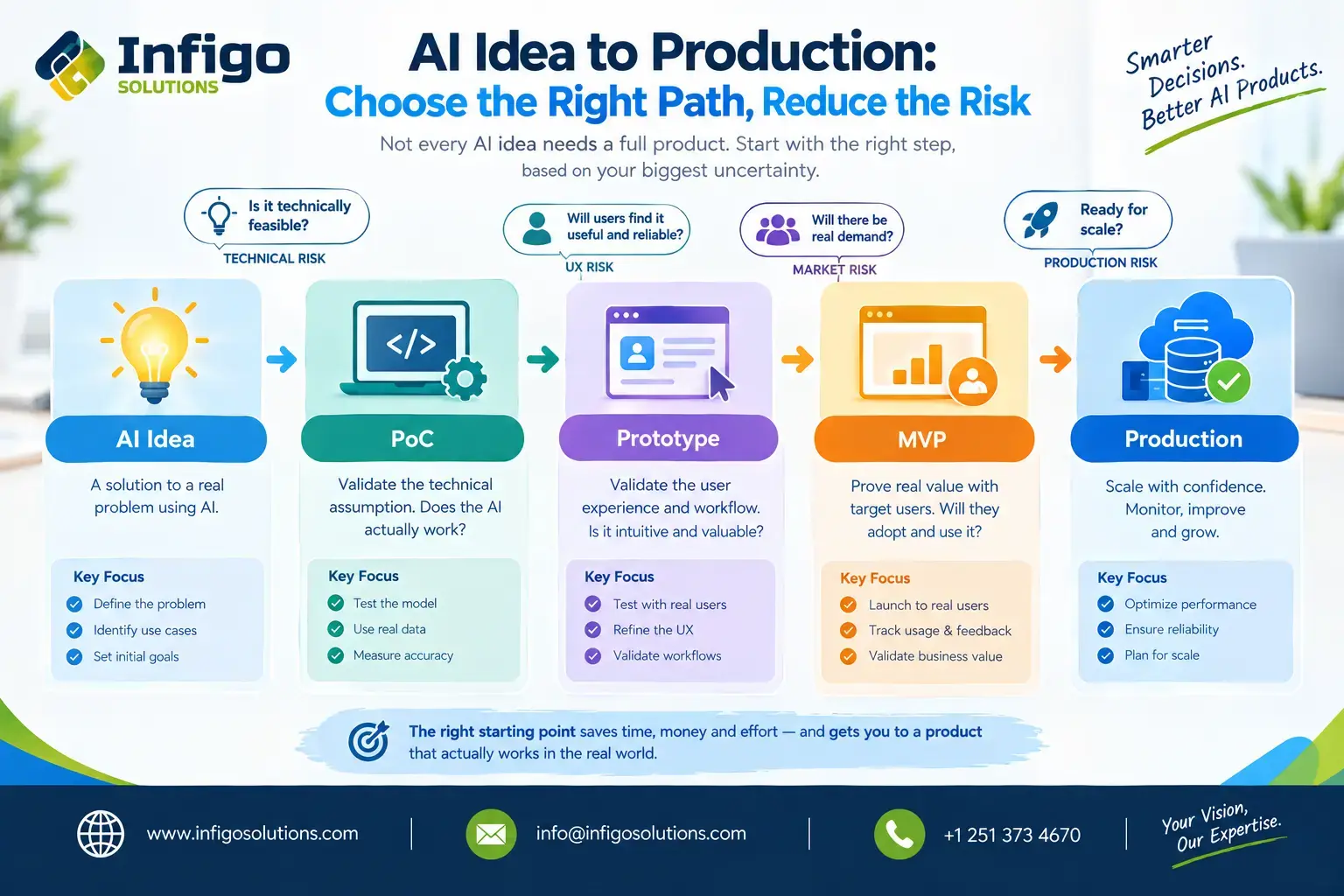
They are better understood as tools for reducing different types of uncertainty.
A PoC tests feasibility.
Can the technology perform the critical task?
A prototype tests the experience.
Can users understand and navigate the proposed workflow?
An MVP tests real-world value.
Will target users actually use the product and receive enough value from it?
A startup with a technically unusual machine learning problem may need a PoC before anything else.
Another startup may be using established AI capabilities but still be uncertain about how users should interact with them. A prototype may provide more useful evidence.
A third startup may already understand both the technology and the workflow. Its biggest unknown may be whether customers care enough to adopt the product. In that case, moving toward an MVP can make more sense.
The objective is not to complete every stage.
The objective is to resolve the uncertainty preventing the next investment decision.
When Should a Startup Build an AI PoC First?
An AI PoC becomes valuable when technical uncertainty could invalidate the product concept.
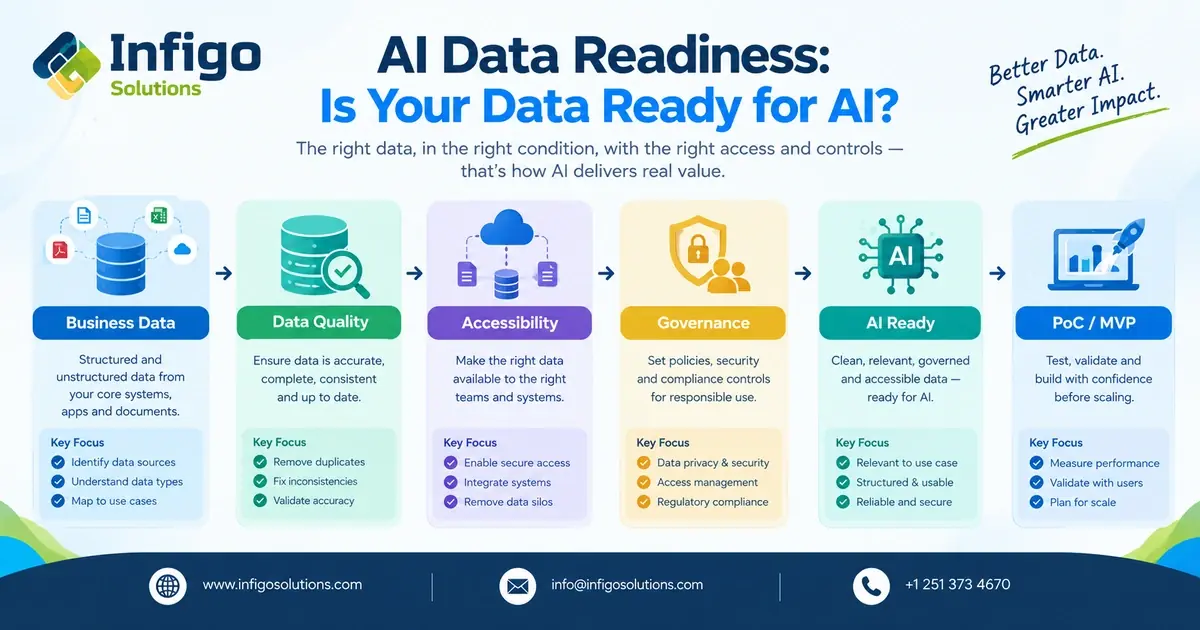
Before testing technical feasibility, it is also important to understand whether the required data is suitable for the proposed AI use case. Assessing AI data readiness can help identify gaps in data quality, availability, accessibility, and governance before those issues affect the PoC.
Consider starting with a PoC when:
- Your product depends on a novel or technically uncertain AI capability.
- Model performance on your domain-specific data is unknown.
- The product requires an accuracy or reliability threshold that has not been demonstrated.
- The proposed AI must work with unusual, inconsistent, or difficult data.
- A critical third-party integration or technical dependency remains uncertain.
- Latency could make the intended experience impractical.
- AI inference costs could make the proposed business model difficult to sustain.
- You need evidence that a particular architecture or model approach is viable before investing in product development.
The objective is not to build a miniature version of the entire application.
It is to isolate the assumption most capable of stopping the product from working and test it as efficiently as possible.
When Can You Skip the PoC and Build an MVP?
A separate PoC is not automatically necessary simply because a product contains AI.
If you are using established models or APIs for a well-understood capability, technical feasibility may not be the biggest risk.
Imagine a startup building an AI assistant that summarizes standard business documents using established language models.
The basic ability of modern language models to summarize text may already be sufficiently understood for the startup's initial hypothesis.
The more important uncertainties could be:
- Which documents users actually want summarized
- How summaries fit into their workflow
- What level of review users expect
- Whether the feature saves meaningful time
- Whether customers use it repeatedly
- Whether the economics work at expected usage levels
Building another isolated technical demonstration may provide little new evidence.
A tightly scoped MVP could teach the team more because it puts the capability inside a real product workflow and exposes it to target users.
However, using an established model does not automatically make your specific product feasible. Your data, reliability requirements, integrations, privacy constraints, latency, economics, and operating environment can introduce technical uncertainty of their own.
The decision should therefore depend on what remains unproven, not simply whether the product uses AI.
A Founder’s Decision Framework: PoC, Prototype, or MVP?
Instead of asking which development artifact sounds more appropriate, identify the assumption carrying the most risk.
1. Is technical feasibility genuinely uncertain?
If yes, build an AI PoC.
Define the technical assumption, representative data, evaluation method, success threshold, and the decision you will make after the experiment.
If no, move to the next question.
2. Is the main uncertainty the user experience?
If yes, consider a prototype.
Test how people understand and navigate the workflow before investing heavily in production engineering.
If no, continue.
3. Is the technology understood, but user value or demand uncertain?
If yes, build an AI MVP.
Give a narrow group of target users enough functionality to complete the core workflow and observe what happens.
4. Are feasibility, workflow, and initial demand already supported by evidence?
Your challenge may no longer be PoC vs MVP.
The focus can shift toward production readiness, reliability, security, monitoring, integrations, economics, and scaling.
The framework can therefore be reduced to four decisions:
Technical uncertainty → PoC
Experience uncertainty → Prototype
Value and demand uncertainty → MVP
Validated core assumptions → Production and scale
AI PoC vs MVP Examples
The difference becomes clearer when applied to realistic AI product scenarios.
Example 1: AI Document Processing
A startup wants AI to extract complex information from inconsistent legal or financial documents.
If nobody knows whether the required fields can be extracted reliably from representative documents, start with a PoC.
The initial goal is not to build the full application. It is to determine whether the underlying AI capability is viable.
If extraction is already performing adequately and the bigger question is whether teams will use the product to review and process documents, move toward an MVP.
Example 2: Customer Support Copilot
A company wants an AI copilot that suggests responses using internal knowledge.
If the main concern is whether retrieval can consistently find relevant information across fragmented company data, a PoC may be justified.
If retrieval quality is sufficiently understood and the uncertainty is whether support agents will trust, edit, and use the suggestions, an MVP can provide more meaningful evidence.
Example 3: AI SaaS Assistant
A founder wants to add an AI assistant to an existing SaaS workflow using established models.
If the AI capability itself is conventional and technically understood, spending weeks proving that a language model can generate responses may add little value.
The more important question could be whether customers use the assistant frequently enough for it to improve the product.
That points toward an MVP.
How Do You Move From an AI PoC to an MVP?
A successful PoC does not automatically become a successful MVP.
The PoC proves that an important technical assumption is viable. The MVP must turn that capability into something target users can actually use.
Several things change during that transition.
Experimental Capability Becomes a Product Workflow
The model must sit inside a clear user journey rather than a developer test environment.
Users need a practical way to provide inputs, understand outputs, correct problems, and complete the task the product is intended to improve.
Test Data Becomes Realistic Operating Data
A PoC may work with a controlled dataset.
An MVP begins encountering the variation, incomplete inputs, unusual cases, and unexpected behavior found in real usage.
That difference can reveal weaknesses that a controlled experiment never exposed.
Technical Metrics Expand Into Product Metrics
Model quality still matters, but it is no longer the only measure of success.
Teams also need to understand adoption, task completion, repeated usage, user feedback, failure rates, and whether the product produces meaningful business value.
The Happy Path Needs Failure Handling
AI systems can produce uncertain, incorrect, or unexpected outputs.
An MVP needs appropriate fallbacks, guardrails, monitoring, and human review based on the risk and use case.
NIST's AI guidance treats risk management as something that applies across the AI lifecycle, including design, development, deployment, use, testing, and evaluation.
A Demonstration Becomes an Operating Product
Authentication, permissions, integrations, logging, security, performance, and support requirements begin to matter.
This is where focused MVP development becomes different from a technical experiment. The objective is to give real users a functional version of the product that can generate meaningful validation evidence.
What Should You Validate Before Moving Toward Production?
Moving from MVP to production should not simply mean adding more features.
The team needs to understand whether the core assumptions demonstrated during PoC and MVP testing continue to hold under more realistic operating conditions.
Questions worth answering include:
- Does AI performance remain acceptable across realistic inputs?
- What happens when the model is uncertain or wrong?
- Can users identify or recover from problematic outputs?
- Are latency and operating costs sustainable?
- Does the product require human review for particular decisions?
- Are security, privacy, and access controls appropriate for the use case?
- Can model and system behavior be monitored after deployment?
- Does the product continue delivering enough user or business value to justify further investment?
For AI products, production readiness is therefore broader than model performance alone.
It combines AI behavior with software reliability, product usability, operational controls, and business viability.
Teams moving beyond validation can use a structured AI product development process to connect product strategy, AI engineering, software development, evaluation, guardrails, and scalable deployment.
The Real Mistake Is Testing the Wrong Risk
The choice between an AI PoC vs MVP is ultimately a choice about evidence.
A PoC is useful when a technical assumption could invalidate the idea.
A prototype is useful when the interaction or workflow remains unclear.
An MVP is useful when you need evidence from real users.
None is automatically more advanced or more valuable than the others. The right choice is the smallest investment that resolves the uncertainty blocking your next decision.
Before starting development, write down the single question you most need answered.
If the question is "Can our AI actually do this?", start with a PoC.
If it is "How should people use this?", test a prototype.
If it is "Will customers get enough value from this?", build an MVP.
If those questions already have convincing answers, the next challenge is turning the validated concept into a reliable product that can operate and scale in the real world.
The goal is not to reach MVP as quickly as possible.
The goal is to generate the right evidence before committing to the next level of investment.
Frequently Asked Questions
What is the difference between an AI PoC and an AI MVP?
An AI PoC tests whether a critical technical assumption is feasible. An AI MVP is a small but usable product released to target users to test product value, workflow, and demand. A PoC primarily produces technical evidence, while an MVP produces real-world product and user evidence.
Should every AI startup build a PoC before an MVP?
No. A separate PoC is most useful when technical feasibility is genuinely uncertain. If the underlying capability is sufficiently understood and the bigger uncertainty is customer value, workflow, or adoption, moving toward a tightly scoped MVP may generate more useful evidence.
Can an AI PoC become an MVP?
Parts of it can, but teams should not assume PoC code is automatically production-ready. An MVP typically requires a usable workflow, realistic data handling, security, integrations, failure handling, monitoring, and other product-level capabilities that a focused technical experiment may intentionally exclude.
What should an AI PoC validate?
An AI PoC should validate the technical assumption most capable of invalidating the product. Depending on the use case, that could involve model quality, data suitability, retrieval performance, latency, integration feasibility, inference cost, or another measurable technical constraint.
When is an AI MVP ready for real users?
An AI MVP is ready when a defined group of target users can complete the core workflow safely enough to generate meaningful evidence. It does not need every planned feature, but it should provide usable value and include appropriate handling for foreseeable AI failures and operational risks.


.webp "LinkedIn")
Leave a Message

Morgan
Senior Consultant
Helps startups and businesses validate product ideas, plan MVPs, evaluate AI opportunities, and build scalable software strategies around real business goals.

Comments
No comments yet. Be the first to comment!