 November 18, 2026
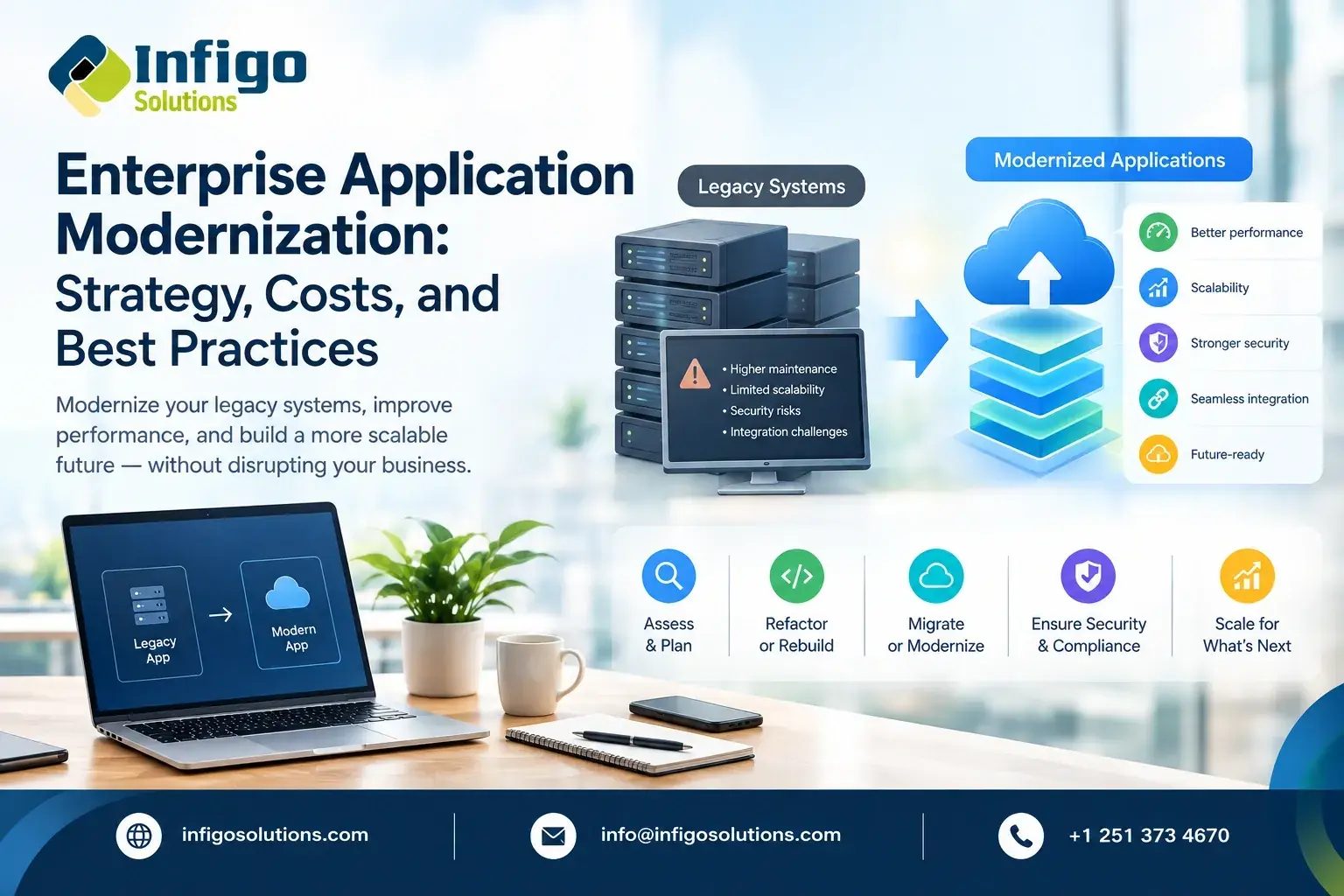
Enterprise Application Modernization: A Step-by-Step Guide
21
Sep
2026
 Infigo Solutions Team
 Enterprise
 0 Comments
Enterprise application modernization is the process of updating legacy business applications so they are easier to change, integrate, secure, and scale. Depending on each application, it can mean rehosting, replatforming, refactoring, rebuilding, retiring, or retaining it, and it is usually delivered in phases to limit downtime and business risk.
Enterprise applications rarely become outdated overnight. The change usually happens gradually. A critical system becomes harder to update, integrations take longer to build, infrastructure costs increase, and engineering teams spend more time maintaining old code than delivering new capabilities.
That is where enterprise application modernization becomes important.
Modernization does not mean replacing every legacy application or moving everything to the cloud. It means assessing existing applications, understanding their technical and business constraints, and choosing the right modernization strategy for each workload.
For enterprises dealing with aging systems, technical debt, complex integrations, or changing business requirements, a structured modernization strategy can reduce risk while creating a more scalable foundation for future growth.
What Is Enterprise Application Modernization?
Enterprise application modernization is the process of updating legacy applications, architecture, infrastructure, data, and development practices so they can better support current and future business requirements.
The scope varies significantly between organizations.
One enterprise may only need to migrate an application from aging infrastructure to a modern cloud environment. Another may need to refactor a monolithic application, modernize its database, introduce APIs, strengthen security, automate deployments, or rebuild critical components.
Common application modernization initiatives include:
- Migrating applications and workloads to cloud infrastructure
- Refactoring legacy application code
- Breaking tightly coupled applications into modular components
- Modernizing databases and data pipelines
- Creating APIs for application integration
- Containerizing suitable workloads
- Introducing DevOps and automated deployment pipelines
- Improving identity, security, monitoring, and compliance controls
- Adding analytics, automation, or AI capabilities
The objective is not simply to adopt newer technology. A modernization initiative should solve specific business or technical problems.
Organizations dealing with aging applications can evaluate a Legacy System Modernization strategy before deciding whether individual systems should be migrated, refactored, rebuilt, retained, or retired.
When Does an Enterprise Application Need Modernization?
Age alone is not a sufficient reason to replace software.
A mature application that remains secure, maintainable, cost-effective, and aligned with business requirements may continue delivering value.
Modernization becomes more relevant when existing technology starts restricting the organization.
Maintenance Is Consuming Too Many Resources
Legacy applications often accumulate technical debt as requirements change.
Small modifications can become increasingly difficult because components are tightly coupled, documentation is incomplete, or underlying technologies are no longer well supported.
When engineering teams spend more time maintaining old functionality than improving the product, technical debt becomes a business problem rather than only an engineering concern.
Integrations Are Becoming Difficult
Modern enterprises rely on connected ERP, CRM, analytics, payment, identity, communication, cloud, and third-party systems.
Older applications may not provide the APIs required for this environment. Teams can end up depending on manual processes, database-level integrations, custom scripts, or fragile middleware.
Modern API-driven architecture can make these integrations easier to maintain and extend.
Scaling Is Difficult or Expensive
Applications designed around predictable workloads may struggle as transaction volume, users, locations, or data increase.
Cloud infrastructure, containerization, caching, asynchronous processing, and other modern architecture patterns can provide more flexible scaling options when they are appropriate for the workload.
Security and Compliance Requirements Have Changed
Unsupported frameworks and outdated dependencies can create security and governance concerns.
Modernization provides an opportunity to reconsider authentication, authorization, encryption, monitoring, auditability, data handling, and compliance controls instead of continually adding patches around an aging architecture.
Technology Is Blocking Business Change
This is often the strongest modernization signal.
If launching a new service, integrating an acquisition, automating a workflow, or connecting a new platform takes months because of existing systems, the cost of maintaining the status quo extends beyond the IT budget.
Why Modernize Legacy Systems Now?
Legacy systems rarely fail all at once. They become slower to change, harder to secure, and more expensive to run, while the people who understand them leave. Waiting usually makes legacy application modernization more expensive, not less, because every new integration adds to the dependencies that will need to be untangled later.
Planning matters as much as timing. A 2022 Wakefield Research survey of 250 technology leaders, commissioned by vFunction, reported that 79% of application modernization projects fail. Broader IT research points the same way: a McKinsey and University of Oxford study of more than 5,400 IT projects found that large IT projects run 45 percent over budget on average.
The organizations that modernize legacy systems successfully tend to share three habits: they start with a clear inventory, they tie each step to a business outcome, and they release in small phases they can measure. The strategy below follows that pattern.
The 6 Rs of Application Modernization
There is no single modernization method that works for every enterprise application.
Microsoft's official 6 Rs application modernization guidance evaluates modernization approaches against factors including architecture, project dependencies, effort, cost, complexity, scalability, integration, security, and compliance.
| Approach | What It Means | When It May Fit |
|---|---|---|
| Rehost | Move the application with minimal code changes | Infrastructure is the primary limitation |
| Replatform | Move to a newer platform with limited application changes | Better managed infrastructure is required |
| Refactor | Modify existing code or architecture | The application remains valuable but needs greater flexibility |
| Rebuild | Redevelop major application components | Existing architecture fundamentally restricts requirements |
| Retire | Decommission the application | The system no longer provides sufficient business value |
| Retain | Keep the application largely unchanged | Modernization cost or risk currently exceeds expected benefit |
This framework helps prevent an expensive modernization mistake: assuming every legacy application needs to be completely rebuilt.
For a large application portfolio, different systems may require different approaches.
How to Build an Enterprise Application Modernization Strategy, Step by Step
Successful enterprise application modernization should begin with assessment, not development.
An enterprise application modernization strategy usually follows five steps: inventory every application and its dependencies, connect each one to a business goal, prioritize by value and risk, choose a modernization path for each application, and deliver the work in measured phases.
1. Inventory the Application Portfolio
Document applications, infrastructure, databases, integrations, dependencies, users, business owners, operating costs, security requirements, and support constraints.
This creates a realistic view of the current digital estate.
2. Connect Modernization to Business Goals
Every modernization initiative should have a reason beyond "our technology is old."
Goals may include:
- Reducing infrastructure or maintenance costs
- Improving deployment frequency
- Increasing reliability
- Supporting business growth
- Improving integration capabilities
- Reducing manual processes
- Strengthening security or compliance
- Preparing systems for automation and AI
Organizations planning broader transformation can connect application modernization with Enterprise Software Solutions rather than treating every application as an isolated technology project.
3. Prioritize Applications by Value and Risk
Not every application should be modernized simultaneously.
Evaluate each system according to business value, technical risk, dependencies, operating cost, modernization complexity, and strategic importance.
A mission-critical system with significant technical debt may deserve priority, but its dependencies can also make it unsuitable as the first migration candidate.
4. Select the Appropriate Modernization Path
Once priorities are established, determine whether each application should be rehosted, replatformed, refactored, rebuilt, retired, or retained.
The decision should be made application by application.
5. Modernize in Phases
Large transformation programs carry operational risk.
A phased strategy allows enterprises to modernize manageable components, validate architecture decisions, measure results, and refine the roadmap before changing more critical systems.
Modern Application Architecture for the Enterprise
Architecture decisions determine whether modernization removes technical debt or simply moves it somewhere else.
A modern enterprise application architecture may use APIs, containers, managed cloud services, event-driven components, serverless computing, microservices, automated deployment, and centralized observability.
But adopting every modern architecture pattern is not automatically a good strategy.
For example, converting a manageable monolithic application into dozens of microservices can introduce unnecessary operational complexity.
Architecture should therefore follow the application's actual requirements.
| Architecture Area | Question to Ask |
|---|---|
| Scalability | Can the application support expected growth efficiently? |
| Integration | Can internal and external systems connect through maintainable interfaces? |
| Security | Are identity, access, data, and monitoring controls appropriate? |
| Reliability | Can critical components recover from failures? |
| Maintainability | Can teams update components without unnecessary risk? |
| Observability | Can teams monitor application health and diagnose failures? |
| Cost | Does the architecture justify its infrastructure and operational complexity? |
Infrastructure, cloud migration, and deployment automation are planned as part of the same modernization program, so they move in step with the application changes.
How Much Does Enterprise Application Modernization Cost?
There is no credible universal price for enterprise application modernization.
Replatforming a contained internal application is fundamentally different from rebuilding a mission-critical enterprise platform with complex integrations, sensitive data, regulatory requirements, and strict availability targets.
The main cost drivers include:
| Cost Factor | Why It Affects the Budget |
|---|---|
| Application size | Larger codebases require more assessment, development, and testing |
| Architecture | Tightly coupled legacy systems can require substantial refactoring |
| Integrations | ERP, CRM, identity, payment, and third-party systems increase complexity |
| Data migration | Large or sensitive datasets require additional planning and validation |
| Compliance | Regulated environments may require additional controls and documentation |
| Modernization path | Rehosting generally requires less application change than rebuilding |
| Testing | Critical applications require deeper functional, integration, performance, and security testing |
| Downtime tolerance | Low-downtime migrations may require parallel environments and additional engineering |
| Cloud architecture | Infrastructure, networking, monitoring, storage, and managed services affect ongoing cost |
Enterprises should evaluate both implementation cost and total cost of ownership.
The least expensive migration option today is not necessarily the most economical option over the next several years.
How to Modernize Enterprise Applications Without Major Downtime
Downtime is one of the biggest concerns when changing business-critical applications.
For many systems, a phased migration is safer than a single large cutover.
Depending on the architecture, modernization teams may use:
- Parallel environments
- Incremental data migration
- API abstraction layers
- Feature flags
- Automated regression testing
- Staged traffic migration
- Continuous monitoring
- Defined rollback procedures
The correct combination depends on application architecture and business continuity requirements.
For critical systems, rollback planning should be treated as part of the modernization architecture rather than an emergency procedure created immediately before deployment.
After launch, ongoing support and improvements can be handled by a dedicated development team that already knows your systems.
How to Calculate ROI From Application Modernization
Modernization ROI should not be measured only through infrastructure savings.
A stronger business case considers multiple dimensions.
| ROI Area | What to Measure |
|---|---|
| Operational cost | Infrastructure, licensing, support, and maintenance expenditure |
| Development efficiency | Release frequency, development effort, and time spent maintaining legacy code |
| Reliability | Incidents, downtime, recovery time, and application availability |
| Scalability | Ability to support increased users, transactions, or data |
| Business agility | Time required to launch features, integrations, products, or workflows |
| Risk reduction | Improvements in security, compliance, governance, and supportability |
Baseline metrics should be established before modernization begins.
Without a baseline, an enterprise may complete a technically successful migration but struggle to demonstrate whether the investment actually improved the business.
Where AI Fits Into Application Modernization
Application modernization can also create the technical foundation required for enterprise AI.
Trying to add AI to fragmented legacy applications, inaccessible data, and tightly coupled systems can create additional integration and governance problems.
Modern APIs, better data pipelines, stronger access controls, scalable infrastructure, and improved observability can make future AI initiatives easier to operationalize.
However, AI should not be added simply because modernization is taking place.
The organization should first identify a valuable use case, determine whether appropriate data is available, establish security and governance requirements, and define measurable outcomes.
Enterprises that have modernized their core systems can then evaluate Enterprise AI Solutions for appropriate automation, analytics, AI integration, and intelligent workflow use cases.
Choosing an Application Modernization Partner
Technology expertise matters, but enterprise modernization requires more than developers who understand a modern framework.
A capable modernization partner should begin by understanding the existing environment.
That includes architecture, dependencies, business processes, data, integrations, compliance requirements, deployment practices, technical debt, and operational constraints.
Before choosing a partner, ask:
- How will the current application environment be assessed?
- Why is the proposed modernization strategy appropriate?
- How will data and integrations be migrated?
- How will testing, deployment, and rollback work?
- How will security and compliance requirements be addressed?
- How will modernization success be measured?
- What support will be required after deployment?
A good partner should also be willing to recommend retaining an application when modernization would not create enough value to justify the investment.
The goal is not to replace technology simply because it is old. The goal is to remove technical constraints that prevent technology from supporting the business effectively.
Real Example: Modernizing Legacy Retail Systems
A retailer with dozens of locations relied on aging point-of-sale systems and spreadsheet-based inventory. Stores could not share data reliably with head office, which caused inconsistent stock counts and heavy manual reconciliation work.
Infigo Solutions replaced the fragmented workflows with a unified cloud-based platform that synchronizes inventory in real time and gives leadership central dashboards for sales, stock, and margins. The phased rollout reduced manual inventory reconciliation work by 35% and created a single source of truth across locations. Read the full legacy retail systems modernization case study.
Frequently Asked Questions
What is enterprise application modernization?
Enterprise application modernization is the process of updating legacy applications, architecture, infrastructure, data, and development practices to improve maintainability, scalability, security, integration, reliability, and business agility.
What is the difference between application modernization and cloud migration?
Cloud migration primarily focuses on moving applications, data, or infrastructure to a cloud environment. Application modernization can go further by changing application code, architecture, databases, integrations, deployment practices, and operating models. Cloud migration can therefore be one component of a broader modernization strategy.
Should every legacy application be rebuilt?
No. Depending on business value, architecture, complexity, dependencies, cost, and risk, an application may be rehosted, replatformed, refactored, rebuilt, retired, or retained.
How long does enterprise application modernization take?
There is no standard timeline. Duration depends on application complexity, architecture, integrations, data migration, security and compliance requirements, testing scope, downtime constraints, and the modernization approach selected.
How can enterprises modernize applications without downtime?
Possible techniques include parallel environments, incremental data migration, API abstraction, automated testing, feature flags, staged traffic migration, continuous monitoring, and rollback mechanisms. The appropriate approach depends on the application and its business continuity requirements.
How do you calculate ROI for application modernization?
Compare modernization investment with measurable improvements in infrastructure and maintenance costs, engineering productivity, reliability, scalability, business agility, and risk. Establishing baseline metrics before modernization makes post-implementation results easier to measure.
What is the best enterprise application modernization strategy?
There is no single strategy that fits every application. The appropriate approach depends on business value, architecture, dependencies, technical debt, security requirements, modernization cost, and expected business value.
Why do application modernization projects fail?
Most modernization projects fail because of scope, not technology. Common causes are trying to replace everything at once, an incomplete inventory of dependencies, weak data migration planning, and no clear business goal for each phase. A phased plan with measurable milestones reduces most of these risks.
Getting Started With Enterprise Application Modernization
Enterprise application modernization works best when it begins with a clear understanding of the existing environment rather than a predetermined technology choice.
Start by inventorying applications and dependencies, identifying measurable business goals, prioritizing systems according to value and risk, and selecting the appropriate modernization approach for each workload.
A phased roadmap can then move the organization from assessment to implementation while reducing unnecessary disruption.
For organizations evaluating aging applications, Infigo Solutions' Legacy System Modernization services can support the assessment and modernization of existing applications, architecture, integrations, and infrastructure.


.webp "Share on LinkedIn")
Leave a Message

Infigo Solutions Team
Software Development Team
The Infigo Solutions team builds MVPs, AI products, SaaS platforms and custom software for startups and enterprises in the US, Canada and the UAE. Founded in 2020, Infigo Solutions is rated 5.0 on Clutch.
Recent Posts
 November 18, 2026
 November 16, 2026
Private LLM: How to Deploy an On-Premise LLM for Business
 November 12, 2026

Comments
No comments yet. Be the first to comment!