 September 24, 2026
AI Data Readiness: Is Your Data Ready for AI?
24
Sep
 Morgan
 AI
AI 0 Comments
AI projects often start with a model question: Which model should we use?
For many businesses, that is not the first question that matters.
Before choosing a model, building a proof of concept, or developing an AI product, you need to know whether the data behind that system is actually ready to support it.
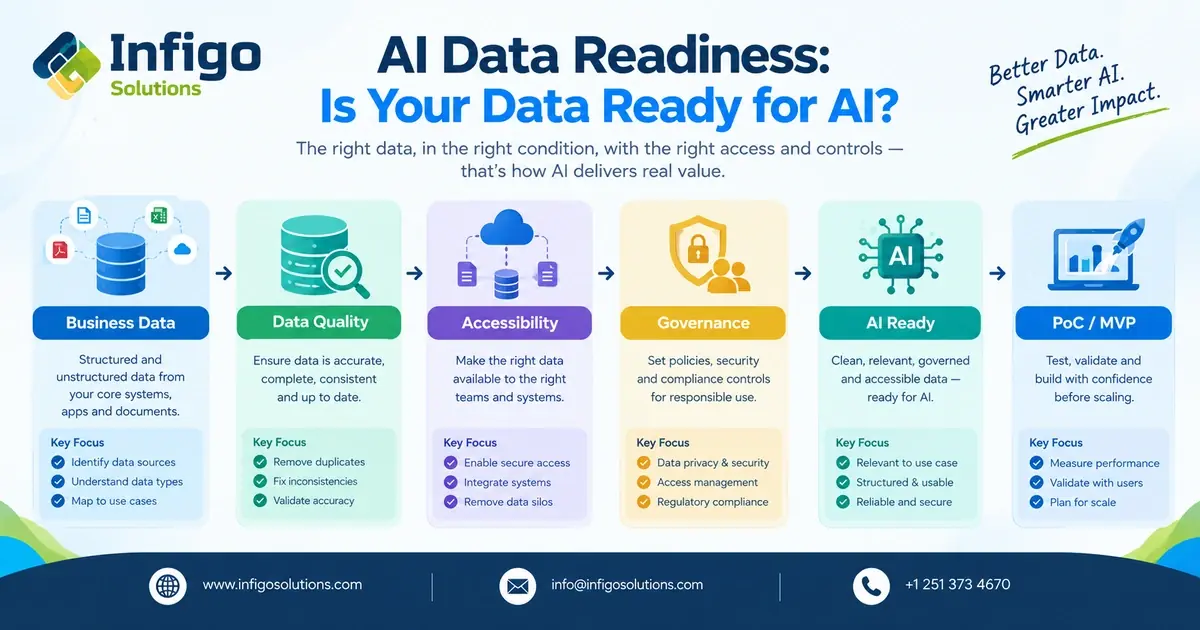
AI data readiness is the process of determining whether your data is available, relevant, accurate, accessible, governed, and usable for a specific AI use case.
A company may have years of customer records, operational data, documents, transactions, or product information and still not have AI-ready data. The issue is not simply how much data exists. What matters is whether the right data can reliably support the outcome the AI system is expected to produce.
This guide provides a practical framework for assessing data readiness before investing heavily in AI development.
What Is AI Data Readiness?
AI data readiness describes how prepared an organization's data is for use in an AI or machine learning system.
Data that is ready for AI should be sufficiently relevant to the use case, accessible to the system, reliable enough for the intended decision or output, and managed with appropriate governance and security controls.
Microsoft's guidance on preparing organizational data for AI emphasizes factors such as data availability, quality, accessibility, organization, security, and governance.
That means AI readiness is not simply:
Do we have data?
A more useful question is:
Do we have the right data, in the right condition, with the right access and controls, for this specific AI use case?
That distinction matters because two AI products inside the same company may have completely different data requirements.
A customer-support assistant may depend on policies, support documentation, product information, and historical tickets. A forecasting system may require structured historical transactions and operational variables. A document intelligence system may depend on PDFs, contracts, forms, or other unstructured content.
The dataset therefore has to be evaluated against the job the AI is expected to perform.
Why Data Readiness Should Come Before AI Development
It is easy to move directly from an AI idea into development.
That can create expensive problems later.
A technically capable model cannot compensate for data that is irrelevant, inaccessible, inconsistent, poorly governed, or unsuitable for the intended use case. Problems that initially look like model-performance issues can sometimes originate much earlier in the data pipeline.
Evaluating data readiness first helps answer several important questions:
- Does the required data actually exist?
- Is there enough relevant data for the proposed use case?
- Can the development team access it?
- Is the data sufficiently accurate and complete?
- Is it structured or organized in a usable way?
- Are there privacy, security, or regulatory constraints?
- Can the data continue to be maintained after the AI system launches?
The goal is not to make every dataset perfect before development starts. It is to identify the gaps that could invalidate the AI concept, distort testing, or create avoidable risk later.
The 6 Dimensions of AI Data Readiness
A useful AI data readiness assessment should examine more than data volume.
1. Relevance
Start with the business problem.
The data must contain information that is meaningfully connected to the outcome you want the AI system to generate.
For example, imagine a company wants to predict customer churn. Having thousands of customer names and email addresses does not necessarily help predict churn. Usage history, subscription changes, support interactions, engagement patterns, and cancellation behavior may be much more relevant.
Ask:
- What exactly should the AI predict, generate, classify, retrieve, or automate?
- Which data points could reasonably influence that outcome?
- Are those signals actually available?
- Does the historical data represent the environment in which the AI will operate?
If the data is not relevant to the problem, increasing its volume will not solve the fundamental issue.
2. Availability and Coverage
Next, determine whether enough usable information exists.
This does not mean every AI project needs millions of records. Data requirements vary significantly by use case, model architecture, task complexity, and whether you are training a model, fine-tuning one, using retrieval-augmented generation, or integrating an existing model through an API.
Evaluate:
- How much relevant historical data exists?
- What time period does it cover?
- Are important scenarios represented?
- Are there significant gaps?
- Is the information distributed across multiple systems?
- Will new data continue to become available after launch?
The key question is whether the available data provides enough evidence to test the assumptions behind the proposed AI capability.
3. Data Quality
Having data is different from having reliable data.
AI systems can inherit problems already present in source data. Missing values, duplicates, outdated records, inconsistent terminology, incorrect labels, corrupted files, and conflicting records can all reduce the usefulness of a dataset.
A practical quality review should examine:
- Completeness
- Accuracy
- Consistency
- Duplication
- Timeliness
- Label quality, where applicable
- Formatting consistency
- Outliers and obvious errors
Not every problem has to be fixed before experimentation. However, you should know which problems exist and whether they could materially affect the AI system's outputs.
For a broader technical perspective, Google's documentation on data quality explains how data quality can be evaluated through defined rules and validation processes.
4. Accessibility and Integration
A business can possess valuable data that its AI system cannot practically use.
Data may be trapped in legacy applications, spreadsheets, departmental databases, SaaS platforms, PDFs, email archives, or systems with limited integration options.
Ask:
- Where is the required data stored?
- Who owns it?
- Can the development team access it?
- Are APIs, exports, connectors, or database access available?
- How frequently does the data change?
- Does the AI system need batch access or real-time access?
- Can multiple sources be connected reliably?
This is especially important for enterprise AI. A prototype built on a manually exported dataset may demonstrate technical feasibility, but a production system needs a repeatable way to retrieve current information.
5. Governance, Privacy, and Security
Data readiness is not only a technical issue.
Before using customer, employee, financial, operational, or other sensitive information in an AI system, organizations should establish clear rules for data access, ownership, security, privacy, and permitted use.
Questions should include:
- Who is authorized to access the data?
- Does the dataset contain personal or sensitive information?
- Are there contractual or regulatory restrictions?
- Where will the data be processed?
- What information may be sent to third-party AI providers?
- How will permissions be enforced?
- Are audit trails required?
- How long should data and AI-generated outputs be retained?
Google Cloud's overview of data governance explains governance in terms of managing data availability, usability, integrity, and security through policies, standards, and controls.
These considerations should be addressed during data preparation rather than treated as a post-launch task.
6. Maintainability
AI data readiness does not end when the first dataset is prepared.
Production AI systems operate in environments that change.
Products change. Customer behavior changes. Policies change. New records appear. Data schemas evolve. Documents are replaced. Business rules change.
Before development, consider:
- Who will maintain the source data?
- How will new data enter the system?
- How will incorrect or outdated information be corrected?
- How will schema changes be handled?
- Can data quality be monitored?
- How will access permissions remain synchronized?
- How frequently should the AI system's data be refreshed?
A dataset that works for a one-time demonstration but cannot be maintained may be enough for an experiment, but it is not necessarily ready for production AI.
AI Data Readiness Checklist
You can use the following questions as an initial AI data readiness assessment.
| Readiness Area | Question | Ready? |
| Use Case | Is the AI problem clearly defined? | Yes / No |
| Relevance | Do we have data directly related to the desired AI outcome? | Yes / No |
| Availability | Is enough relevant data available for meaningful testing? | Yes / No |
| Coverage | Does the data represent important scenarios and edge cases? | Yes / No |
| Quality | Is the data sufficiently accurate, complete, and consistent? | Yes / No |
| Accessibility | Can the development team reliably access the required data? | Yes / No |
| Integration | Can data sources be connected to the planned AI system? | Yes / No |
| Governance | Are ownership and permitted uses of the data understood? | Yes / No |
| Privacy & Security | Are sensitive data and access risks appropriately controlled? | Yes / No |
| Maintenance | Is there a process for keeping the data current after launch? | Yes / No |
A few "No" answers do not automatically mean the AI project should stop.
They tell you where uncertainty exists.
The next decision is whether those gaps can be resolved through data preparation, integration work, governance controls, a narrower use case, or an early technical experiment.
Is Your Data Ready for AI? A Simple Decision Framework
Instead of assigning an arbitrary readiness score, use the assessment to decide what should happen next.
Scenario 1: The Required Data Does Not Exist
Do not begin by building the complete AI product.
First determine whether the missing information can be collected, generated, licensed, derived from another source, or replaced by a different approach.
If the AI concept fundamentally depends on unavailable data, that is a business feasibility issue, not merely a development issue.
Scenario 2: The Data Exists but Quality Is Uncertain
Run a focused data assessment.
Profile the relevant sources, measure missing or inconsistent values, examine representative samples, and determine whether preparation can make the data usable.
Scenario 3: The Data Exists but Technical Feasibility Is Uncertain
A proof of concept may be appropriate.
For example, you may have the required documents but not know whether an AI system can extract a particular field accurately enough. Or you may have historical data but not know whether it contains enough signal for useful predictions.
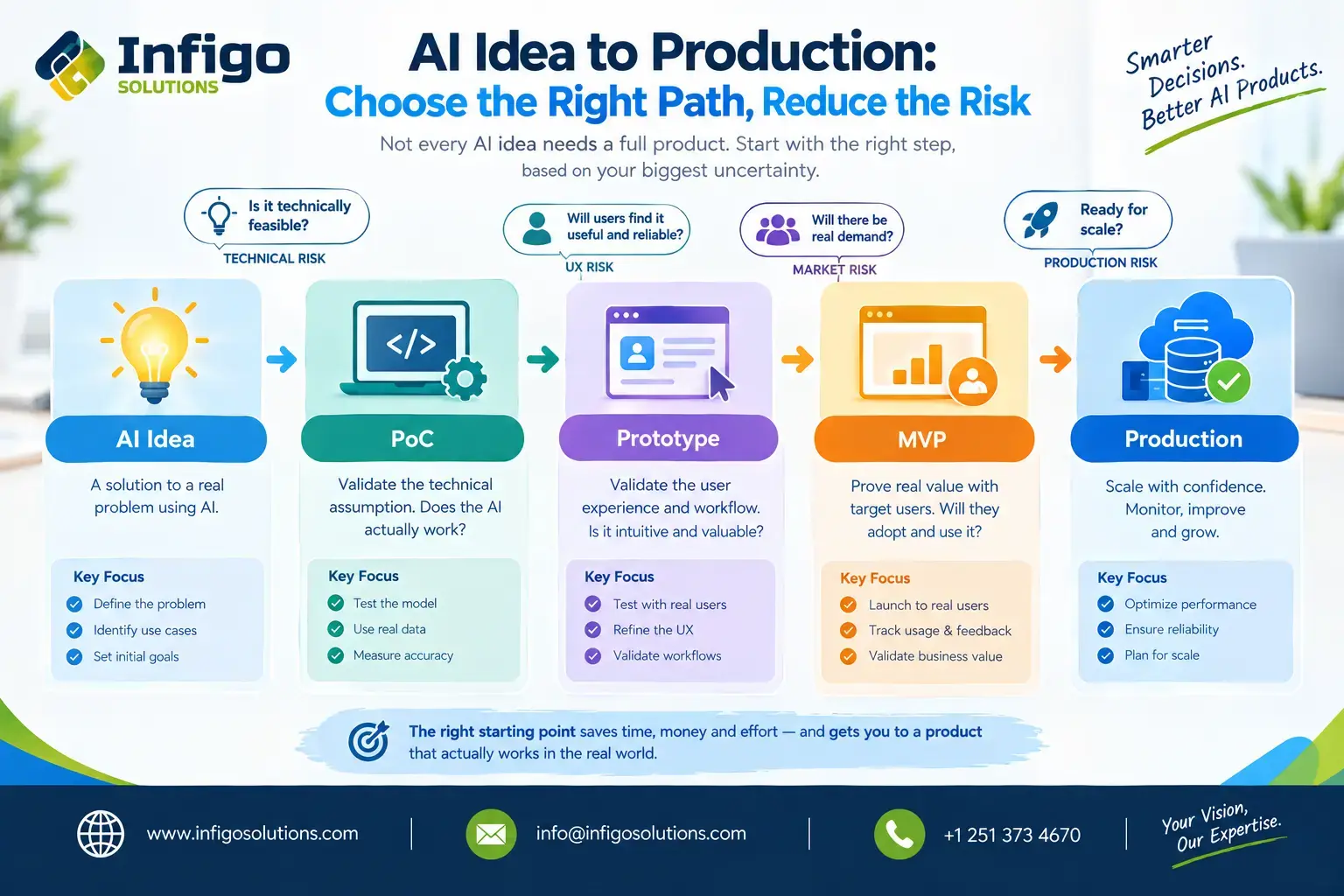
Our AI PoC vs MVP guide explains how to choose between a proof of concept and an MVP based on what you still need to validate.
Scenario 4: The Data Is Usable and Core Technical Assumptions Are Understood
You may be ready to move toward an MVP.
At this point, the focus shifts from proving one technical assumption to delivering a usable product experience around the AI capability.
If you are moving into this stage, our MVP development services cover the process of turning a validated concept into a focused, testable product.
Scenario 5: The AI Product Works but Needs to Scale
Data readiness becomes an operational concern.
You need repeatable pipelines, monitoring, permissions, governance, data quality controls, and processes for handling changing source data.
This is where prototype assumptions need to become production architecture.
Structured and Unstructured Data Need Different Readiness Checks
Not every AI system depends on rows and columns.
Modern AI products increasingly work with unstructured information such as documents, emails, images, transcripts, support conversations, policies, and knowledge bases.
For structured data, readiness may involve:
- Schema consistency
- Missing values
- Duplicate records
- Data types
- Historical coverage
- Labels
- Feature availability
- Update frequency
For unstructured data, readiness may involve:
- Document quality
- File formats
- Metadata
- Duplicate documents
- Version control
- Access permissions
- Content freshness
- Retrieval suitability
This distinction is particularly important for generative AI and retrieval-based systems.
A company may have thousands of documents available for an AI assistant, but if those documents contain contradictory policies, obsolete versions, unclear ownership, or inconsistent access permissions, simply connecting them to an LLM does not make the system production-ready.
Data Readiness for Generative AI and RAG
Retrieval-augmented generation, or RAG, allows an AI application to retrieve relevant information from external data sources and use that context when generating a response.
This can reduce the need to train a model on all proprietary information, but it does not eliminate data-readiness requirements.
For a RAG-based product, evaluate:
- Whether the knowledge source is authoritative
- Whether documents are current
- Whether duplicate or conflicting versions exist
- Whether content can be segmented and retrieved effectively
- Whether metadata can improve retrieval
- Whether permissions need to vary by user
- Whether retrieved information can be traced back to its source
- How updates and deletions will propagate through the system
The goal is not simply to give an AI model access to more information.
It is to give the application access to the right information, under the right conditions, at the right time.
Data Readiness for Predictive AI and Machine Learning
Predictive AI has a different set of concerns.
If the goal is forecasting, scoring, classification, recommendation, anomaly detection, or another predictive task, historical data needs to support the relationship you are trying to learn.
Important questions include:
- Is the target outcome clearly defined?
- Do reliable historical labels exist?
- Is there enough history?
- Could the data contain information that would not actually be available at prediction time?
- Are important populations or scenarios underrepresented?
- Have business processes changed during the historical period?
- Will the same input variables be available in production?
A model can perform well during experimentation and still perform poorly in production if the training data does not adequately represent the environment in which future predictions will be made.
Common AI Data Readiness Mistakes
Collecting More Data Before Defining the Use Case
More data is not automatically better.
Start with the outcome the AI system needs to support, then identify the information required to test it.
Assuming Clean Data Means AI-Ready Data
A perfectly formatted dataset can still be irrelevant to the business problem.
Relevance comes before cleanliness.
Using a One-Time Export as Production Architecture
A CSV export may be sufficient for a PoC.
A production AI system usually needs reliable integrations and repeatable data pipelines.
Ignoring Permissions During Prototyping
A prototype may be built by a small trusted team, while the final system may serve hundreds or thousands of users with different access rights.
Permissions should therefore be considered before the architecture becomes difficult to change.
Treating Governance as a Post-Launch Task
Governance, privacy, security, and accountability can affect which data can be used and how the AI system should be designed.
They should be considered during planning, not added only after development.
Trying to Fix Every Data Problem Before Testing Anything
The opposite mistake is waiting for perfect data.
The objective is to make the data sufficiently ready for the next validation step.
A tightly scoped PoC can sometimes reveal which data-quality improvements actually matter before the business invests in a large cleanup program.
From AI-Ready Data to an AI Product
Once the critical data gaps are understood, the next step depends on what uncertainty remains.
If you still do not know whether the core AI capability can work with your data, test that assumption through a focused PoC.
If technical feasibility is sufficiently understood but the product still needs to prove user value and workflow fit, move toward an MVP.
If both the AI capability and product value have been validated, focus on production architecture, monitoring, security, governance, and scale.
For businesses moving from data assessment into implementation, AI product development connects the AI capability with product engineering, integrations, user experience, and the systems required to turn an AI concept into usable software.
The important point is that AI data readiness is not a separate documentation exercise.
It is an early decision tool that helps determine what should be built, what should be tested, and what needs to be fixed first.
Frequently Asked Questions
What is AI data readiness?
AI data readiness is the degree to which data is suitable for a specific AI use case. It includes factors such as relevance, availability, quality, accessibility, governance, security, and the ability to maintain the data as the AI system evolves.
How do I know if my data is ready for AI?
Start by defining the AI use case. Then evaluate whether the required data exists, is relevant to the desired outcome, can be accessed reliably, has sufficient quality, and can be used under appropriate privacy, security, and governance controls.
Does AI require a large amount of data?
Not always. Data requirements depend on the use case and technical approach. Training a predictive model, fine-tuning an existing model, building a RAG application, and using a third-party model through an API can require very different amounts and types of data.
What happens if our data is not AI-ready?
Identify the specific gap rather than abandoning the AI initiative immediately. Depending on the problem, the next step may involve cleaning data, improving access, connecting systems, adding governance controls, collecting missing information, narrowing the use case, or running a focused PoC.
Can we start an AI PoC before all our data is ready?
Yes, if the available data is sufficient to test the specific technical assumption behind the PoC. A PoC does not require production-perfect data, but the limitations of the test dataset should be understood so experimental results are not mistaken for production readiness.
What is the difference between data readiness and AI readiness?
Data readiness focuses specifically on whether information is suitable for the intended AI use case.
AI readiness is broader. It can also include business strategy, infrastructure, governance, security, people, organizational processes, and the ability to deploy and operate AI systems effectively.
Who should be involved in an AI data readiness assessment?
The exact team depends on the use case, but it may include business stakeholders, data owners, engineering or data teams, security and compliance stakeholders, and the people responsible for the workflow the AI system is intended to support.
Getting Started
You do not need perfect data to begin exploring AI.
You need enough relevant and trustworthy data to test the right assumption at the right stage.
Start with the business outcome. Identify the information the AI system would need. Assess its relevance, quality, accessibility, governance, and maintainability.
Then use the remaining uncertainty to decide whether the next investment should be data preparation, a PoC, an MVP, or production development.
That sequence keeps AI development grounded in evidence rather than assumptions.


.webp "LinkedIn")
Leave a Message

Morgan
Senior Consultant
Helps startups and businesses validate product ideas, plan MVPs, evaluate AI opportunities, and build scalable software strategies around real business goals.

Comments
No comments yet. Be the first to comment!