
 September 14, 2026
How RAG Is Transforming AI Support Systems
12
Jun
 Admin
Admin Technology
 0 Comments
How RAG Is Transforming AI Support Systems
How RAG Is Transforming AI Support Systems
Let's be honest. Nobody enjoys being stuck in a support loop. You ask a chatbot a simple question, and it either gives you a completely wrong answer or sends you to an article that has nothing to do with what you asked. You follow up, it repeats itself. You give up and call a human. Sound familiar?
This is the reality most businesses are still dealing with when it comes to AI-powered support. And it's not because AI isn't capable. It's because most AI systems are working with outdated, disconnected information. That's the problem RAG was built to fix.
Retrieval-Augmented Generation, RAG for short, is the reason some support experiences feel genuinely helpful while others feel like talking to a wall. It's not a buzzword. It's a practical shift in how AI finds and uses information, and it's quietly changing the way businesses support their customers.
So, What Exactly Is RAG?
Think of a new employee on their first week. They're smart, eager, and well-educated, but they don't know your company's specific processes yet. Now imagine that same person has instant access to every internal document, every policy update, every FAQ your team has ever written. Suddenly, they can answer questions accurately and confidently from day one.
That's essentially what RAG does for AI.
Traditional AI models are trained on large datasets, but once training is done, their knowledge is frozen in time. They can chat fluently and sound convincing, but they don't actually know what your return policy says or what changed in your product last Tuesday. When they don't know something, they sometimes fill in the gap with a plausible-sounding but completely made-up answer, a problem the industry calls "hallucination."
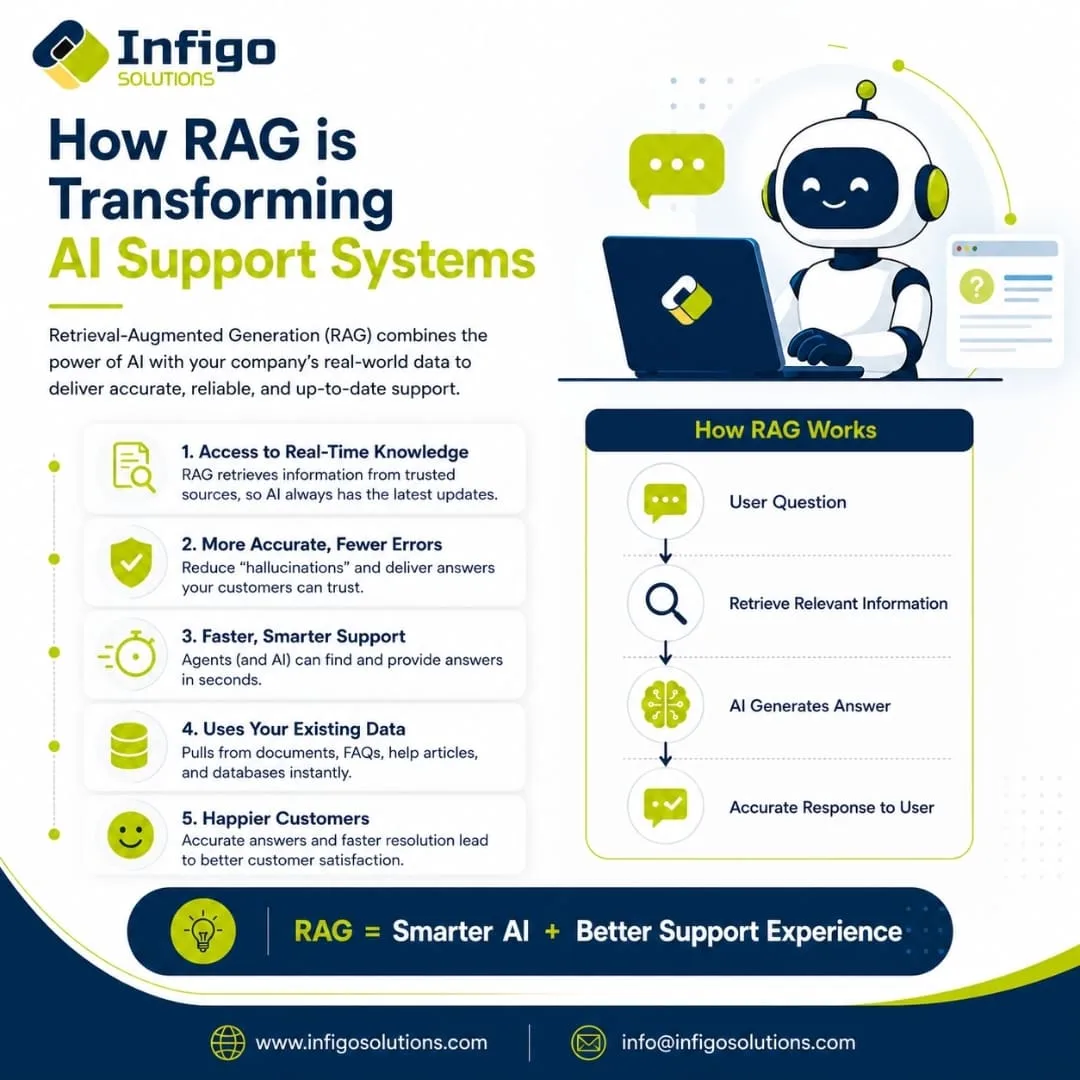
RAG fixes this by giving the AI a live connection to your actual data. When a customer asks a question, the system first searches your documents, help articles, FAQs, or databases to find relevant information. Then it hands that retrieved content to the AI, which uses it to craft a clear, grounded response.
It's the difference between an AI that guesses and one that actually looks it up.
How It Works in Practice
You don't need to be an engineer to understand the flow here. Here's what happens behind the scenes every time a RAG-powered system handles a support query:
The customer asks a question. It could be anything. A billing concern, a technical issue, a question about shipping timelines. They type it in and hit send.
The system goes looking for answers. Instead of generating a response from memory, the RAG system searches your connected knowledge sources, your help center, product manuals, internal wikis, policy documents, and pulls the most relevant information it can find.
The AI puts it all together. With the retrieved content in hand, the language model reads through it and writes a response that actually addresses what the customer asked, in plain, natural language.
The customer gets a real answer. Not a generic deflection. Not a link to an article that's three years old. An actual, accurate response based on real information.
The whole thing happens in seconds. And it keeps getting better the more you use it.
Five Things RAG Gets Right That Traditional Chatbots Don't
1. It Stays Current Without You Having to Rebuild Anything
Updating a traditional AI means retraining it, which takes time, money, and technical resources. With RAG, there's no retraining involved. The moment you update a document or add a new help article, the AI has access to it. Your AI is only as outdated as your documentation, which is exactly how it should be.
2. It Stops Making Things Up
Hallucinations aren't just embarrassing. They erode customer trust. When a support system confidently tells someone the wrong thing, that person doesn't just lose faith in the chatbot. They lose faith in your company. RAG keeps responses grounded in retrieved facts, which means the AI is far less likely to go off-script and invent an answer.
3. It Makes Support Genuinely Fast
We're talking seconds, not minutes. And that speed compounds. Faster resolutions mean fewer follow-up messages, shorter queues, and a support team that isn't constantly firefighting. Customers get what they need and move on. That's the goal.
4. It Uses the Data You Already Have
A lot of companies hesitate when they hear "AI integration" because they assume it means starting from scratch. RAG doesn't work that way. It connects to what you've already built, your existing knowledge base, your product documentation, your CRM records. You're not building a new system. You're making your current one dramatically smarter.
5. Happier Customers, Plain and Simple
When people get accurate answers quickly, they're satisfied. When they feel like your support system actually understands their question, they trust you more. RAG doesn't just improve metrics on a dashboard. It changes how customers feel about interacting with your brand. That matters more than most companies realize.
A Real Example Worth Looking At
Picture a growing SaaS company. They've got thousands of customers, a product that ships updates every couple of weeks, and a support team that's constantly overwhelmed. Their old chatbot was doing more harm than good, giving outdated answers, sending customers in circles, and generating a flood of unnecessary escalation tickets.
They implemented a RAG-based system connected to their help center articles, internal runbooks, and product changelog. Within the first quarter:
- Routine support questions were being resolved without any human involvement
- Escalation tickets dropped noticeably
- Response times went from several minutes to a few seconds
- Customer satisfaction scores improved across the board
Their support team didn't shrink. They just stopped spending half their day answering the same ten questions over and over. They focused on the complex stuff, the stuff that actually needs a human. And the AI handled everything else, correctly, every time.
RAG vs. Traditional Chatbots: A Quick Comparison
| Traditional Chatbot | RAG-Powered AI |
| Where it gets information | Static training data | Live retrieval from your content |
| Risk of wrong answers | High | Significantly lower |
| Keeps up with changes | Only after retraining | Automatically |
| Feels personalized | Rarely | Yes |
| Works with your existing data | Limited | Built for it |
A Few Things to Keep in Mind
RAG is genuinely impressive, but it's not magic. A few things worth knowing before you dive in:
- Garbage in, garbage out. If your knowledge base is a mess, outdated articles, conflicting information, orphaned documents, RAG will reflect that. Cleaning up your content before connecting it to the system will make a noticeable difference in quality.
- The retrieval part needs tuning. Getting the system to pull the right content for any given question takes some configuration. It's not complicated, but it does require attention and occasional refinement.
- Access controls matter. If you're connecting the AI to internal data, make sure the right guardrails are in place. Not every user needs access to every document, and a well-implemented RAG system will respect those boundaries.
Frequently Asked Questions
Is RAG just a fancier chatbot? Not quite. A standard chatbot generates responses from whatever it was trained on, which is often general information with no connection to your specific business. RAG actively searches your company's own content before responding, which is what makes it genuinely accurate rather than just conversational.
Do we need to overhaul our knowledge base first? No, and this is one of the most common misconceptions. RAG is designed to connect to content that already exists. Your help articles, PDFs, internal wikis, database records. It works with all of it. The better organized your content is, the better the results, but you don't need to start from scratch.
What happens when our information changes? Because RAG retrieves information at the moment a question is asked, it always pulls from whatever is currently in your data sources. Update the document, and the AI reflects the update. No retraining. No delay.
Can it work alongside our human support team? Yes, and honestly this is where it shines. RAG handles the high-volume, repeatable questions so your human agents can focus on the cases that actually need judgment, empathy, and creative problem-solving. It can also assist agents in real time by surfacing relevant information during live conversations.
What about industries with strict compliance requirements? RAG can be implemented with compliance in mind. You control which data sources it connects to, and access controls can be layered in to make sure sensitive information stays appropriately restricted. Organizations in finance, healthcare, and legal sectors are already using RAG-based systems with proper governance in place.
Wrapping Up
RAG isn't a futuristic concept. It's something businesses are using right now to make their support operations genuinely better. It's practical, it's measurable, and it works with the infrastructure most companies already have in place.
The days of crossing your fingers and hoping your chatbot gives the right answer are over. With RAG, AI support goes from being a source of frustration to being something customers actually appreciate, because it works the way it's supposed to.
If you're thinking about what better support could look like for your business, RAG is a very good place to start.
Interested in building a smarter support experience? The team at Infigo Solutions works with businesses to design and implement AI systems that actually deliver. Get in touch. We'd love to help.
We Are Awesome.
A business consulting agency is involved in the planning, implementation, and education of businesses. We work directly.


.webp "LinkedIn")
Leave a Message
Recent Posts
 September 11, 2026
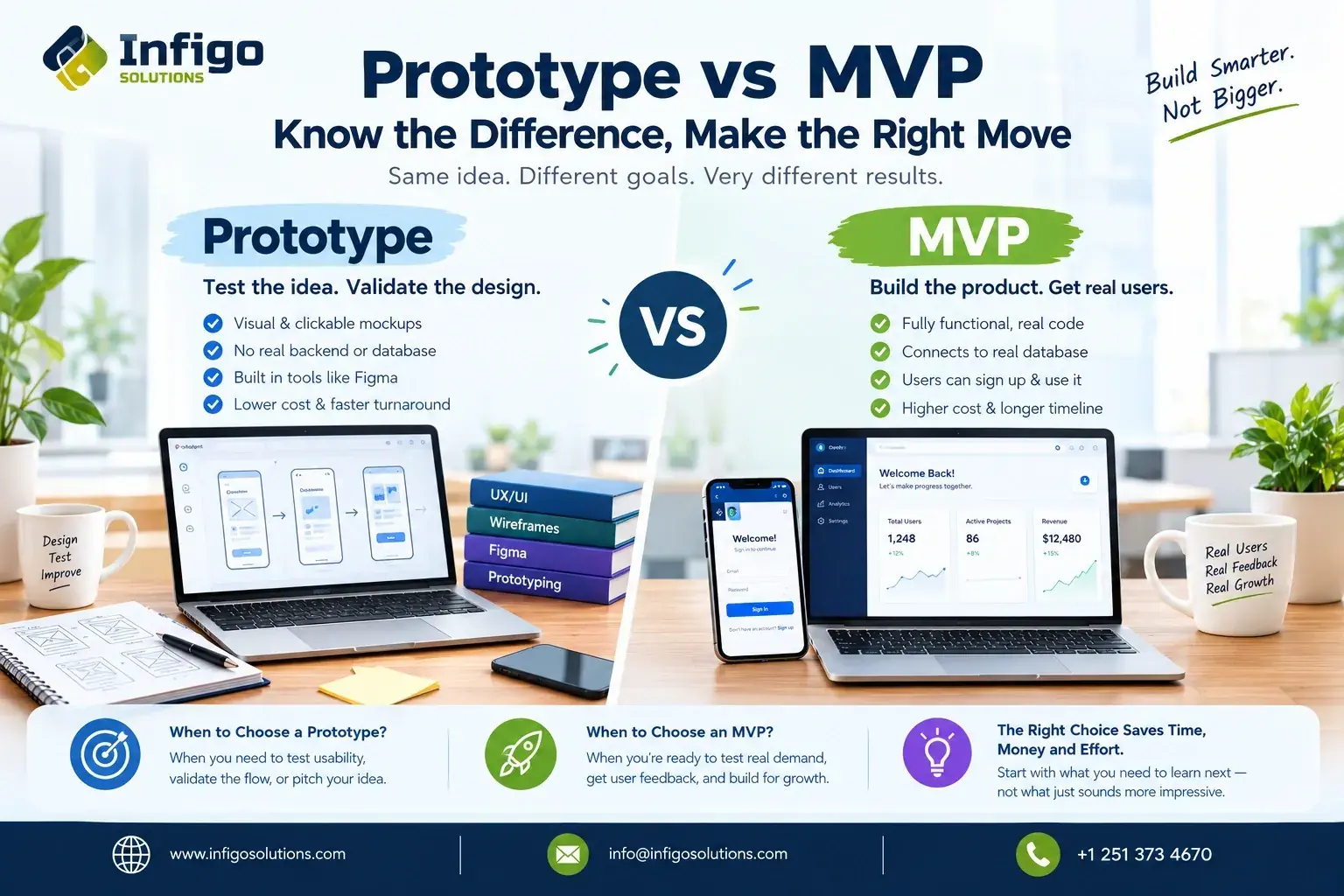
Prototype vs MVP: What's the Difference and Which Do You Need First?
 September 9, 2026
Comments
No comments yet. Be the first to comment!