 November 18, 2026
Enterprise RAG: How to Build Secure, Accurate AI Search

10
Nov
2026
 Infigo Solutions Team
 AI
 0 Comments
Enterprise RAG (retrieval-augmented generation) is an AI setup that lets a large language model answer questions from a company's own documents, databases and tools while respecting who is allowed to see what. Instead of guessing from its training data, the model first retrieves approved, current sources, then writes an answer that cites them.
That last part, permissions and citations, is what separates enterprise RAG from a weekend chatbot demo. A prototype can answer questions about ten PDFs. An enterprise RAG system has to answer the right person, from the right version of the right document, and leave a trail that someone can audit later. This guide covers how enterprise RAG works, the architecture that holds up in production, when to build or buy, what drives cost, how to measure quality and a rollout plan you can follow.
What Is Enterprise RAG?
Retrieval-augmented generation was introduced by Lewis et al. in 2020 as a way to pair a language model with an external index that it searches at answer time. Enterprise RAG applies the same idea to private company knowledge: policies, contracts, support tickets, product documentation, CRM records and internal wikis.
Three things make a RAG system "enterprise" rather than experimental:
- Access control on every document. A user only gets answers built from content they could open themselves.
- Traceable answers. Every answer shows its sources, so people can check it and trust it.
- Operations you can audit. Data refresh, monitoring, evaluation and logging run as a service, not as a one-off script.

If you want the simpler version first, our explainer on how RAG is transforming AI support systems covers RAG in a customer support setting.
How Does Enterprise RAG Work?
Every enterprise RAG system follows the same basic flow, from raw content to a cited answer:
- Ingest. Connectors pull content from tools such as SharePoint, Google Drive, Confluence, ticketing systems and databases, together with each item's permissions.
- Chunk and enrich. Documents are split into passages and tagged with metadata such as source, owner, date and access group.
- Embed and index. Each passage is turned into a vector and stored in a vector database next to a keyword index.
- Retrieve. A question runs as a hybrid search (keyword plus vector), filtered by the user's permissions, and the best passages are re-ranked.
- Generate. The language model receives only the approved top passages and writes an answer with citations.
- Log and evaluate. The question, the sources and the answer are logged so quality and security can be reviewed.
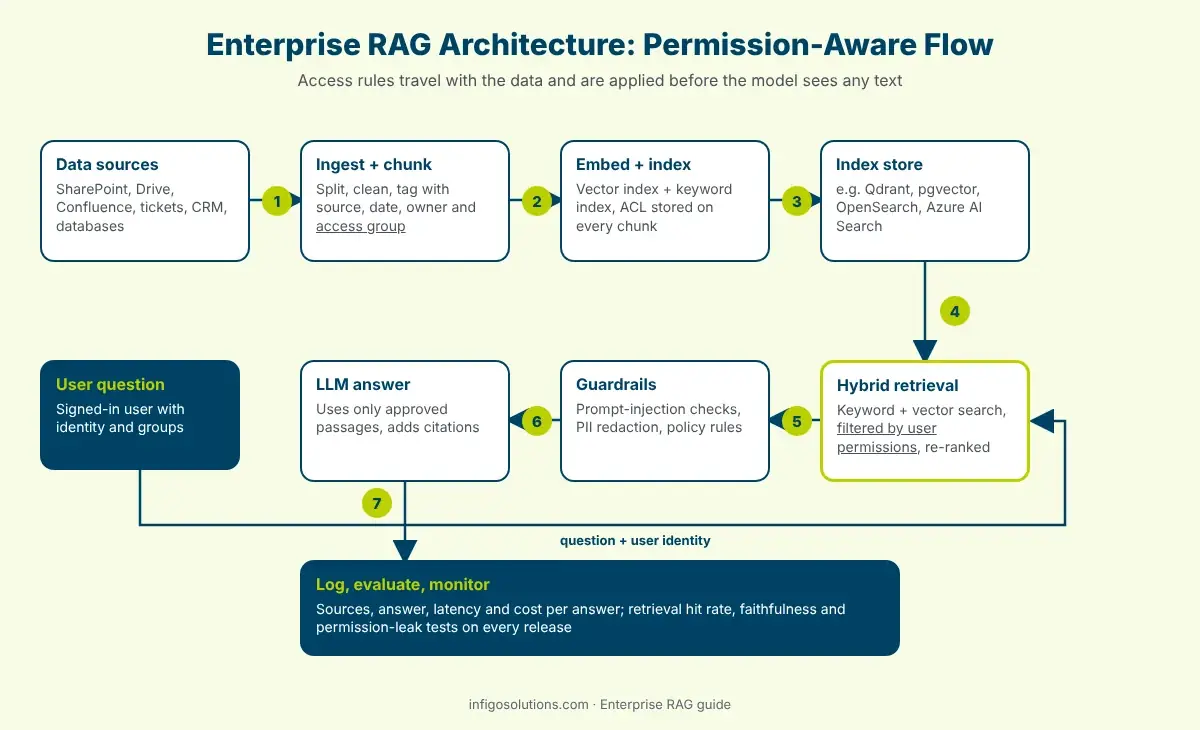
The order matters. Permission filtering happens during retrieval, before the model sees anything. If you filter after the answer is written, sensitive text has already reached the model and may already be in the answer.
What Does an Enterprise RAG Architecture Look Like?
A production enterprise RAG architecture is a set of layers, each with a clear job. The table below shows what each layer does and what an enterprise needs from it.
| Layer | What it does | Common choices | Enterprise requirement |
|---|---|---|---|
| Data connectors | Pull content and permissions from source systems | SharePoint, Google Drive, Confluence, Zendesk, SQL databases | Sync access lists, not just files |
| Processing | Clean, split and tag content | Chunking rules, OCR for scans, metadata tagging | Keep source, version and owner on every chunk |
| Embedding model | Turn text into vectors | Hosted or open-source embedding models | Multilingual support if your teams work in several languages |
| Index | Store vectors and keywords for search | Qdrant, pgvector, Elasticsearch, OpenSearch, Azure AI Search | Tenant or group filters, encryption, backups |
| Retrieval and re-ranking | Find and order the best passages | Hybrid search plus a re-ranker | Permission filter applied at query time |
| LLM gateway | Generate the answer | Hosted APIs or self-hosted open models | Fallback models, rate limits, data retention terms |
| Guardrails | Block unsafe prompts and outputs | Input checks, output checks, PII redaction | Rules agreed with security and legal |
| Observability | Log, measure and alert | Tracing, evaluation sets, dashboards | Audit trail for every answer |
Hybrid retrieval deserves special attention. Pure vector search is good at meaning but weak at exact terms such as product codes, contract numbers and acronyms. Microsoft's Azure AI Search guidance for RAG recommends hybrid queries that combine keyword and vector search for maximum recall, and it is often the first change worth making when users say the system "cannot find" a document they know exists.
Why Do Permissions Matter So Much in Enterprise RAG?
RAG security starts with access control: a system can only be as safe as its permissions. The OWASP Top 10 for LLM Applications (2025) lists vector and embedding weaknesses as a top risk, including data leakage through misaligned access controls, information leaking between users or tenants in a shared vector database, and embedding inversion attacks that recover source text.
In practice, five rules prevent most problems:
- Carry each document's access list into the index as metadata.
- Filter by the user's identity at query time, before the model sees any text.
- Use separate indexes or strict tenant filters when you serve several clients.
- Redact or exclude sensitive fields, such as salaries or health data, before embedding.
- Log every retrieval so security teams can review who saw which source.

Enterprise RAG vs Fine-Tuning: Which Do You Need?
Teams often ask whether they should fine-tune a model on company data instead of building a retrieval system. For most knowledge use cases, retrieval wins, because company knowledge changes every day and fine-tuning cannot enforce permissions. The two can also work together.
| Factor | Enterprise RAG | Fine-tuning |
|---|---|---|
| Best for | Answering from changing documents and records | Teaching a style, format or narrow task |
| Fresh data | Updated as soon as the index refreshes | Needs retraining to learn new facts |
| Access control | Enforced per user at query time | Not possible once data is inside the model |
| Citations | Shows the exact source passages | Cannot point to sources |
| Upfront effort | Connectors, indexing and evaluation | Clean training data and training runs |
| Typical failure | Retrieves the wrong or outdated passage | States outdated facts with confidence |
For a wider view of how prompting, RAG and fine-tuning fit into a full project, see our generative AI implementation plan.
Should You Build or Buy an Enterprise RAG Platform?
You do not always need custom code. The right choice depends on where your knowledge lives and how the answers will be used.
- Buy when your content sits mostly in standard workplace tools, the main need is internal search and question answering, and the product already supports your permission model.
- Build when enterprise RAG must sit inside your own product, use data from custom systems, follow strict data residency rules, or trigger actions in your workflows.
- Combine when a platform covers the basics but you need custom connectors, a different model, or your own evaluation and logging.
Our guide to custom AI development: build vs buy walks through this decision in more detail.
What Drives the Cost of Enterprise RAG?
There is no single price for enterprise RAG, because cost follows scope. These are the factors that move a budget most:
- Number and type of sources. Each connector, and any scanned files that need OCR, adds build and maintenance work.
- Data volume and refresh rate. Large or fast-changing content means more indexing and storage.
- Permission model. Mirroring group-based or document-level access is often the hardest engineering task.
- Model choice and query volume. Token prices and traffic decide monthly running costs.
- Evaluation and monitoring. Test sets, dashboards and review time are ongoing, not one-off.
- Hosting and data residency. Private or regional hosting usually costs more than shared cloud services.
For typical budget ranges by project type, see our AI app development cost guide.
How Do You Measure Enterprise RAG Quality?
You cannot improve what you do not measure. Build a test set from real questions your teams ask, with the correct answer and source for each, and track these RAG evaluation metrics on every release:
- Retrieval hit rate. How often the right passage appears in the top results.
- Context precision. How much of the retrieved text is actually relevant.
- Faithfulness. Whether every claim in the answer is supported by the sources.
- Citation accuracy. Whether the cited source really contains the answer.
- Permission leakage. Test users with limited access should never receive restricted content. The target is zero.
- Latency and cost per answer. Users notice slow answers, and finance notices expensive ones.
- User feedback. Simple thumbs up and down with a comment box shows where the system fails.

A 5-Step Enterprise RAG Rollout Plan
- Pick one use case and one owner. For example, policy questions for HR or product questions for support. A narrow start makes quality measurable.
- Audit data and permissions. Find where the content lives, who owns it, how current it is and how access is controlled. Our AI data readiness guide has a checklist for this step.
- Run a pilot. Connect the sources, use hybrid retrieval and citations from day one, and give it to a small group of real users.
- Evaluate and red-team. Run the test set, try prompt injection, and test permission leakage with restricted accounts before you widen access.
- Harden for production. Add monitoring, model fallbacks, data refresh schedules and an owner for each source. Our AI production readiness checklist covers what to check before launch.
What We Learned Building Our Own RAG Product
Our team built Supportive Agents, a RAG-based platform for customer support and lead capture, so these choices come from real build work rather than theory. The stack combines a Qdrant vector database with MySQL keyword retrieval, multilingual MiniLM embeddings (384 dimensions) and the Llama 3.3 70B model served through Groq, with fallback models when a provider is slow or unavailable.
Three design choices carry over to any enterprise RAG project. Keyword retrieval runs next to vector search, because customers type product names and codes exactly. Multilingual embeddings let one index serve users who ask in different languages. And model fallbacks keep answers flowing when a single provider has an outage.
Frequently Asked Questions
What is the difference between RAG and enterprise RAG?
RAG is the technique of retrieving relevant text before a language model writes an answer. Enterprise RAG is the production version for companies: it adds connectors to business systems, document-level access control, citations, data refresh, monitoring and audit logs. A basic RAG demo answers questions, while enterprise RAG answers them safely for the right person.
Is RAG obsolete in 2026?
No. Larger context windows and AI agents have changed how retrieval is used, but they have not removed the need for it. Companies still need answers from current data, filtered by permissions, with sources people can check. Feeding entire document stores into every prompt is slower, costlier and cannot enforce access control, so retrieval remains the practical core.
How long does it take to build an enterprise RAG system?
It depends on the number of data sources and how complex your permissions are. A focused pilot for one use case can usually be built in weeks when data access is ready. A company-wide rollout takes longer, because every new source needs a connector, permission mapping, testing and an owner who keeps the content current.
Can enterprise RAG run on private or on-premise data?
Yes. The index, the embedding model and even the language model can run in your own cloud account or data center, so documents never leave your environment. This is common in regulated industries. The trade-off is more infrastructure to manage, and open models may need more tuning than large hosted models to reach the same answer quality.
What is the best enterprise RAG platform?
There is no single best enterprise RAG platform, because the choice depends on where your data lives and how strict your permissions are. Cloud teams often start with managed services such as Azure AI Search, Amazon Bedrock Knowledge Bases or Google Vertex AI Search. Teams that need full control combine an open-source vector database with their own retrieval and evaluation.
What are the main types of RAG?
The most common types are standard RAG, which runs one search before answering; hybrid RAG, which mixes keyword and vector search; graph RAG, which searches a knowledge graph of linked entities; agentic RAG, where an AI agent plans several searches; and multimodal RAG, which also retrieves images and tables. Most enterprise RAG systems start with hybrid RAG.
What is agentic RAG?
Agentic RAG lets an AI agent decide how to search instead of running one fixed retrieval step. The agent can break a question into parts, query several sources, check results and search again before answering. It handles complex questions better but adds cost and testing work. Our AI agent development team builds these workflows.
How do you stop enterprise RAG from leaking data?
Enforce permissions at retrieval time, not after the answer is written. Store each document's access list with its chunks, filter every search by the user's identity, separate tenants, redact sensitive fields before indexing and log every retrieval. Then test regularly with restricted accounts to prove that private content never appears in their answers.
Ready to Plan Your Project?
Enterprise RAG works best when it starts small, measures quality from day one and treats permissions as a core feature. If you want help scoping a pilot, choosing a stack or hardening an existing prototype, our enterprise AI development services team can help. Tell us about your project and we reply within 24 hours.


.webp "Share on LinkedIn")
Leave a Message

Infigo Solutions Team
Software Development Team
The Infigo Solutions team builds MVPs, AI products, SaaS platforms and custom software for startups and enterprises in the US, Canada and the UAE. Founded in 2020, Infigo Solutions is rated 5.0 on Clutch.
Recent Posts
 November 18, 2026
 November 16, 2026
Private LLM: How to Deploy an On-Premise LLM for Business
 November 12, 2026

Comments
No comments yet. Be the first to comment!