 October 7, 2026
Custom AI Development vs Off-the-Shelf AI: When to Build, Buy, Customize, or Integrate
7
Oct
 Admin
Admin AI
AI 0 Comments
AI adoption is often framed as a simple decision: build or buy.
That question is now too limited.
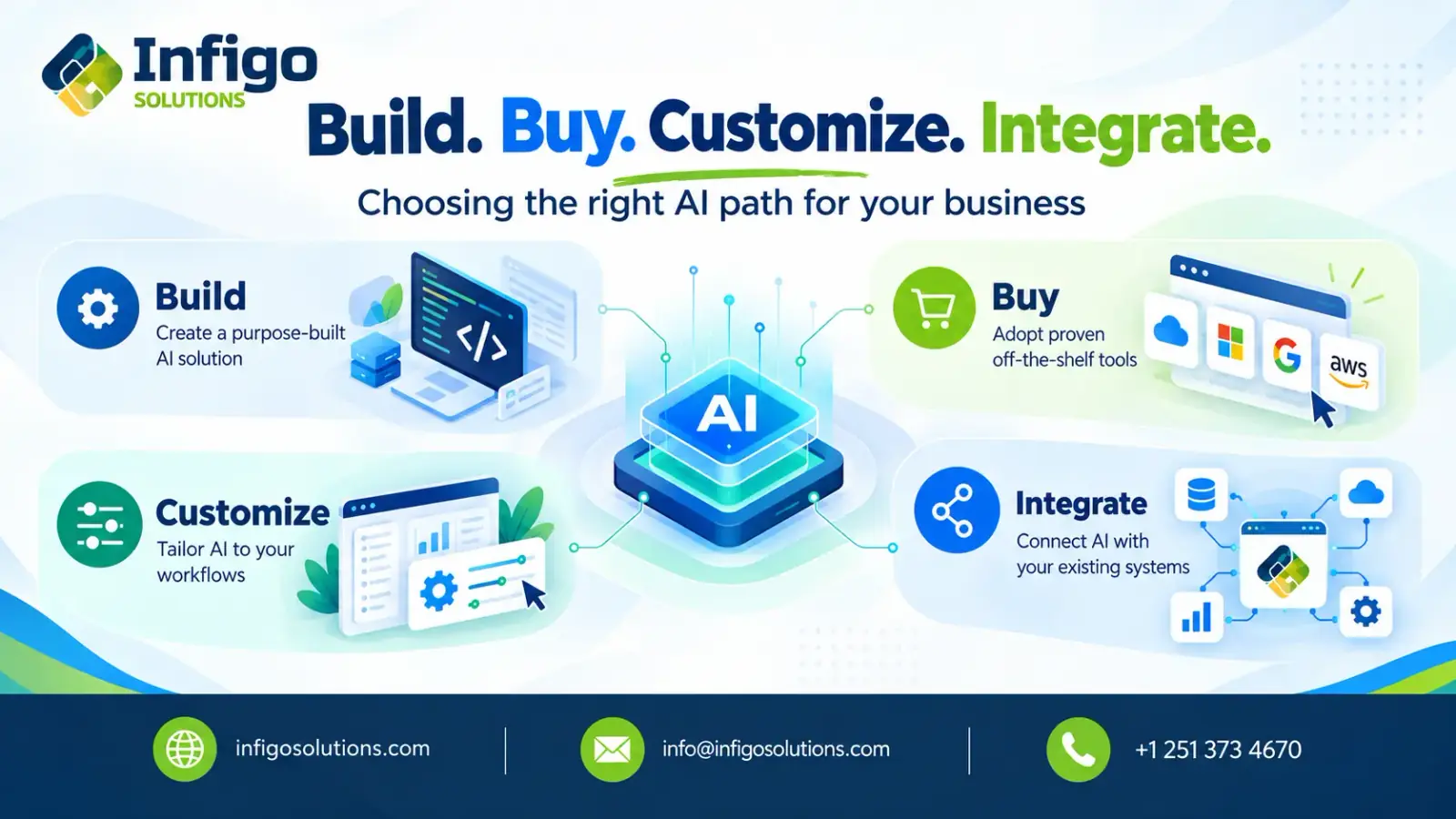
A business can purchase an existing AI product, integrate a third-party model into software it already owns, customize an existing AI system around proprietary data, or invest in full custom AI development.
Those options have very different implications for cost, speed, control, data ownership, intellectual property, scalability, and long-term flexibility.
The right answer is therefore not automatically "build custom AI" or "buy the fastest tool available." The better question is:
How much AI ownership does the business actually need?
A company using AI for meeting summaries has very different requirements from a logistics platform automating operational decisions or a SaaS company embedding AI into its core product.
This guide explains when to buy, integrate, customize, or build AI, and where custom AI development becomes worth the additional investment.
What Is Custom AI Development?
Custom AI development is the process of designing an AI-powered system around a company's specific data, workflows, integrations, users, rules, and business objectives.
That does not necessarily mean training an artificial intelligence model from scratch.
In most business environments, a custom solution combines several existing and proprietary components, such as:
- large language models or machine learning models
- proprietary company data
- retrieval-augmented generation
- business rules
- workflow automation
- internal APIs
- CRM, ERP, or other system integrations
- user permissions
- monitoring and evaluation
- custom interfaces
The underlying model may come from an external provider, but the workflow, application logic, data layer, integrations, controls, and user experience can still be custom.
For example, a logistics company may need an AI system that reads shipment documents, extracts structured information, validates it against its transportation management system, identifies discrepancies, requests human approval when required, and updates downstream systems.
A generic document-processing tool might handle the first step. The complete workflow requires a much broader custom AI solution.
Businesses developing AI as part of a proprietary digital product may therefore need a broader AI product development approach rather than a standalone model implementation.
Custom AI Development vs AI Model Development
The two terms are related but not identical.
AI model development focuses primarily on the model itself. That can include training, fine-tuning, evaluation, feature engineering, optimization, or model selection.
Custom AI development covers the wider production system.
A simplified architecture might look like:
Data → AI Model → Business Logic → Integrations → Application → Monitoring
For most companies, business value comes from how these components work together rather than from owning a model simply for the sake of owning one.
The Four Ways Businesses Can Adopt AI
Businesses should think about AI adoption as a spectrum rather than a binary build-versus-buy decision.
1. Buy an Off-the-Shelf AI Tool
The simplest option is purchasing an existing AI-powered product.
Typical examples include:
- meeting assistants
- writing tools
- transcription platforms
- support automation
- sales intelligence
- document processing
- marketing tools
- general-purpose AI assistants
Buying makes sense when the problem is common and the product already solves most of the requirement.
Implementation is usually faster, infrastructure is handled by the vendor, and the company avoids the engineering cost associated with building its own system.
The trade-off is control.
The vendor controls the product roadmap, pricing, available integrations, customization options, and often parts of the data-processing architecture.
2. Integrate an Existing AI Model
Integration is useful when a business already has working software but wants to add AI capabilities.
For example, an existing CRM might use AI to:
- summarize customer interactions
- classify leads
- generate follow-up suggestions
- search historical conversations
- draft responses
- extract information from uploaded documents
The business does not build the underlying model.
Instead, an existing AI model or API becomes one component inside the company's application.
A simplified flow might be:
Existing Application → Business Logic → AI API → Result → Existing Workflow
This can provide a strong balance between speed and differentiation.
3. Customize an Existing AI System
Customization becomes relevant when existing AI works reasonably well but lacks knowledge of the company's domain, terminology, data, or workflows.
Customization may include:
- retrieval-augmented generation
- fine-tuning
- proprietary knowledge bases
- custom prompts
- domain-specific evaluation
- business rules
- workflow automation
- application-level controls
Retrieval-augmented generation, commonly called RAG, is particularly useful when an AI system needs controlled access to current company information such as policies, manuals, contracts, technical documentation, customer records, or product data.
Fine-tuning can be useful when the business needs more consistent task behavior, terminology, classifications, or output formats.
The important distinction is that businesses do not always need to build a model from zero in order to create a highly customized AI experience.
4. Build a Custom AI System
Full custom development becomes more attractive when AI is closely connected to proprietary processes, data, intellectual property, or competitive advantage.
Common triggers include:
- unique workflows
- complex integrations
- proprietary datasets
- strict control requirements
- specialized automation
- industry-specific behavior
- custom user experiences
- high transaction volumes
- multi-model orchestration
- advanced security requirements
- proprietary decision logic
For companies building autonomous or semi-autonomous workflows, dedicated AI agent development may also become part of the architecture.
Custom AI Development vs Buying, Integrating, and Customizing
The four approaches are easier to compare when viewed side by side.
| Factor | Buy | Integrate | Customize | Build |
| Time to market | Fastest | Fast | Medium | Slowest |
| Initial investment | Low | Low to Medium | Medium | High |
| Customization | Low | Medium | High | Highest |
| Data control | Limited | Medium | High | Highest |
| Workflow control | Limited | Medium | High | Highest |
| Proprietary IP | Low | Medium | High | Highest |
| Maintenance responsibility | Vendor | Shared | Shared | Primarily internal |
| Vendor dependency | High | Medium to High | Medium | Lower |
| Integration flexibility | Limited | High | High | Highest |
| Best fit | Standard requirement | Existing software | Domain-specific requirement | Strategic AI capability |
The most expensive option is not automatically the best option.
The objective should be to choose the lowest level of technical complexity that can reliably meet the business requirement.
When Off-the-Shelf AI Is the Better Choice
Custom development is unnecessary when an existing tool already solves the problem effectively.
Buying usually makes sense when:
- the workflow is standardized
- the problem is common across industries
- the team needs rapid deployment
- the budget is limited
- AI is not a strategic differentiator
- requirements are unlikely to become highly specialized
Consider meeting transcription.
If the requirement is simply to record a meeting, create a transcript, and produce a summary, building proprietary transcription infrastructure would usually add cost without creating meaningful competitive advantage.
In that situation, buying is likely to be the better business decision.
When AI Integration Is Better Than Building From Scratch
Integration is often the overlooked middle ground.
Many companies do not need a new AI platform. They need AI capabilities inside software they already use or own.
An integration-first approach works well when:
- the existing product is already valuable
- AI is an additional capability rather than the entire product
- time-to-market matters
- existing models can perform the core AI task
- the company's differentiation sits in workflow or user experience
For example, a SaaS platform may already contain customer records, workflows, permissions, reporting, and integrations.
Adding an AI assistant to that platform does not automatically justify rebuilding the product as an AI-native system.
An API integration may solve the requirement more efficiently.
When Customizing Existing AI Makes More Sense
Customization should be considered when generic AI gets close to the desired outcome but does not consistently understand the company's context.
Typical signals include:
- responses lack domain knowledge
- company terminology is misunderstood
- AI needs controlled access to private data
- outputs need specific formats
- business rules must be enforced
- generic assistants cannot complete the full workflow
A company may, for example, connect an existing language model to an internal knowledge base rather than developing an entirely new model.
The business gains context and control without absorbing the cost of building every component from scratch.
When Custom AI Development Is Worth the Investment
Full custom AI becomes more defensible when the technology affects how the company creates value.
The strongest cases usually involve several of the following conditions.
Proprietary Data Creates an Advantage
If a company owns useful historical, operational, customer, technical, or domain-specific data that competitors cannot easily access, custom AI can help convert that data into a functional advantage.
The Workflow Is Unique
A generic tool is designed to satisfy many companies.
If the company's process is fundamentally different, forcing it into generic software can create workarounds, manual intervention, and fragmented systems.
Existing AI Tools Have Become a Constraint
A business may start with several SaaS tools and eventually discover that employees spend significant time moving information between them.
At that point, subscription software may be creating operational complexity rather than reducing it.
AI Is Part of the Product
If customers are paying for AI capabilities directly, control becomes more important.
Performance, user experience, reliability, evaluation, and product differentiation can become core product concerns.
Integration Complexity Is High
Enterprise environments often contain ERP systems, CRMs, databases, document repositories, internal APIs, identity systems, and legacy applications.
When AI needs to operate across several of these systems, custom engineering may become necessary.
Organizations working at this scale may need a broader enterprise AI solutions architecture rather than an isolated AI feature.
Governance and Control Matter
Production AI requires more than useful outputs.
Organizations may need controls for security, privacy, accountability, monitoring, testing, and risk management.
The NIST AI Risk Management Framework provides organizations with a structured approach for incorporating trustworthiness and risk management into AI design, development, deployment, and use.
Custom AI vs Off-the-Shelf AI by Business Situation
| Business Situation | Recommended Starting Point | Why |
| Common business task | Buy | Existing tools probably already solve it |
| Existing software needs AI | Integrate | Preserve the current product while adding capability |
| Generic AI lacks company knowledge | Customize | Add domain context without rebuilding everything |
| AI depends on proprietary workflows | Build | Greater control and differentiation are required |
| Need to validate an idea quickly | Buy or Integrate | Reduce upfront risk |
| Proprietary data is strategically valuable | Customize or Build | Data can become a competitive advantage |
| Workflow requires multiple systems | Integrate or Build | AI must operate across existing architecture |
| Requirements are still unclear | Prototype first | Avoid premature engineering |
| AI is central to the customer product | Customize or Build | Greater control over experience and performance |
How Much Does Custom AI Development Cost?
There is no responsible single price for custom AI development.
A simple AI-enabled feature and an enterprise AI platform have fundamentally different engineering requirements.
Rather than focusing only on initial development cost, businesses should evaluate total cost of ownership.
For custom development, that can include:
Discovery + Data Preparation + Development + Integrations + Infrastructure + Model Usage + Evaluation + Monitoring + Maintenance
Purchased AI software has its own total cost structure:
Subscriptions + Seats + Usage + Add-ons + Integrations + Administration + Switching Costs
A SaaS product may therefore be cheaper at the beginning but become expensive as usage, users, integrations, or premium features increase.
Custom software may require more investment upfront but provide greater control over how long-term costs scale.
The decision should be based on expected business value, not simply which option produces the smallest initial invoice.
What Affects the Cost of Custom AI Development?
Several variables can materially change project cost.
| Cost Factor | Why It Matters |
| Data readiness | Poorly structured or inaccessible data increases preparation work |
| AI model choice | Different models have different usage, hosting, and engineering requirements |
| Number of integrations | Connecting AI to several systems increases implementation complexity |
| RAG or fine-tuning | Domain customization adds data and evaluation requirements |
| Security | Sensitive workflows may require additional controls |
| Compliance | Regulated environments need stronger governance and documentation |
| Scale | Higher usage requires stronger infrastructure and monitoring |
| User experience | Custom interfaces and workflows add software development effort |
| Evaluation | Production AI needs systematic testing and quality measurement |
| Maintenance | Models, prompts, data, APIs, and business rules continue evolving |
This is why two projects both described as "custom AI development" can have very different scopes.
Build vs Buy AI: A Practical Decision Framework
Before approving a custom build, decision-makers should answer seven questions.
1. Does an Existing Tool Already Solve Most of the Problem?
If the answer is yes, buying or integrating should be evaluated before custom development.
2. Is the Workflow Strategically Important?
Custom investment makes more sense when the workflow affects revenue, customer experience, operational advantage, or proprietary capability.
3. Does the Business Have Useful Proprietary Data?
Unique data can significantly strengthen the case for customization or custom development.
4. What Must the AI Integrate With?
The greater the dependency on internal software, databases, APIs, and workflows, the more important architecture becomes.
5. How Much Control Is Actually Required?
Consider data processing, output behavior, access control, model selection, user experience, infrastructure, and vendor dependency.
6. Can the Business Operate the System After Launch?
AI products require monitoring, evaluation, maintenance, cost management, and ongoing improvement.
Launching the system is not the end of development.
7. Can the Business Measure the Value?
There should be a measurable business outcome.
Possible measures include:
- reduced processing time
- lower operational cost
- fewer manual tasks
- faster customer response
- higher conversion
- increased productivity
- fewer errors
- better decision quality
If the value cannot be defined, the business may be too early for a major custom investment.
The Mistake of Building AI Too Early
AI projects can become expensive when companies start with technology instead of a business problem.
Common warning signs include:
- no measurable use case
- insufficient data
- unclear users
- no baseline for measuring improvement
- building infrastructure before validating demand
- choosing a model before defining the workflow
- copying competitors without understanding the business case
The better sequence is:
Business Problem → Feasibility → Prototype → Evaluation → Production
A prototype should answer whether the AI approach is useful before the company invests heavily in production infrastructure.
The Opposite Mistake: Staying With Off-the-Shelf AI Too Long
Buying too early is not the only risk.
Businesses can also remain dependent on generic tools after their requirements have outgrown them.
Warning signs include:
- employees rely on manual workarounds
- several AI tools perform overlapping tasks
- information is repeatedly copied between systems
- licensing costs increase rapidly with usage
- the vendor cannot support required integrations
- the business cannot control important outputs
- critical data is fragmented across platforms
- the product cannot create differentiation
At that stage, the business should evaluate whether integration, customization, or full AI custom software development would produce a lower long-term operational cost.
From AI Idea to Production
Regardless of which route a company eventually selects, implementation should follow a staged process.
Define the Business Problem
Start with the workflow, not the model.
Identify what needs to improve and how success will be measured.
Assess Data and Systems
Determine what data exists, where it is stored, how reliable it is, and which existing systems the AI must access.
Validate Technical Feasibility
Test whether available models can perform the required task to an acceptable standard.
Build a Focused Prototype
Validate the highest-risk assumptions before developing the full system.
Evaluate the Results
Measure quality, reliability, latency, cost, safety, and business impact.
Choose the Appropriate Architecture
Only after validation should the team decide whether the final solution should be purchased, integrated, customized, or built.
Move Into Production Carefully
Production requires security, observability, permissions, evaluation, fallback behavior, infrastructure, and ongoing monitoring.
This is where structured AI product development becomes significantly different from simply connecting a model to an interface.
Build, Buy, Customize, or Integrate?
There is no universal winner.
The right AI strategy depends on how unique the problem is and how strategically important AI will become to the organization.
| If This Is Your Situation | Start Here |
| Existing product solves the need | Buy |
| Existing application needs AI functionality | Integrate |
| Generic AI lacks business context | Customize |
| Proprietary workflow creates competitive value | Build |
| Unsure whether AI will deliver ROI | Prototype first |
The strongest AI strategy is usually not the one that uses the most custom technology.
It is the one that applies the appropriate level of customization to a clearly defined business problem.
For many organizations, the path will evolve over time:
Buy → Validate → Integrate → Customize → Build
Custom AI development becomes worthwhile when additional control, proprietary data, integration depth, scalability, or differentiation creates enough business value to justify owning more of the system.
Frequently Asked Questions
What is custom AI development?
Custom AI development is the creation of an AI-powered system designed around a company's specific workflows, data, integrations, users, and business requirements. It can use existing AI models while customizing the surrounding software, data layer, business logic, and user experience.
Is custom AI better than off-the-shelf AI?
Not always. Off-the-shelf AI is often better for common problems that existing products already solve effectively. Custom AI becomes more attractive when a company requires proprietary workflows, deeper integrations, greater control, unique data usage, or competitive differentiation.
How much does custom AI development cost?
There is no universal price because project scope varies significantly. Cost depends on factors such as data readiness, model selection, integrations, infrastructure, RAG or fine-tuning requirements, security, scale, evaluation, and ongoing maintenance.
When should a business build its own AI?
A business should seriously evaluate custom AI when AI is central to a proprietary workflow, uses strategically valuable data, requires complex integrations, needs greater operational control, or creates measurable competitive advantage that generic tools cannot provide.
Can an existing AI model be customized instead of building one from scratch?
Yes. Many business AI systems use existing models combined with RAG, fine-tuning, proprietary data, custom prompts, workflow automation, APIs, and application-specific controls. Building a foundation model from scratch is unnecessary for most business use cases.
What is the difference between custom AI development and AI model development?
AI model development focuses on creating, training, fine-tuning, or optimizing an AI model. Custom AI development covers the wider business system, including data, models, integrations, workflows, application logic, security, interfaces, monitoring, and infrastructure.
Should a company build, buy, customize, or integrate AI?
Buy when a standard product already solves the problem. Integrate when existing software needs AI capabilities. Customize when available AI needs proprietary data or domain context. Build when AI is deeply tied to unique workflows, intellectual property, complex integrations, or strategic differentiation.


.webp "LinkedIn")
Leave a Message

Admin
Senior Consultant
Infigo Solutions helps businesses build scalable software, AI products, intelligent automation systems, and enterprise digital solutions designed around real operational requirements.


Comments
No comments yet. Be the first to comment!