
 September 14, 2026
Reasons of MVP Failures: Why Most Products Never Survive Their First Users
24
Jun
 Admin
Admin Technology
 0 Comments
Reasons of MVP Failures: Why Most Products Never Survive Their First Users
Why Most MVPs Fail Before They Ever Get a Real Chance
There is a number that gets quoted often in startup circles. Somewhere between 70 and 90 percent of new products fail. People say it, nod solemnly, and move on as if it is simply the nature of the game. As if failure is randomly distributed, like weather, and there is not much to be done about it.
That framing is wrong, and it lets too many founders off the hook.
MVP failures are not random. They follow patterns. The same four mistakes show up across failed products in different industries, different markets, different countries, built by founders with vastly different backgrounds and budgets. The details change. The underlying reasons do not.
What follows is not a list of tips. It is a post-mortem. A look at what actually went wrong, why it keeps going wrong, and what the founders who avoid these mistakes do differently.
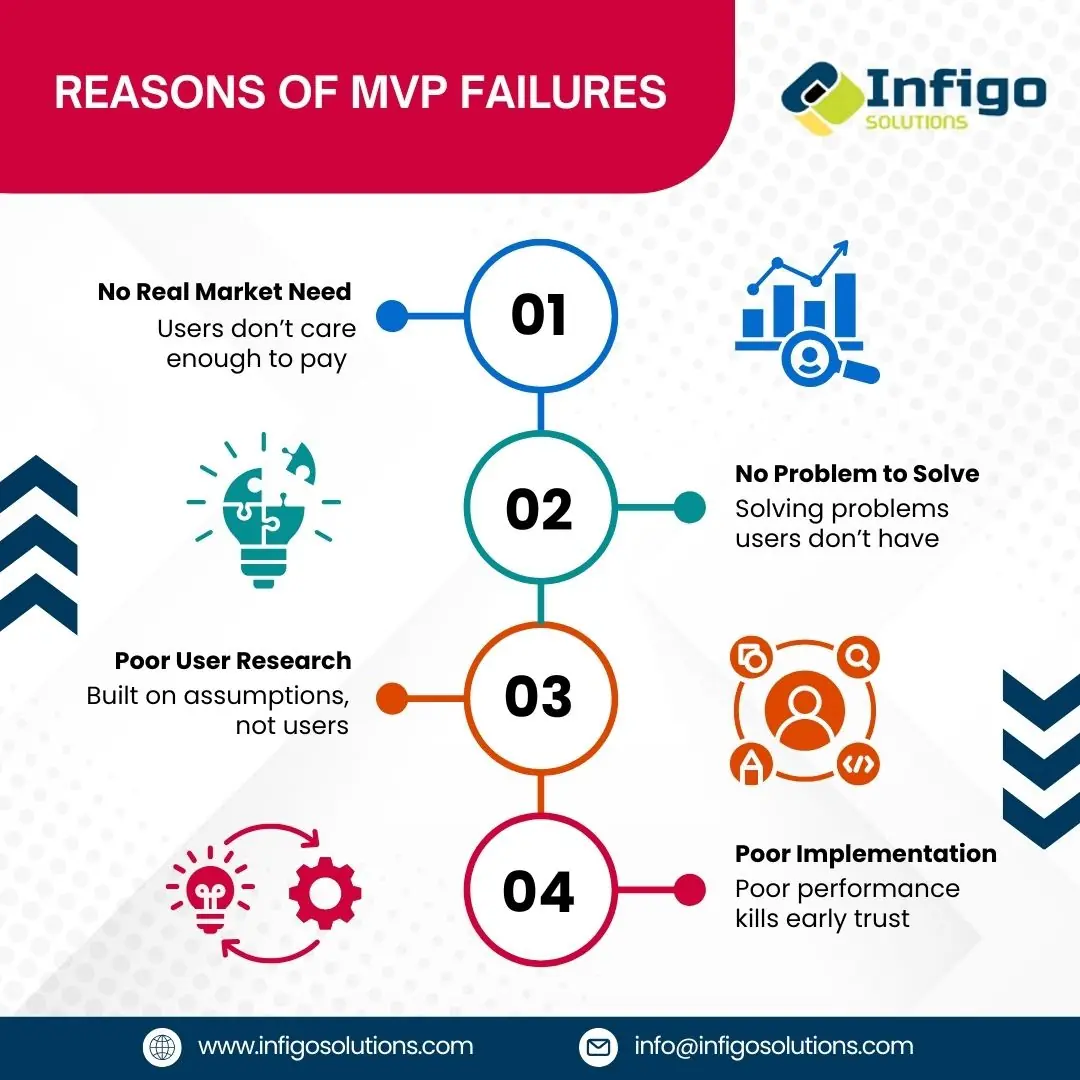
Reason 01: No Real Market Need
Users did not care enough to pay for it.
This is the one that stings the most because it is the hardest to accept. The idea felt real. The founder was genuinely excited about it. Friends and family said it sounded great. Early conversations with potential users seemed promising. And then the product launched, and almost nobody used it, and the ones who did were not willing to pay for it.
CBInsights has run this analysis multiple times across hundreds of failed startups. In their most cited report, 42 percent of founders listed "no market need" as the primary reason their company failed. Not bad technology. Not poor execution. Not running out of money. No market need.
The painful truth behind this number is that most of these founders did talk to users before building. They just asked the wrong questions. "Would you use something like this?" is not a market validation question. "Would you pay for this, and how much?" is closer. "Can I take your credit card right now?" is the real one.
Interest is not demand. Enthusiasm is not commitment. The only reliable signal that a market need is real enough to build on is evidence that people will give something up, their time, their money, their current workflow, to get what you are offering.
Everything else is a hypothesis.
Reason 02: No Real Problem to Solve
Building solutions to problems users do not actually have.
This one is subtler than the first, and in some ways more dangerous, because the founders who fall into this trap are often the most technically capable ones.
They see an inefficiency. They design an elegant solution to it. They build it. And then they discover that while the inefficiency exists, the people experiencing it have either already adapted to it, do not find it painful enough to change their behavior, or simply do not recognize it as a problem worth solving.
The classic example is the product that is genuinely impressive from an engineering standpoint but solves a problem that sits at the wrong place on the pain scale. Users will change their behavior for severe pain. They will consider changing it for moderate pain if the alternative is easy enough. They will not change for mild inconvenience, no matter how elegantly you have solved it.
The founders who avoid this mistake are the ones who obsess over pain before they think about solutions. Not "here is an interesting problem I could solve" but "here is a problem that is costing people something real, measurable, and recurring, and that they are actively looking for a way to fix."
That distinction sounds small. In practice it is the difference between a product people seek out and one they admire but do not use.
Reason 03: Poor User Research
Built on assumptions, not on actual users.
Ask a founder who has been deep in product development for six months to describe their target user and they will give you a detailed answer. They know the demographics, the use case, the pain points, the buying behavior. They have thought about this person extensively.
What they often have not done is actually talk to that person. Not in a structured way. Not with the specific goal of challenging their own assumptions. Not enough times to surface the patterns that individual conversations can hide.
User research is uncomfortable for most founders because it carries the risk of learning something you do not want to know. That the persona you built your product around does not behave the way you assumed. That the workflow you designed around does not match how people actually work. That the feature you spent two months building is not the thing anyone was asking for.
That discomfort is the entire point. The founders who do user research properly, who talk to enough real people, ask open-ended questions, watch people actually use their product rather than describe how they would use it, are collecting the information that makes every subsequent decision better. The founders who skip it are building on assumptions that feel like knowledge but are not.
By the time poor user research shows up in the data, you have already built the wrong thing. At that point, the cost is not a conversation you did not have. It is months of development time and real money spent going the wrong direction.
Reason 04: Poor Implementation
Poor performance kills early trust, and early trust does not come back.
A product can have a real market need, solve a genuine problem, be built on solid user research, and still fail at this stage. Because execution matters in ways that are easy to underestimate when you are focused on getting something out the door.
The first version of a product sets a ceiling on what users believe the product is capable of. If it is slow, they assume it will always be slow. If it crashes, they lose confidence that it will ever be stable. If the interface is confusing, they blame themselves for a moment and then quietly stop using it, rarely giving feedback, rarely asking for a fix, simply moving on.
Early users are the most important users a product will ever have. They are the ones whose experience shapes the word of mouth that either builds organic momentum or quietly kills it. They are the ones who, if they have a genuinely good experience, become the advocates who bring in the next wave of users. They are the ones who, if they have a poor experience, tell fewer people but in more certain terms.
Poor implementation at the MVP stage is not just a technical problem. It is a trust problem. And trust, once lost with early users, is significantly harder to rebuild than it was to establish in the first place.
This does not mean the MVP needs to be perfect. It means it needs to do the core thing reliably and well enough that the user comes away believing the product is worth more of their time.
The Pattern Underneath All Four Reasons
These four failure modes look different on the surface. One is a market problem. One is a problem definition problem. One is a research problem. One is an execution problem. But they share something in common that is worth naming directly.
Every single one of them is the result of building too much before validating enough.
The founder who builds a product with no real market need did not talk to enough real users before writing code. The founder who solved a problem nobody has did not validate the pain before designing the solution. The founder who built on assumptions did not do the research that would have challenged them. The founder whose implementation killed early trust did not test with real users early enough to catch the problems before they mattered.
The antidote to all four is the same habit: get something in front of real people earlier than feels comfortable, ask better questions than "do you like it," and let the answers shape what you build next before you build too much more of the wrong thing.
Frequently Asked Questions
How do you validate market need before building anything?
The most reliable early validation is finding people who are already trying to solve the problem using workarounds, spreadsheets, manual processes, or competing products. If people are already solving it imperfectly, the need is real. The question then becomes whether your solution is meaningfully better than what they are already doing.
What does good user research actually look like at the MVP stage?
Conversations with at least fifteen to twenty people who match your target user profile, structured around understanding their current behavior and pain points rather than pitching your solution. Watching people actually use an early version of your product and observing where they get confused or stuck, without jumping in to explain it. The goal is to surface patterns, not to collect opinions.
How much performance is "good enough" for an MVP?
Good enough means the core function works reliably under realistic conditions and the user can accomplish the primary task without needing help. It does not mean every edge case is handled or every feature is polished. It means the thing the MVP exists to do, it does well enough that users leave the experience believing it is worth coming back to.
Can a startup recover from a failed MVP?
Yes, but the recovery looks different depending on what failed. A product that failed due to poor implementation can often be rebuilt with the same core concept. A product that failed due to no real market need typically requires a more fundamental rethink of what is being built and for whom. The key in either case is diagnosing the actual cause of failure honestly rather than attributing it to bad timing or bad luck.
How do you know if you are solving a problem users actually have?
The clearest signal is whether users are already trying to solve it on their own. If they have built workarounds, if they are paying for imperfect existing solutions, if they bring it up unprompted when you ask about their biggest frustrations, the problem is real. If you have to convince them that they have the problem before explaining your solution, that is a warning sign worth taking seriously.
What This All Points To
MVP failures are not inevitable. They are not the random tax that innovation pays. They are the predictable outcome of specific, avoidable mistakes made at specific, identifiable moments in the building process.
The founders who build products that survive their early users are not necessarily smarter or more experienced. They are more honest, earlier. Honest about whether the need is real before they build. Honest about whether the problem is painful enough to change behavior. Honest about what their assumptions are and which ones have actually been tested. Honest about whether their product performs well enough to deserve a second chance from the people who try it first.
That kind of honesty is uncomfortable in the moment and invaluable in hindsight.
If you are building an MVP and want a partner who has seen enough of these failure patterns to help you avoid them, the team at Infigo Solutions works with founders from early validation through development and launch. Reach out at info@infigosolutions.com for a free consultation.
We Are Awesome.
A business consulting agency is involved in the planning, implementation, and education of businesses. We work directly.


.webp "LinkedIn")
Leave a Message
Recent Posts
 September 11, 2026
Prototype vs MVP: What's the Difference and Which Do You Need First?
 September 9, 2026
Comments
No comments yet. Be the first to comment!