
 September 14, 2026
Challenges for Founders in Turning an Idea into an MVP: What Nobody Tells You
23
Jun
 Admin
Admin Technology
 0 Comments
Challenges for Founders in Turning an Idea into an MVP: What Nobody Tells You
The Idea Is the Easy Part. Here Is Where Founders Actually Get Stuck.
Every founder remembers the exact moment the idea clicked.
Maybe it was 2 AM, maybe it was in the shower, maybe it was while you were stuck in traffic frustrated at a problem nobody had solved properly yet. The idea felt so clear in that moment. So obvious. So doable.
Then you tried to build it.
And somewhere between that initial spark and a product real users could actually touch, something went wrong. Or more accurately, several things went wrong in a sequence that nobody warned you about and no startup book quite prepares you for.
This is that conversation. The one about what actually derails founders between idea and MVP, and what the ones who make it through have figured out that the others haven't.
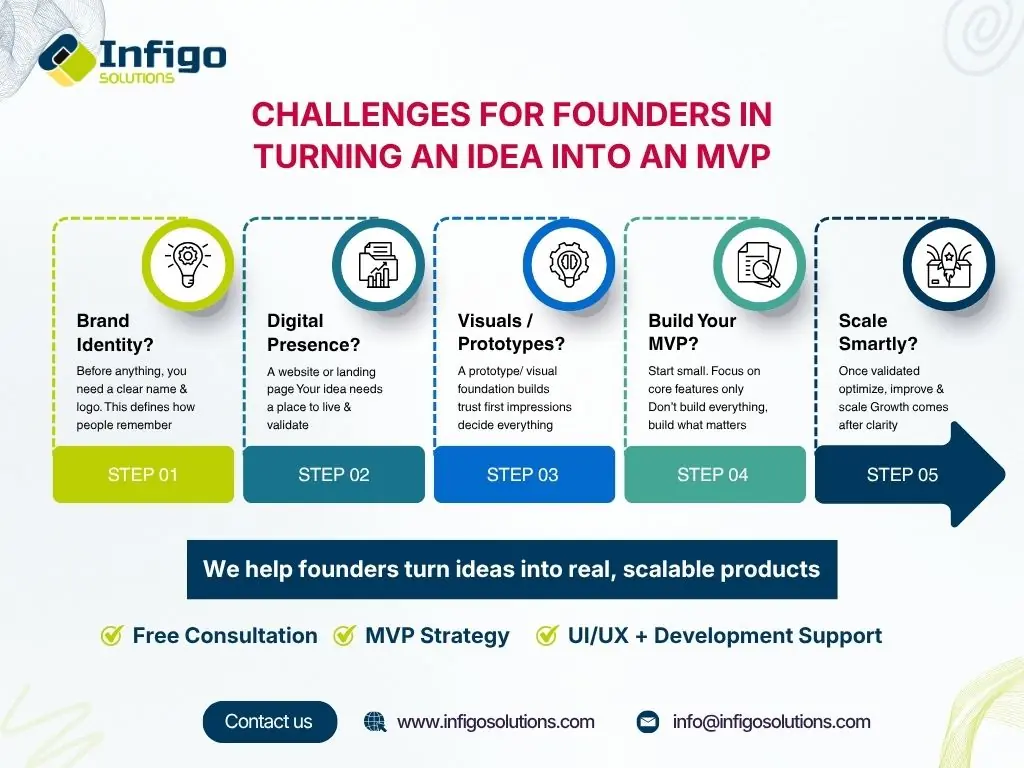
Step 1: Brand Identity : The Part Founders Want to Skip
The very first instinct most technical founders have is to start building. The product is the thing, right? Why spend time on a name and a logo when there's actual code to write?
Here is what happens when you skip this step. You build something real. You want to show it to people. You open your laptop to demo it and realize there is no name on it, no logo, no visual identity, nothing that communicates who you are before the product even loads. You scramble to put something together quickly. It looks like it was made quickly. And that first impression, which you will never get back, communicates something you did not intend.
Brand identity is not decoration. It is the frame through which everything else gets perceived. A strong name and a coherent visual identity tell potential users, investors, and early customers something important before they have seen a single feature: that the people behind this took it seriously. That signal matters more in the early days than most founders realize until they see what its absence costs them.
You do not need a six-figure branding exercise. You need clarity on what you are, who it is for, and how it should feel. That can be done lean and early. But it needs to be done.
Step 2: Digital Presence : Your Idea Needs a Place to Live
Here is a scenario that plays out more often than it should. A founder has been working on their product for months. The idea is solid. The early prototype is promising. They start talking to potential customers and investors.
And then someone asks: "Where can I learn more about this?"
The answer should not be "I will send you a long email" or "I will add you to a Notion doc." The answer should be a URL. A landing page. Something that exists in the world independently of whether the founder is in the room to explain it.
A digital presence, even a single well-crafted landing page, does several things that a founder's verbal pitch cannot. It validates that the idea is real enough to have a home. It gives people something to share with colleagues who might be interested. It captures email addresses from people who are curious but not ready to commit yet. And it forces the founder to articulate their value proposition clearly enough to fit on a screen, which is a discipline that sharpens everything else about how they communicate the idea.
Build the page before you think you need it. You need it earlier than you think.
Step 3: Visuals and Prototypes : First Impressions Decide Everything
There is a well-documented psychological reality about how people evaluate new products. They decide whether something feels trustworthy and worth their attention in seconds, based almost entirely on how it looks before they have had time to assess how it works.
This is frustrating for founders who have poured months into functionality and architecture. It feels deeply unfair that a polished interface outperforms a technically superior but visually rough product. And yet here we are.
A prototype or visual mockup is not a nice-to-have deliverable you get to after the real work is done. It is one of the most powerful tools available to an early-stage founder, for several reasons.
It lets you test whether people understand what your product does before you have built any of it. It surfaces UX problems that are far cheaper to fix in a mockup than in production code. It gives investors and early customers something concrete to react to rather than asking them to imagine. And it communicates, visually, that the team behind this has thought carefully about the experience of using it, not just the mechanics of making it work.
A rough prototype built quickly and tested with real people is worth more than months of building in isolation without that feedback loop.
Step 4: Build Your MVP : And Only Your MVP
This is where most technically capable founders make their most expensive mistake.
The product in their head is fully formed. Every edge case is handled. Every feature they have ever wanted to build is in there. The version they imagine building is the version they eventually want to exist. So they start building that version.
Six months later, they have a product that does a lot of things moderately well, costs significantly more than planned, took significantly longer than expected, and has never been tested with a real user because it was never quite finished enough to show anyone.
An MVP is not a smaller version of your full product. It is a deliberately limited version designed to answer one specific question: does this core thing work well enough that real people will use it? Everything else, every additional feature, every edge case, every piece of polish beyond what is needed to answer that question, is a distraction from the only thing that actually matters at this stage.
The discipline of building only what is necessary is genuinely difficult for founders who can see the whole product in their head. But it is the discipline that separates teams that ship and learn from teams that build and wait.
Start with the one thing your product absolutely must do. Do that one thing well. Get it in front of real users. Then let their behavior tell you what to build next.
Step 5: Scale Smartly : Growth Comes After Clarity, Not Before It
Scaling too early is one of the quietest and most common ways that promising startups fail.
It looks like success from the outside. More infrastructure. More team members. More marketing spend. More everything. But if the underlying product has not yet been validated, scaling is not growth. It is amplification of uncertainty at a higher cost.
The founders who scale well are the ones who achieved something specific before they started spending on scale. They know exactly who their user is. They know which feature drives retention. They know what the conversion path looks like and where people drop off. They have a model that works in small numbers and are scaling it because it works, not hoping that scale will make it work.
Once that clarity exists, scaling is a relatively mechanical problem. Without it, no amount of scaling fixes the underlying uncertainty.
Optimize before you amplify. That sequence matters more than almost any other strategic decision a founder will make.
The Pattern Behind Every Stuck Founder
Looking across these five steps, there is a common thread running through every place where founders get stuck.
It is not technical skill. It is not funding. It is not even market timing, though that matters.
It is the gap between what the idea looks like in a founder's head and what it needs to become in the real world to be understood, trusted, and used by people who have no emotional investment in seeing it succeed.
The idea in your head is perfect. It always makes sense when you explain it. Every feature is justified. Every decision is obvious.
Real users do not have access to your head. They have access to what you put in front of them. And they will make their decision about whether your product is worth their time in the first thirty seconds, based on how it looks, what it communicates, and whether it solves something they actually care about.
The gap between those two realities is where MVPs succeed or fail.
Frequently Asked Questions
How long should it realistically take to go from idea to MVP?
For most software products, a focused MVP with a clear scope can be built and ready for initial user testing in eight to sixteen weeks. The founders who take significantly longer have usually not made hard decisions about scope early enough, and have built features before validating whether the core concept works.
How do I know when my MVP is actually ready to launch?
When it does the core thing well enough that a real user can accomplish the primary task without needing you to explain it. Not when it is perfect. Not when every edge case is handled. When the core loop works and you can learn from watching someone use it.
Should I build the MVP myself or hire a team?
That depends on your technical background and timeline. If you have the skills and time, building yourself gives you maximum control and minimum cost. If you do not, hiring a team with a clear spec and strong project management is often faster than learning to build while also trying to validate a business.
How much should an MVP cost?
Highly variable, but the more important question is what is the minimum you need to spend to answer your core validation question. Many founders spend significantly more than necessary by building features that are not needed to answer that question.
What is the single most common MVP mistake?
Building too much before talking to real users. Almost every other mistake follows from this one. The earlier you get your product, even an unfinished version of it, in front of real people, the better every subsequent decision becomes.
One Last Thing
The idea was never the hard part. Every founder who has made it through from concept to a product real people use will tell you the same thing: the idea was the beginning of the work, not the work itself.
What separates the products that exist in the world from the ones that stayed in someone's head is not better ideas. It is better execution of the steps between the idea and the thing people can actually use.
If you are somewhere in the middle of that journey and it feels harder than you expected, that is not a sign that the idea is bad. It is a sign that you are doing the actual work.
The team at Infigo Solutions has helped founders navigate exactly this journey, from brand identity and digital presence through prototype, MVP, and into scale. If you want a partner who has been through this process enough times to know where the real obstacles are, reach out at info@infigosolutions.com. We offer free consultations for founders who are serious about building something real.
We Are Awesome.
A business consulting agency is involved in the planning, implementation, and education of businesses. We work directly.


.webp "LinkedIn")
Leave a Message
Recent Posts
 September 11, 2026
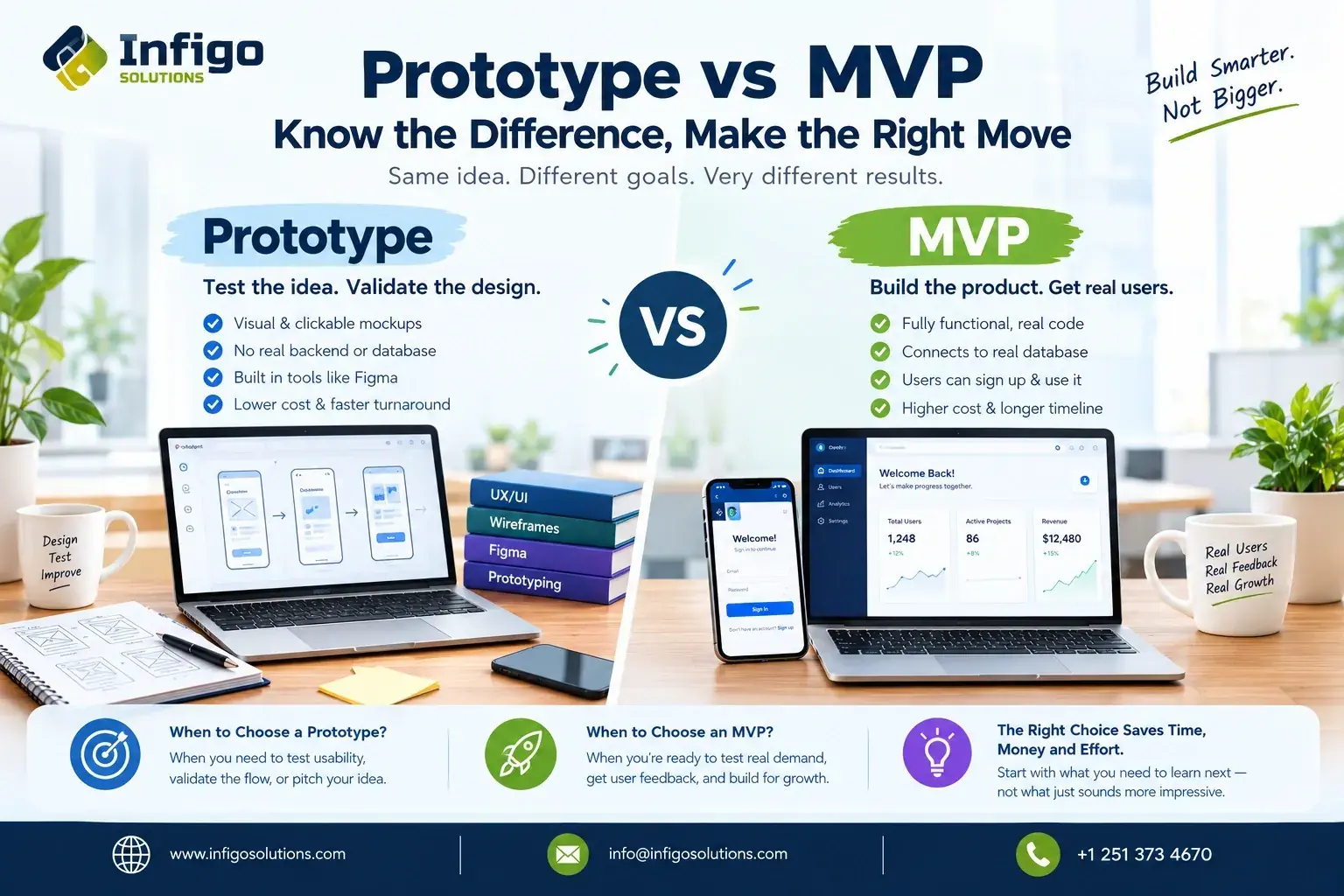
Prototype vs MVP: What's the Difference and Which Do You Need First?
 September 9, 2026
Comments
No comments yet. Be the first to comment!