
 September 14, 2026
Importance of Offshore Development: What Most Businesses Get Wrong
22
Jun
 Admin
Admin Technology
 0 Comments
Importance of Offshore Development: What Most Businesses Get Wrong
Offshore Development Is Not Plan B. It Never Was.
Somewhere along the way, offshore development picked up a reputation it never deserved.
Plan B. The backup option. What you do when the budget runs dry and you can't afford the "real" team you actually wanted. That narrative stuck around for years, repeated enough times that even smart business leaders started believing it.
Here's what's interesting though. The companies quietly building some of the most technically sophisticated products in the world? A significant number of them went offshore on purpose, strategically, from day one. Not as a fallback. As a deliberate competitive move.
So what do they know that the skeptics don't?
The Question Nobody Asks Until It's Too Late
Most conversations about offshore development start with the wrong question. "How much will it save us?" is usually the first thing on the table, and while the answer to that question is genuinely compelling, it's not the most important one.
The more interesting question is this: what is it costing you right now to not have access to the right talent, at the right time, moving at the right speed?
That's a harder number to put on a spreadsheet. But it's a real one. Every week a product feature sits unbuilt because your local hiring pipeline is dry, every sprint that slips because your team is stretched too thin, every market window that closes while you're still interviewing candidates. These costs don't show up on a budget report. They show up in growth that didn't happen.
Offshore development doesn't just reduce what you spend. It eliminates a category of loss that most businesses have simply accepted as normal.
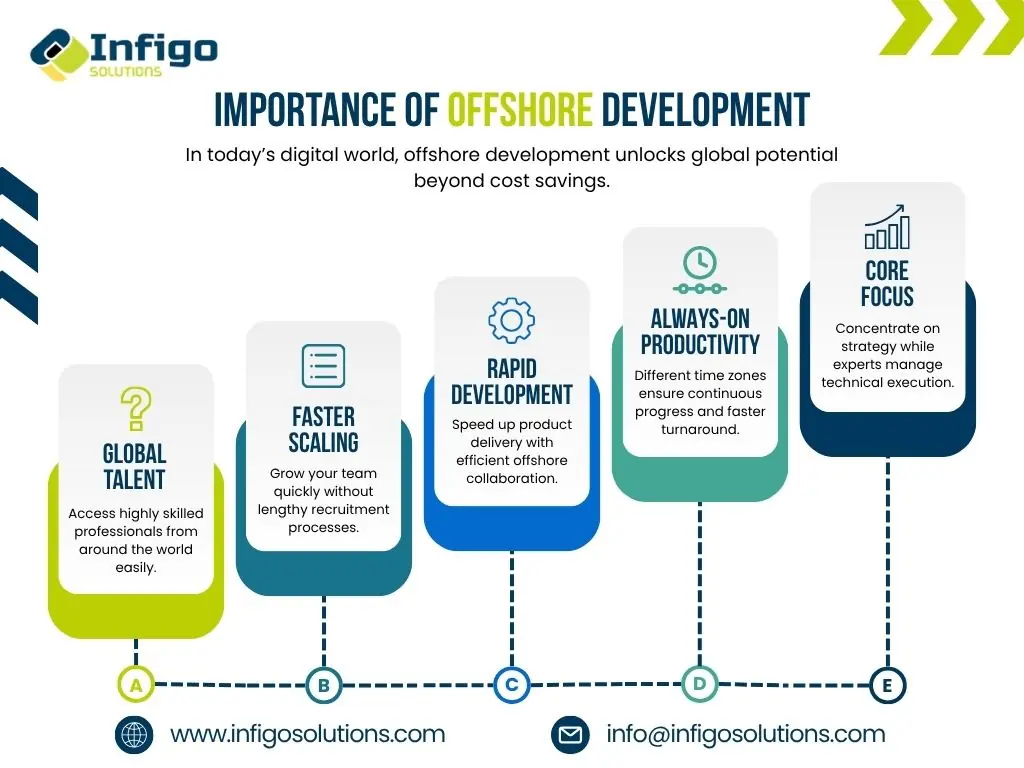
Five Things Offshore Development Actually Unlocks
A. Global Talent, Without the Global Search
Finding a senior React developer with specific fintech experience in your city is genuinely difficult. Finding one quickly is nearly impossible in most local markets. The talent simply isn't concentrated there, and the hiring process alone can stretch across months.
Offshore development dissolves that constraint entirely. When your talent pool is global, "we can't find the right person" stops being an acceptable answer. You're not limited to whoever happens to live within commuting distance of your office. You're choosing from a worldwide field of specialists who have spent their careers building exactly what you need built.
This isn't about settling for whoever's available. It's about finally having access to the best fit for the role, regardless of geography.
B. Faster Scaling Without the HR Marathon
Hiring locally is slow. Job postings, screening calls, technical assessments, offer negotiations, notice periods, onboarding. By the time a new local hire is fully productive, two to three months have passed in the best-case scenario. If the hire doesn't work out, you start the entire process again.
Offshore development through an established partner compresses that timeline dramatically. Pre-vetted talent, structured onboarding, and teams built to slot into existing workflows mean you're not waiting months to get moving. You scale when the business needs it, not when the recruitment process catches up.
C. Rapid Development That Matches Your Actual Ambitions
There's a particular kind of frustration that comes from having a clear product vision and a team that simply can't execute at the pace the market demands. Features get delayed. Competitors ship first. Momentum stalls. The bottleneck isn't strategy. It's capacity.
Offshore development solves for capacity in a way that local hiring often can't, at least not quickly. Bringing in a specialized team that has already worked together, already knows the tools, and already operates at speed means your development timeline reflects your ambitions, not your hiring constraints.
D. Always-On Productivity That Works While You Sleep
This one tends to surprise people when they first experience it in practice. A team operating in a different time zone isn't a coordination challenge. When structured correctly, it's a compounding advantage.
Your core team closes out the day with a set of priorities. The offshore team picks them up, makes progress through the night, and by the time the morning standup happens, there's new code to review, new problems solved, and a development cycle that never actually stopped. Companies that crack this rhythm don't just move faster in theory. They ship noticeably more, consistently, over time.
E. Core Focus for the People Who Drive Strategy
This might be the most underappreciated benefit on the entire list. When technical execution is handled by a capable offshore team, your internal leadership gets something genuinely valuable back: their attention.
The business decisions, the market positioning, the client relationships, the strategic pivots that only people deep inside the company can make, those things get the focus they deserve instead of getting squeezed out by day-to-day development management. The people who should be steering the company get to steer it, because the engine is being well taken care of elsewhere.
What Good Offshore Development Actually Looks Like
There's a version of offshore development that earns every bad reputation it gets. Misaligned expectations, poor communication structures, teams that disappear after the first sprint, deliverables that don't match what was discussed. None of that is inevitable. All of it is the result of poor implementation, not a fundamental flaw in the model.
The companies that get it right share a few consistent habits. They treat offshore teams as an extension of their core team, not a separate vendor relationship. They invest in clear communication structures upfront. They set expectations around outcomes, not just hours. And they choose partners who have done this enough times to know where the friction points are and how to avoid them.
When those pieces are in place, offshore development doesn't feel like managing an outside team. It feels like having a capable, committed part of your organization that happens to be located somewhere else.
Frequently Asked Questions
How is this different from just outsourcing a project?
Traditional outsourcing is typically transactional, you hand off a defined scope, someone delivers it, the relationship ends. Offshore development done well is structural. The team learns your codebase, your standards, your product, and becomes genuinely integrated into how you build, not just a one-time vendor.
What's the realistic timeline from decision to productive offshore team?
With the right partner, teams can be onboarded and contributing meaningfully within two to four weeks. This is significantly faster than most local hiring timelines for equivalent roles.
How do communication and time zone differences actually get managed?
The most effective approach is a defined overlap window for synchronous communication, typically two to four hours per day, combined with strong async practices for everything else. Most teams that struggle with this haven't built the right communication structure, not because the time zone gap is insurmountable.
What kinds of projects are best suited to offshore development?
Product development, custom software builds, ongoing engineering support, QA and testing operations, and data engineering are among the most common and successful use cases. The common thread is work that benefits from sustained, expert attention over time rather than a one-off task.
How do we protect our intellectual property when working with an offshore team?
Through properly structured agreements, defined IP ownership clauses, secure development environments, and working with partners who have compliance frameworks already in place. IP protection is a legal and process question with well-established answers, not an unsolvable risk.
Here Is the Honest Version
Offshore development will not fix a broken product strategy. It won't rescue a failing project on its own. And it absolutely requires investment in communication, trust, and clarity to work well.
But for businesses that are serious about moving faster, accessing better talent, and building the kind of technical capacity that actually matches their ambitions? It is one of the highest-leverage decisions available.
The companies that figured this out early are not sitting around wondering if offshore development is worth it. They are too busy shipping.
If you want to understand what the right offshore setup could look like for your specific situation, the team at Infigo Solutions has helped businesses build distributed development teams that actually work. Get in touch at info@infigosolutions.com and let's have a real conversation about it.
We Are Awesome.
A business consulting agency is involved in the planning, implementation, and education of businesses. We work directly.


.webp "LinkedIn")
Leave a Message
Recent Posts
 September 11, 2026
Prototype vs MVP: What's the Difference and Which Do You Need First?
 September 9, 2026
Comments
No comments yet. Be the first to comment!