
 September 14, 2026
Why Top Startups Use Offshore Teams (It Has Nothing to Do With Being Cheap)
17
Jun
 Admin
Admin Technology
 0 Comments
Why Top Startups Use Offshore Teams (It Has Nothing to Do With Being Cheap)
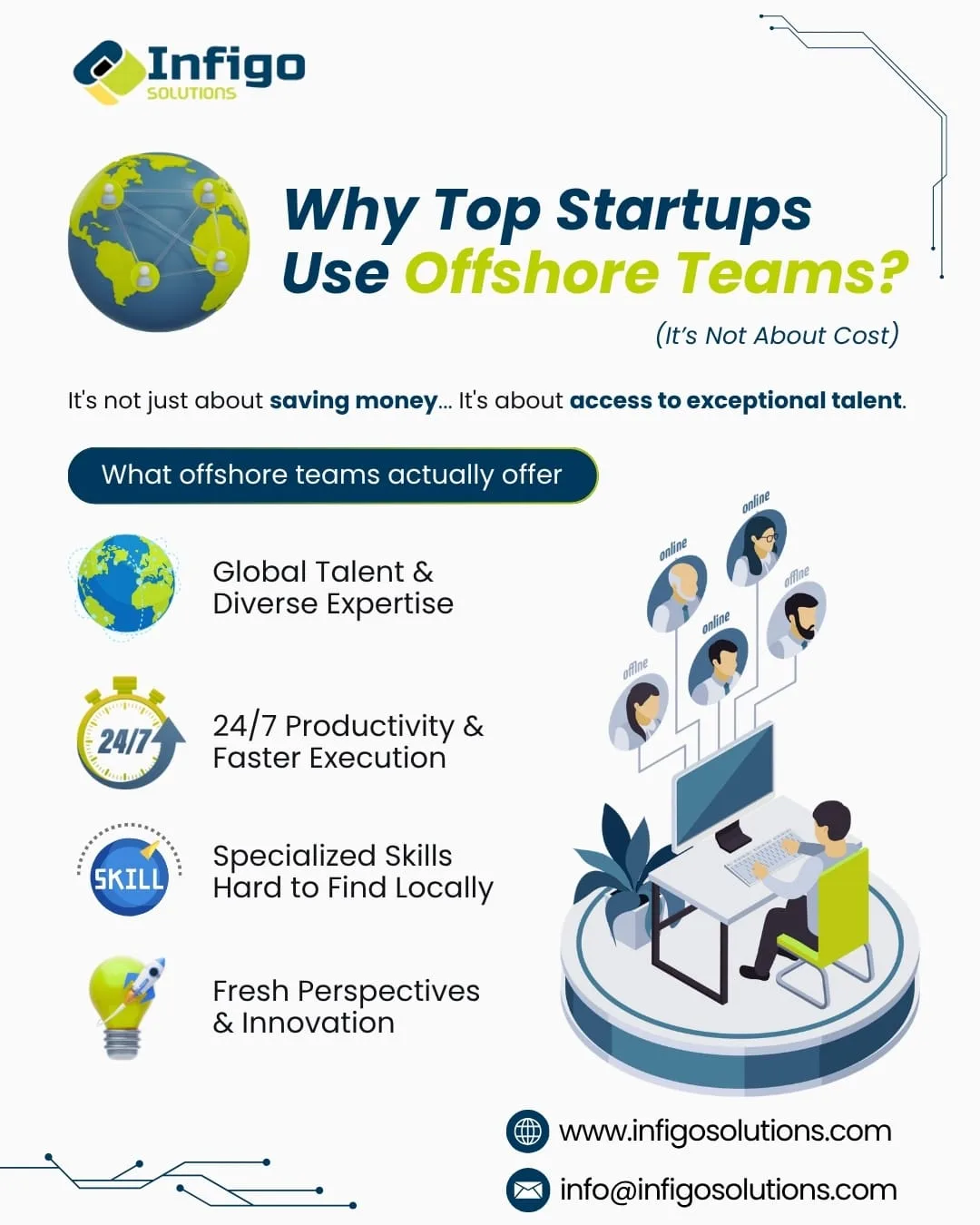
Ask most people why startups hire offshore teams and they'll give you the same answer: to save money. It's the assumption that has followed offshore hiring for decades, and it's mostly wrong.
Yes, cost efficiency is part of the picture. But if that were the whole story, you'd expect offshore hiring to decline the moment a startup raises a solid funding round and can afford local talent. That's not what happens. Some of the most well-funded, fastest-growing startups in the world, companies that could hire anyone anywhere, actively choose to build and maintain offshore teams. Not because they have to. Because it gives them an edge that money alone can't buy.
Here's what the data actually says.
The Numbers Behind the Trend
Offshore hiring isn't a workaround. It's a mainstream strategy backed by measurable outcomes.
According to Deloitte's Global Outsourcing Survey, 70% of companies cite cost reduction as a reason for outsourcing, but 40% point to access to skilled talent as an equally important driver. That second number has been growing every year. Among tech startups specifically, the talent access argument is now outpacing the cost argument in decision-making conversations.
The global IT outsourcing market was valued at over $617 billion in 2023 and is projected to cross $800 billion by 2027. This isn't a niche workaround used by cash-strapped early-stage companies. It's the operating model of choice for scaling businesses across every sector.
GitLab, Automattic, Basecamp, and Toptal all built their core operations on distributed, geographically diverse teams from the very beginning. These aren't companies that couldn't afford local hires. They're companies that understood something most others took years to figure out.
What Offshore Teams Actually Deliver
Access to a Global Talent Pool
The United States alone faces a shortage of approximately 1.2 million software developers, a gap that's expected to widen through the end of the decade. Europe faces similar pressures in specialized engineering, AI, and data science roles. Local hiring markets simply cannot produce enough qualified candidates fast enough to meet demand.
Offshore hiring solves this by opening access to talent ecosystems that are deep, skilled, and growing. Countries like Pakistan, India, Ukraine, Poland, and the Philippines produce hundreds of thousands of engineering graduates every year. Many of them work with global clients from early in their careers, which means they arrive with both technical skills and real-world project experience.
For a startup trying to build a product quickly, access to this talent pool isn't a compromise. It's a strategic unlock.
Round-the-Clock Productivity
A startup with a core team in New York and a development team in Lahore isn't just working in two locations. It's working across two time zones in a way that effectively extends the productive day.
When the New York team wraps up and hands off priorities, the Lahore team picks them up. Bug fixes happen overnight. Feature builds progress while founders sleep. By morning, there's new code to review, new problems solved, and new progress to build on.
Research from Stanford economist Nicholas Bloom found that distributed teams, when properly managed, show productivity levels equal to or higher than co-located teams. The time zone distribution, rather than being a challenge, becomes a structural advantage when communication systems are set up correctly.
Specialized Skills That Are Genuinely Hard to Find Locally
Certain technical skills have become so specialized and so in-demand that finding them locally is less a matter of budget and more a matter of availability. AI/ML engineers, blockchain developers, niche cybersecurity specialists, and certain data architecture roles are simply scarce in most local markets regardless of what salary you're willing to offer.
Offshore teams give startups access to specialists who have built entire careers around these specific domains, often working across multiple international projects that give them depth and breadth local candidates rarely have.
Fresh Perspectives That Drive Innovation
There's a body of research in organizational psychology showing that teams with diverse cultural backgrounds consistently outperform homogeneous teams on creative problem-solving tasks. A 2018 Harvard Business Review study found that companies with above-average diversity produced 19% higher innovation revenues than their less diverse counterparts.
When your engineering team spans three continents and brings different educational traditions, problem-solving frameworks, and cultural references to the table, you get solutions you wouldn't have thought of in a room full of people with the same background. For startups where differentiated thinking is a survival skill, this is not a soft benefit. It's a competitive one.
The Myths Worth Retiring
"Quality suffers with offshore teams." Quality is a function of hiring standards, communication, and process, not geography. Startups that struggle with offshore quality almost always have the same problems with local hires too. The issue is rarely where someone is located.
"Time zone differences make collaboration impossible." A four to eight hour overlap window is enough for daily standups, sprint planning, and real-time problem-solving. Most successful distributed teams report that async communication actually improves documentation habits and reduces the meeting overhead that slows local teams down.
"It only works for low-skilled tasks." This was true fifteen years ago. Today, offshore teams routinely handle product architecture, AI model development, UX research, and full-stack engineering for some of the world's most technically demanding products.
What the Fastest-Growing Startups Understand
The startups that use offshore teams most effectively don't think of them as vendors or outsourced labor. They think of them as part of the core team, with the same access to company context, product roadmaps, and decision-making conversations.
That mindset shift is what separates companies that get mediocre results from offshore hiring and companies that build genuinely world-class distributed teams. Treat offshore talent as an extension of your ambition rather than a cost line item, and the outcomes reflect that.
At Infigo Solutions, this is exactly how we approach the teams we build for our clients. Not as outsourced capacity, but as integrated capability designed to move fast, think clearly, and build things that last.
Frequently Asked Questions
How do top startups manage offshore teams effectively? The most successful approach combines clear async communication systems, overlapping working hours for real-time collaboration, strong onboarding that gives offshore team members full product context, and treating distributed members as core team, not external contractors.
Is offshore hiring only viable for technical roles? No. While software development is the most common use case, startups also build offshore teams for product design, QA engineering, data analysis, content operations, and customer support. The key is matching the role requirements to the talent available in the target market.
How do startups protect their IP when working with offshore teams? Through properly structured NDAs, IP assignment agreements, secure development environments, and working with established offshore partners who have compliance frameworks already in place. IP protection in offshore arrangements is a legal and process question, not an unsolvable problem.
What's the typical ramp-up time for an offshore team? For a team of two to five engineers working on a defined product area, most startups report a two to four week onboarding period before the team reaches full productivity. This is comparable to, and in some cases faster than, onboarding local hires.
Does offshore hiring hurt local employment? The evidence suggests it's more complex than a simple yes or no. Startups that scale faster through offshore hiring tend to create more local jobs in management, sales, and senior technical roles over time. Growth enabled by offshore teams often creates domestic employment, not just displaces it.
The Bottom Line
The smartest startups aren't using offshore teams because they're trying to cut corners. They're using them because the global talent market offers skills, speed, and perspectives that no single local market can match on its own.
Cost efficiency is a side effect. Access to exceptional talent is the strategy.
If you're building something and want to understand what the right offshore team structure could look like for your specific stage and goals, the team at Infigo Solutions has helped companies figure this out across dozens of industries. Reach out at info@infigosolutions.com and let's have a real conversation about it.
We Are Awesome.
A business consulting agency is involved in the planning, implementation, and education of businesses. We work directly.


.webp "LinkedIn")
Leave a Message
Recent Posts
 September 11, 2026
Prototype vs MVP: What's the Difference and Which Do You Need First?
 September 9, 2026
Comments
No comments yet. Be the first to comment!